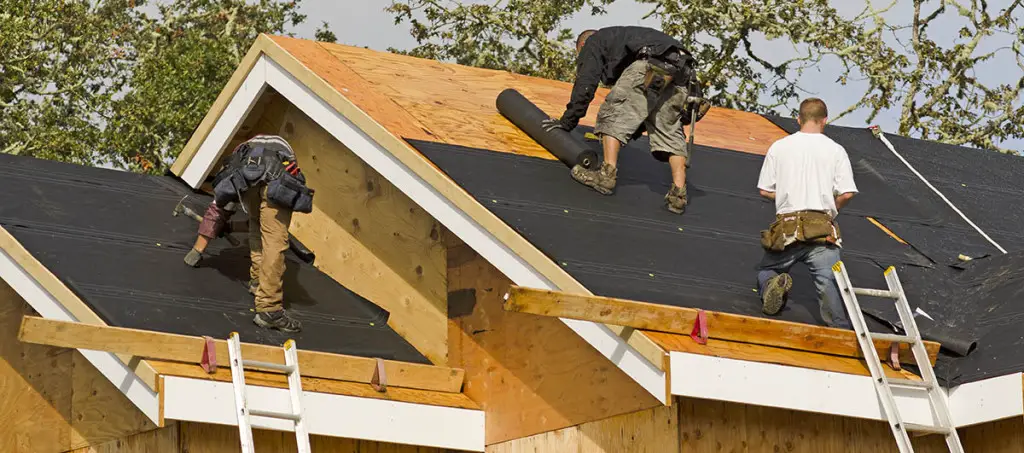
Are we talking about a single storey house here? Or is scaffolding - how should I put this - not so much of a consideration?
j
Are we talking about a single storey house here? Or is scaffolding - how should I put this - not so much of a consideration?
j
scaffolding?
unless you have an unusually steeply sloped roof, the roofers just go up there via ladders and get to work.
Something done literally every twenty years is just not a significant inconvenience.
It’s more like having a car where you replace the engine, well, once every twenty years or so.
OK, got it.
j
It really swayed! So, I could tell it was big and far away…and Lucy Jones just said what I said. It was a 6.4 near Ridgecrest (central California).
Does that include changing the whole roof, or just re-shingling? And does it involve roofs on a 4th floor? My flat in the mountains is at the top of the house: a 4th floor the way Americans count and the whole roof involves two covers, the insulation between them, and the tiles on top.
We did a partial reshingle and complete reinsulation last summer (first one ever; building date 1958 so the touch-up was done after a mere 6 decades): the initial exam was done from the crawlspace between our ceilings and the roof for the bottom and to look for any possibly leaky spots (we’ve never had leaks that reached the actual flats), then go out through the trapdoor to examine the tiles. The actual work involved the insulation being removed from the bottom (the bottom cover is removable planks) and new insulation injected, scaffolding all around the building (it meant less time than doing each of our four simmetrical wings separatedly) and any broken tiles replaced by new ones. A couple of days, which in a high-precipitation location like that one is important; you really don’t want to have to put up tarps if the sky decides to open up in the middle of reroofing. And at least we’re a location where precipitation is frequent but mild; the megastorms of Seville wouldn’t be stopped by any amount of tarpaulins. Seville’s roofers watch the weather report even more attentively than farmers.
The problem with older homes is that for the most part they are tiny. Modern homes are just so much bigger. I like a smaller than average home but most older houses unless they are in the rich part of town are too small if you have kids and/or like privacy. Plus even bigger older homes have tiny closets, tiny bathrooms, and tiny kitchens.
It’s my understanding that the trade Apprentice system in Europe is much better structured and demanding. People actually learn their trade very well.
I did construction in college. Some roofing and other manual labor. I learned on the job and got cursed out when I did it wrong. I could have eventually learned enough to pursue carpentry full time. I didn’t want to put my body through that much punishment for fifty years.
A Contractor license isn’t required for jobs under $20k. Anyone that has some tools and a local Home Depot can remodel your bathroom.
It’s not that hard to get a contractor’s license. Pass a test, 4 years experience and pay a fee.
https://www.contractors-license.com/the-exam/arkansas
Should we be surprised a lot of crappy work is the result?
I agree the building products from China are a major problem.
Formaldehyde in drywall is just the tip of the iceburg.
the last time my folks had their roof done, it was a full tear-off and re-roof. I think it took about a workday + a couple hours the next day to finish because some of the wood needed replacement too. Roofing companies are pretty good at knowing how big a crew they need to assign to a particular job. Esp. since they generally bill by job and not by hour, so it’s in their best interest to get the job done as quickly as feasible so they can get to the next one.
no, but in my area (can’t speak for the entire US, of course) I can’t recall ever seeing a 4-story dwelling with a conventional sloped roof. Houses are 2 stories at the most, and apartment buildings with more floors than that tend to have flat built-up (tar and gravel) roofs.
I watched a youtube video of a couple of Texas builders who went to Germany and Switzerland to attend building expos. They were blown away by the quality of the parts they saw. Apparently in Switzerland all new home windows have to be triple glazed. The construction quality of the windows doors and cabinetry far exceeded the average in the US. They also far exceeded the cost in the US. But these builders build high-end homes in Texas and indicated that almost all the things they saw were available in the US, but they were expensive imports. I gathered from the video that the US does build much cheaper homes than Europe. But it is a choice. I am not sure how the final home cost compares in the US vs Europe. That cost is set mostly by supply and demand, not the construction materials cost.
I like that Maryland quote. A couple of doors down from where I am sitting in Bethesda Md, there is a tear-down/rebuild going up that is literally a factory-built home. all the walls, joists, etc arrived on a truck and assembled in a few days. The house will be > 5K sq ft and sell for around 1.6M. While the home was still just a hole in the ground for the basement, someone approached the builders inquiring about buying the house when it is finished. They were told to come back when it was done and the builder would not entertain any offers and certainly no modifications until the house was ready for market. It is going up fast.
All that said, I still don’t see the advantage of a masonry house. Brittle and hard to insulate, what advantage does it have? And I say that even though my home has a brick facade all around. But the bricks could be removed completely and siding put on (not that I would ever do that) without compromising the integrity of the building.
You used to be able to order houses from the Sears catalog.
In this street the Council replaced all the roofs on the [row house] houses which they still owned. The scaffold was up for several weeks. Renting scaffold by the day is not very expensive - it’s the putting it up and taking it down which is expensive.
Unless you got them bouncy bouncy base isolators
One other thing not mentioned here is that at least in Canada (and I’d imagine the US is the same), the building codes specify the minimum standard to which residential housing is to be built. That basically means that Gen Contractors are going to build them to what they can get away with unless you’re willing to spend the simoleons. Want a better house, be prepared to pay for it.
Buying that "better built in the old days " craftsmanship has its own perils as well; knob and tube wiring, aluminum wiring, iffy insulation (if there even is any), asbestos tiles and ducting, the list goes on and on. For those of you questioning the whole concept of Lego homes, check out the link forFlex homes.
I’m not sure the front of the house is the most pretty place to put a garage, but it is the most practical.
Do you really want to waste that much room on driveway space and pave a path from the street to the back or sides of the house? Wouldn’t you rather have that as lawn rather than wasting that much of your property on pavement? (When I travel, I’m usually in city centers, so I don’t know what happens in the 'burbs. Is paving the crap out of your property common overseas?) I grew up in an older suburb where there would, theoretically, have been enough room to put the garage in the back - but that would have meant a lot of asphalt, which does not seem very aesthetically pleasing.
Probably depends on where you live. Around here the older houses are mostly large; they may not have been when they were new, but over the years additional rooms and sometimes entire stories or two-story wings were added on to accommodate large families and/or additional enterprises, porches got first screened and then enclosed and then additional porches got added outside them, etc. (Process is still ongoing; a few years ago my next-door neighbors jacked up their entire (fairly new) house and added another story underneath.) And many of them have quite large kitchens, because people were processing their own food from gardens and livestock in order to have winter storage and needed the room to work in – not to mention the room to work around large cast iron wood cookstoves without letting the baby get too close.
Bathrooms were add ons and while some were made out of closets and can indeed be tiny, a lot of them were made out of bedrooms; sometimes two made out of one bedroom (doors opening in different directions, often one into the hall and one into an adjacent bedroom) but often just an entire bedroom turned into a bathroom; those can be quite large.
The closets I’ll grant you – original storage space tended to be less individual closets in each room than a large closet each upstairs and down. Some of those I’ve seen are quite large but later additional closets built into individual rooms are often small.
I think you’re having some confirmation bias–you’re seeing the old houses that were well cared for and are still standing. Certainly in the areas I’ve worked in with historic homes (Telluride and Martha’s Vineyard) there are multitudes of buildings that simply don’t exist anymore, whether through neglect, catastrophe or demolition.
It comes down to cost and changing codes and building standards. Composition shingles with a 25 year life span might be $1=2 a square foot, metal $5 or so. Slate or tile? Depends where you are. Could be on the order of $30/ft plus increased framing costs for the extra load. Masonry is expensive, brittle, and very hard to insulate to today’s codes. And has a terrible carbon footprint (concrete). OSB is fine if properly installed. Modern tools and techniques mean we can build a strong, tight, efficient houses for a relatively reasonable price. There is certainly crap building, and codes have definitely gone backwards at times.
There’s also the consideration that older residential buildings were unlikely to have been engineered. Again, that means you are seeing the ones that were adequately or over-engineered. You may be looking at a construction that is grossly in excess of what was necessary and thinking, “that looks stout!” True enough, but not what you want to base your building standards on.
Huh. I did a full-tear down and re-roof back around 2012 and it was a few days with a multi-person crew and a highly rated firm. The tear down itself was one full day. Of course this a fairly high-peaked Victorian, steep enough that it required personal tie-downs. And it still had the original turn of the century tiling under a half-dozen layers of modern roof. I still have a hand-hammered c.~1900 square nail I kept as a souvenir from the tear-down.
I’ve only visited Japan: I am not an expert. Japan has a tradition of wood & paper houses, some of which are hundreds of years old, by simple replacement of wood and paper. But it is a tradition of disposable paper houses. Which carries over into the approach to modern city houses, which includes the possibility that you might build a house, and when you sell it, it is torn down and replaced.