I meant as opposed to the art the appreciator creates in her/his mind. I don’t feel the same way about art as others. They don’t feel that same as I do about other subjects. There are plenty of analogies, and they don’t have to be in areas traditionally classified as arts. It is interesting to get a better idea of how people appreciate art though.
The art inspires the feelings; it reinforces them? I’m not sure how to understand your question. Haven’t you ever read a book more than once, or watched a movie several times, or listened to the same song album, over, and over again? Why do you do any of those?
OK, but this would tend to argue that the painting mentioned earlier about “The Song of the Lark” is not great art. One person looks at it and sees exhaustion put forward powerfully. But it turns out that the artist was really trying to convey fascination with a bird singing.
You could design a test for this pretty easily. Put out ten paintings, and have the artist for each write down what he thought his vision was and what he was trying to convey. Then show the canvases to a thousand people, and have them write down what they thought the point of the painting was. If some significant number could tell what the artist was trying to convey, it’s good art - otherwise, not.
Regards,
Shodan
It was a rhetorical question. I then made the analogy to intellectual exercises, which are what interest me.
[QUOTE
Haven’t you ever read a book more than once, or watched a movie several times, or listened to the same song album, over, and over again? Why do you do any of those?[/QUOTE]
I don’t do any of those things. The first time is always the best for me.
Do you spend hours studying thermodynamics because you are curious about how things work? That’s what appeals to me and inspires me.
I’m not criticizing anyone’s love of the arts. Are you criticizing me for not feeling the same way you do?
Why in the world would you get that idea? I’m giving you a couple of analogies–I thought you wanted them by your next sentence, but I guess once again I misunderstood what you were asking. I understand many people just don’t react the same way, and that’s fine. That sentiment is in my first post on this subject in this thread and in my post in response to marshmallow.
I assume this is rhetorical, too, but, no, not thermodynamics, but there are subjects of left-brained curiosity that appeal and inspire me (math, linguistics, computer programming, etc.) and I’ve spend countless of hours on just for fun. (Up until junior year college, I had a heavy math/science background.) But that doesn’t matter. You do understand what others are getting from art, and you do understand its genuineness. Others here seem to intimate that it’s some weird affectation or pretension or something. (And, yes, I think for some it may be.)
It’s certainly possible to over-interpret things. Sometimes a cigar is just a cigar. There are a lot of great paintings that are simply portraits of a person, done as accurately as possible. Or perhaps a painting of a landscape is merely an attempt to capture a scene that no one else has ever witnessed.
Before we had cameras and easy transportation, an important role of great paintings was to bring to the masses vistas that they have never seen before. A peasant living on a plain was not likely to ever see an ocean, or a mountain range. So painters would travel and set up easels in difficult places and record what they saw. That’s about the extent of the interpretation required, other than to notice the composition, the choice of light and color, etc. But there’s no hidden meaning - it’s just a painting of a mountain.
Sometimes a great painting just captures a character. A lot of great portraiture captures a person in a pose or with an expression that really shows the inner character underneath. It doesn’t even have to be intentional on the part of the artist - the artist may simply be painting what he sees, knowing nothing of the personality of the person, but he captures the subject in enough detail and skill that the ‘real person’ shines through.
Have a look at this painting of King Ludwig I, by Joseph Karl Stieler. Before you read any further, Think about the impressions you get from this. What kind of guy do you think Ludwig was? What clues does the painting give you about him?
So before I describe him, I’ll put a little space here by talking about the painting itself. Notice that he’s not posed sitting on a throne, or in particularly regal fashion. He’s got his hand on his hip, he’s holding his sceptre in a kind of cavalier fashion, and the whole scene looks a bit disheveled compared to other royal portraits.
Also, the painting is gorgeous in its detail. I just saw this in real life, and the colors are amazing. Look at how fine the detail is on the fringing of his robe, and the intricate shadow detail required because of all the billowing cloths. The artist was extremely talented.
So what did you decide about King Ludwig I? Is he a tyrant? Is he regal in bearing, or vicious, or intolerant? When I saw the painting, my first thought was that the guy looks like he’s kind of fun to hang out with. I said to my wife almost instantly “Hey, I like this guy!” He’s got a kind of impish look to him. He probably likes to have a good time. His hair is all messed up. It looks like he just came in from a night on the town with his buddies. He’s kind of a cool guy.
So here’s what Wikipedia had to say about him:
He was also a great patron of the arts, a supporter of freedom movements (in his early years), and he loved Greek art and architecture (look at what’s in the background of the painting). He enjoyed taking his friends out and buying them drinks, and he apparently had a great sense of humor. He liked writing poetry, but was really bad at it - so bad that his contemporaries mocked him for it. He didn’t care.
So… Did the artist do him justice? Did your intuitive feeling for him based on looking at his portrait match the qualities he had in real life?
As a side note, isn’t he the spitting image of Seth from Deadwood? That was the second thought I had when I saw the painting.
Art would be a lot less interesting if an artist’s intended message was the only valid interpretation.
Carved out of paint, some of them.
And that’s great. Now imagine if you were an artist, and you had the skill to express your curiousity and love for thermodynamics in a way that could make it accessible to other people without having to know how to do partial derivatives and simultaneous equations. You might make something like this. Does that inspire you? Does it scratch your thermodynamics itch at all? Does it give you an insight into thermodynamic processes you might not get from the raw equations?

(You can see more of this person’s work here).
One of my interests is data visualization. A great data visualization can be art. In fact, I have this visualization framed on the wall of my office. It’s a chart done by Charles Joseph Minard, depicting Napoleon’s 1812 March on Washington. What makes it rise to the level of art (for me) is that it visually expresses exactly what happened in great detail. The large line follows the path of Napoleon’s army. The thickness of the line represents the number of soldiers. It’s overlaid on a cartographic map of the route, showing rivers and other terrain. The brown line is the trip to Moscow, the black line is the trip back. At the bottom of the chart is a graph that lines up the temperature with each stage of the return trip.
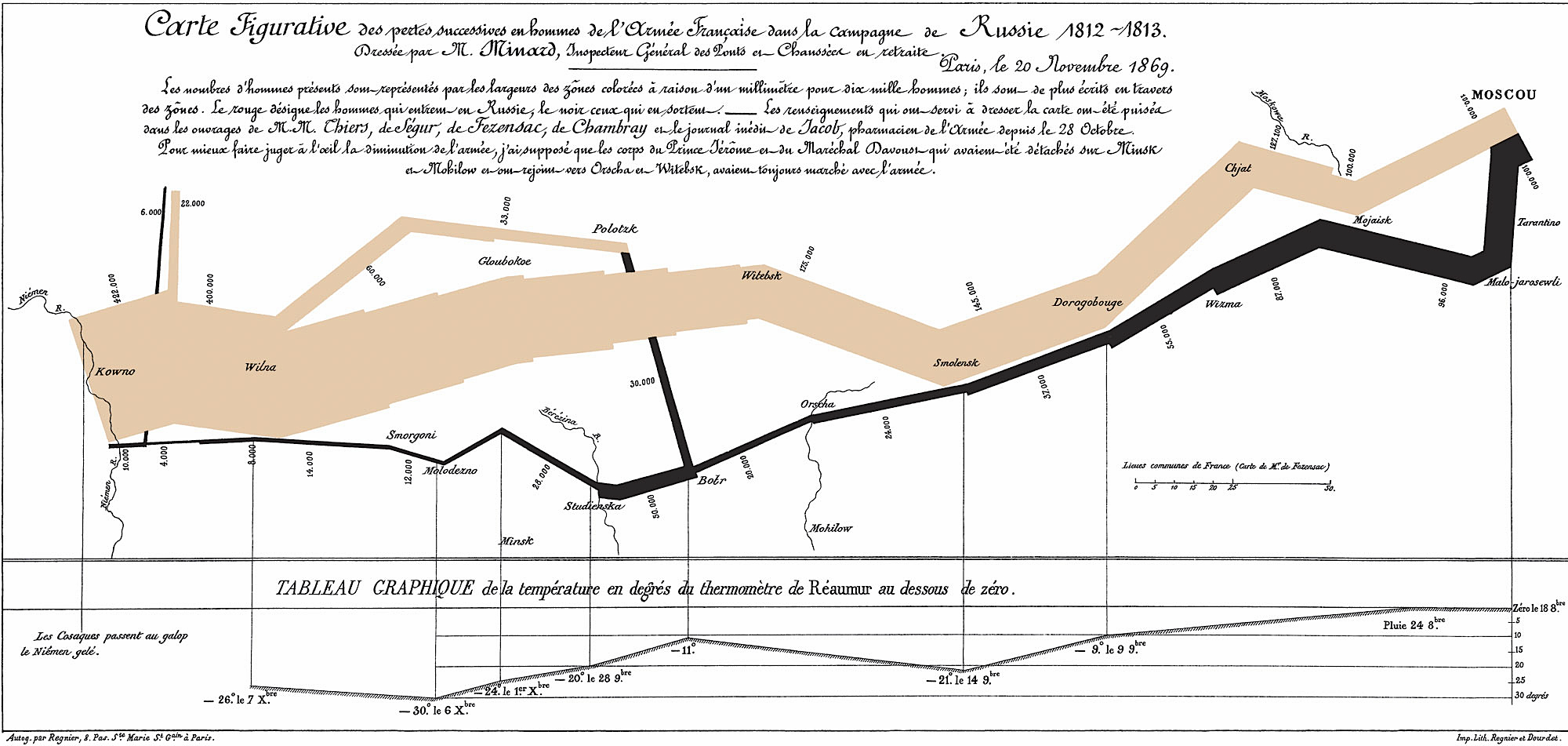
The story of Napoleon’s march is this: 422,000 men left for Moscow in June of 1812. They marched all summer. The Russians practiced a scorched earth policy, depriving the soldiers of the ability to live off the land and spoils of war as they marched. They also engaged them in small skirmishes along the way. So you can see that thick line slowly get whittled down. Men died mostly of starvation and disease from drinking polluted water. By the time the exhausted, weakened army reached Moscow, there were only 100,000 men left. Napoleon’s plan was to supply his army to Moscow, then have them take the city and live off the city’s supply. But the Russians burned Moscow to the ground in front of them, depriving them of replenishment. So that great army turned around, short on food and water, and started back. They had no choice.
Then winter set in. Look at the black line in that chart. That’s the route of the army on the way back. Watch it shrink with each river crossing as men froze to death in the harsh Russian winter. At one point you can see on the chart, 50,000 men tried to cross a river in -20 weather. 28,000 survived. Horrible. And all captured on that one simple chart.
In the end, only 10,000 men made it back to France - 2.3% of the force that started out. And Napoleon was finished as a conquerer of nations.
All of that is captured in one chart. The style of the chart makes it almost come alive. Once you understand what you are looking at, the chart paints a very graphic visual picture. I can no longer look at that line without picturing the masses of men dying in the most miserable way possible. It has a big emotional impact.
So art doesn’t have to be a painting. It can be almost anything, so long as it inspires people or instills emotion in them or tells them something in a new way or reveals something they never knew. A 3D representation of flow. A great visualization that tells a story. Imaging the Mandelbrot set. A photograph that captures something worth seeing. It doesn’t have to be abstract or have deep meaning, but it can.
You’re hitting this thread out of the park Sam. Respect.
Edit: And there’s another post to absorb. Heh.
When I was at the Neue Pinakothek, I got reprimanded by a security guard for getting too close to a Van Gogh (Plain near Auvers). I wanted to get a macro shot of the fields so I could capture the 3D nature of the image. I got a whole lot of great images from various paintings that day - I knew I could get prints of them all pretty much anywhere, so a lot of photos were closeup zooms to capture brush stroke and texture. I got a little overzealous with the Van Gogh…
When I first started to see paintings in real life that I’d only ever seen in books, my first instinct was to touch them and smell them. (Still is) Obviously I didn’t, and don’t, but there’s still the urge with some of them. I’ve got pretty conventional tastes - yer Turner, yer Van Gogh, yer regular Impressionists - but whatever, those paintings move me. Best exhibition ever was Turner, Whistler, Monet at Tate Britain.
I didn’t think you were being critical. I just asked to be sure. And yes, I understand, it just doesn’t work that way for me. I have no problem with people appreciating art. And some of those who claim they do are posers. That doesn’t bother me much. But whether they are genuine or not, some people look down on people who don’t share their appreciation of art, or science, or sports, or whatever. That annoys me.
Correction to a prior statement: I have seen Raging Bull many times. That is art to me. It doesn’t light a flame within me, but I do appreciate it’s quality, and how it is more than mere entertainment.
[QUOTE=Baron Greenback]
When I first started to see paintings in real life that I’d only ever seen in books, my first instinct was to touch them and smell them. (Still is) Obviously I didn’t, and don’t, but there’s still the urge with some of them. I’ve got pretty conventional tastes - yer Turner, yer Van Gogh, yer regular Impressionists - but whatever, those paintings move me. Best exhibition ever was Turner, Whistler, Monet at Tate Britain.
[/QUOTE]
I know what you mean. I felt like doing that with the Van Gogh. Of course, if I had tried it I’d probably have been tasered by the nice lady in the uniform who told me to back off when I got too close.
Thank you. It is your posts in particular that give me better understanding of art appreciation. I assumed such analogous views, but you have provided excellent descriptions from the side of art.
Thermodynamics and many areas of science have been difficult for me because I am horrible at equations. It has always been the beauty of such representations instead of the equations themselves. It’s just not the image which scratches my itch, but something at a conceptual level, in terms of relationships and constraints. The same applies to data visualizations, but I do find them a much better way of presenting data than simple numbers or graphs.
I doubt I will change much in this regard, but my lack of appreciation has not led me to believe that art cannot be appreciated. I’m sure there are people with that attitude though.
Perhaps you, or anyone else could explain one thing to me: What on earth is the big deal about the Mona Lisa? I saw the real thing when I was a child, and many reproductions, but I frankly do not understand what is so good about it. Maybe it is too ubiquitous, but I don’t see the skill, composition, use of color, or anything enigmatic about the grin. I recognize that it may have been remarkable compared to similar works at the time. But I have seen many more appealing images.
I doesn’t really do much for me, either, but Cecil tackled this one in his usually insightful manner. However, I do find it a skillful painting, with wonderful use of light, composition is flawless, color palate is harmonious, and the blurred background was revolutionary for its time. Still, it doesn’t resonate with me.
This is really an interesting post.
Maybe portraiture is an example of something I can understand more easily. A good portrait captures personality. And people can look at the portrait and say "That really looks like him!’ not merely in the sense that they can recognize the physiognomy, but also characteristic expressions and representations of things that are true about the subject - like the clothing and pose you mention.
But photography is also an art form, and therefore representational art is not as dead an art form as sometimes gets implied. A great photograph does the same thing as a great portrait.
Abstact art is far more ambiguous, it seems to me. And therefore more subject to the unfortunate tendency to imply that anyone who doesn’t “get” the piece is simply not as smart as the artist.
Art seems to me has to be something that is done well, and brings about an intended effect. Just putting blue paint on a canvas and saying “that’s art” doesn’t qualify, IMO. Art requires skill to create, or it isn’t art.
If the spectator is expected to create his own meaning, then the art and the artist isn’t necessary, and he has wasted his time. If you can find deep meaning in a soup can, then nobody needs to bother painting a picture of one.
Regards,
Shodan
For suitably vague definitions of ‘talent’. It can be a talent to be able to see things other people don’t see. It can be a talent to know how to invoke a feeling in someone with a few geometric shapes. The talent doesn’t lie in the moving of the brush, it lies in the perception of how to get inside someone else’s head and plant an idea or an emotion they weren’t able to conjure up on their own.
Take those five men in “Tired of Life”. If you will concede that this is a great painting, where does the greatness come from? It not from just the technical skill of the painter. There are a lot of painters around who are utterly unknown and who can paint as well as that, or even much better. So that’s not really the talent. The talent came from seeing the essence of those men and to be able to capture it on canvas. He saw the desperation and sadness in their faces, and recorded it. Now, a hundred and twenty years later, we get to experience what he saw, including the things he chose to focus on. Those old men get to live a little again each time that painting is studied.
Or let’s try a different angle: How much would you give to be able to experience Einstein’s brain for just a few minutes? I don’t mean Einstein the personality in the brain, I mean to just be able to understand what it’s like to see math and space and relationship the way he did? I think it would be awesome.
The other day I was watching a show about Mandelbrot the mathematician, and he said that he saw geometric equations as shapes. His brain was able to process an equation and convert it into appropriate shapes without conscious effort. Show him a formula for a curve, and he’d just see the curve. When he came up with fractals, he’d look at an equation and see a shape, then he’d start iterating it in his head, and he could see the fractal ‘forms’ appear in his mind. When he saw the first computer printouts of the Julia Set and eventually the full Mandelbrot set, he was amazed because it was exactly like the picture in his mind. Wouldn’t it be great to experience what that’s like?
Well, with great art, you get to do that. You get to see what it’s like to see the world as an artist, because the artist captured it and gave it to you to see. He’s saying, “Look, I painted what’s in my mind. This is how I see the world.” The good artists help you understand, and maybe to be impressed by the talent of the artist. But the great ones actually let you live in the artist’s mind a little bit. That applies to authors, sculptors, painters, and musicians.
The trick to really learning to love and appreciate art is to find the pieces that you really connect with. If you have that, it doesn’t matter if it’s a Renoir or a picture you took of your daughter that caught her in just the perfect pose and expression.
Judging a work primarily by its capability to convey an intended meaning is called “the intentional fallacy”.
The intentional fallacy is an attempt to create an objective basis for aesthetic judgment. But as Wimsett and Beardsley point out, basing our critical assessments on artist’s original intent doesn’t accurately reflect how people actually engage with works of art. When we read or see a work that touches or inspires us, we’re almost always ignorant of the artist’s intent. We like or dislike works because of the immediate effect they have upon us, and any aesthetic theory that doesn’t take this response into account is missing the point.