Of course, but as I stated, this topic is only about actually wealthy people, not relatively wealthy people.
He is rich/wealthy compared to homeless people therefore by his very definition he has a moral obligation rid himself of excess to help the world.
BTW, how many limbs do you have? 4? You don’t need that many. You can get by with one of each. Cut off an arm and a leg and sell them and give the money to charity.
Well since the definition of wealthy is: Anyone who is not homeless.
Then, yes, BigT is wealthy.
Where did you get that definition?
To what extent do you take that? If the richest 5% of the population is controling 32% of the wealth of the nation, are you saying it would be unfair to have them shoulder 33% of the total tax burden?
Do you see the difference between “I have 5,000 pairs of pants, I will give 4,000 pairs away to charity” and “I have 2 pairs of pants, I will give 1 away to charity”?
Probably a little of everything mentioned. I would add the threat of inflationary pressures and a belief that more tax revenue for government leads to more waste and more government power. There is intellectual justification for low taxation on the rich and principles involved.
It doesn’t seem to take much for people to be considered rich, two mid career teachers in California would have a household income in the top 20% and would be looking at top 10% at the end of their careers. For those people to look ahead and say I don’t want to hurt myself in a couple of years is a no brainer.
For everyone else when you’re poor it isn’t hard to see a path to be not poor. Two people making $15/hr working full time would be in the 60th percentile and that’s at least viewable by the people below them when you get there getting two management jobs making $50K is viewable and put them in the top quarter. From there getting a professional type position like a teacher is achievable. So no matter how low you are you can see how you could get close to the top of the pyramid, of course, the older you are the more you realize you’ve reached your peak but then you’re looking at your kids climbing the ladder. In the end, the urge not to screw yourself or the next generation if they succeed is pretty strong.
The OP asked a good question-if initially a bit confused.
Why does the bottom 99% of the electorate actually oppose increasing taxes on the top 1%?
We have had a variety of answers, some good, some not so good. Lets blame the OP for the latter 
From what I can understand, the answer is mostly opposition to paying taxes at all-regardless of who pays them. Tax opponents don’t want to give the Gov’t more regardless of the source because it allows the Gov't to do more things that the opponents disapprove of. Opponents don't like (fill in the blank-lets say environmental regulations) and if we reduce the amount of the Gov’t has, it will be easier to convince congress/president to transfer whatever existing funds are available from environmental regulations to more fighter planes (both examples are arbitrary-pick your own).
So, by reducing the Gov’t funding, opponents feel they can better restrain the Gov’t from doing things they oppose. It isn’t so much they want the Gov’t to do less, they want to the Gov’t to do less of the things they are against. Tax opponents (most of them) are quite in favor of maintaining Gov’t spending for the things they like, but they want other things that they oppose cut to pay for them.
They feel that increasing tax revenue makes cutting things they oppose harder.
 :smack:
I didn’t hunt down your antecedent, but we don’t tax the rich because of his “moral obligation” — we do so because that’s where the money is.
And I’m not sure who is asking the rich man to chop off his limbs. We don’t even appeal to his charitable nature and “ask” him to pay taxes. We compel him to. This doesn’t seem hard to understand.
Where did you get confused?
re: It’s where the money is, see CBO: https://www.cbo.gov/sites/default/files/cbofiles/images/pubs-images/51xxx/51361-land-figure1.png
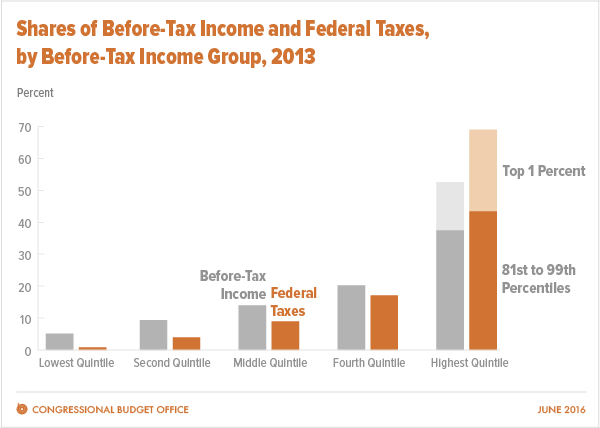
The top quintile makes about half the income (this is before-tax market income plus government transfers). The bottom two make like 14%. Blood, stone, etc.
Now that top quintile is paying two-thirds of the taxes.
If we looked at share of income over some survivability threshold, I’m guessing the share to the top quintile goes up, but I don’t have the data to crunch that.
The actual Federal Income Tax numbers for 2013, based on Adjusted Gross Income, were:
- the top 1% of filers a controlled 19% of total AGI and paid 38% of all federal income tax dollars paid (27% avg. tax rate)
- the top 5% controlled 34% of AGI and paid 59% (23% avg. tax rate)
- the top 10% controlled 46% and paid 70% (20% avg. tax rate)
- the top 50% controlled 89% and paid 97% (15% avg. tax rate)
- the bottom 50% controlled 11% and paid 2.78% (3.3% avg. tax rate)
Seems pretty progressive - and fairly distributed - to me.
I would say, “Why are you hoarding that pair of pant? There are homeless people who have no pant at all. Don’t you care about people less fortunate than you?”
Exactly the opposite is true - the large majority of tax revenue comes from the middle classes. The rich have more per person, but there aren’t enough of them. (See Doctor Jackson’s post.)
Which is the source of some of the resistance to raising other people’s taxes - the realization that it isn’t going to cover anything like how much the tax-raisers want to spend. So we jack up the deficit and the national debt, and burden our children and grandchildren, who are not necessarily “the rich”.
We aren’t talking about me - we are talking about you.
Regards,
Shodan
Okay, first we need to accept some premises as true or we can’t have any kind of discussion:
- For society to function Governments need money they get through taxation.
- Currently the three “pillars” of taxation are Sales tax, Property Tax and Income Tax.
Okay so what is most fair is if each economic group gets the higher burden of one of these as percentage of income. Currently the poor are hit most by sales tax and the middle class is hit most by property tax. That leaves income tax to be the wealthy’s burden.
Lucky for us Income tax is the most flexible and they are the group that can easily afford it.
History shows the entire economy does best when the rate on the highest incomes is high. Why? Because if you know all your income after, say $5,000,000 is going to be taxed at, say 50% you now have an incentive to reinvest it into your company rather than just pocket it and given Uncle Sam half. That;s how things worked until the Reagan and the 80s? What also started in the 80s? The widening of the income gap and the stagnation of real wages. None of that is a coincidence.
Also governments actually had money to do things. Now they are starved and because politicians are gutless and Tax is a dirty word they get their income (especially at local levels) by creating a revolving door of fees (especially court fees) that fleece the poor and middle class.
So why do I care what rate the wealthy pay? Because a higher rate benefits society as a whole at a minimal cost.
Seems strange that you would focus on the guy with 2 pairs of pants, and ignore the guy with 5000 pairs.
The question is, if the government told everyone with 5000 pairs of pants that they had to give 1000 pairs to the poor, why would a person with only 2 pairs of pants care enough to be against that government decree?
There is a fourth pillar which raises much more money nationally than either sales tax or property tax: Payroll taxes, incl. especially SocSec and Medicare.
Repeat the calculation using Income Tax Plus Payroll Tax instead of just Income Tax. Is it still “pretty progressive”?
(Yes, the payroll taxes are for specific services. But the same can be said of components of the income tax.)
Agreed, 100%. If you own a business, you have two things you can do with any profit you may have. You may put it in your pocket, or you can put it in your business.
If you put it in your pocket, there may be some small economic stimulus as you buy a luxury or two that you otherwise would not have, but you are probably going to put it into the bank, where it will sit with trillions of other dollars looking for a place to be invested, or you will be investing it overseas, where there are more growth markets than here in the US.
If you put it in your business, then it goes to your employees, your vendors, your landlord, and creates valuable equity.
Reinvesting your profits into your business seems as though it is going to do much more to stimulate the economy than putting it in your pocket.
Taxes can incentivize this. Nearly any dollar I spend reinvesting into my business is tax free. I do not pay taxes on the parts of my profit that get spent on business related expenses. Every dollar that I put into my pocket gets taxed. This means that I have a tax incentive to keep my money in the business, and not draw it for my personal use, or to make other investments overseas.
When the tax rate for taking money out of your business is 15%, there really is no reason to leave the money there, it is better for you personally to remove as much operating capital and equity from the company and put it into your own pocket for personal use. It is bad for the employees, it is bad for the business, and it is bad for the economy, but it is good for you. If you have to pay 75% tax to take another million from your business, it makes more sense to leave it there, as wealth you can control, even if it is not wealth you can use for personal use. This is good for the employees, good for the business, good for the economy, and actually, good for you too.
Because people have a sense of fairness and do not like seeing violated, even when that violation does not directly affect them. It is not necessarily rational. Wikipedia has some articles on Justice, Distributive Justice, Procedural Justice, etc.
CBO (linked figure above) includes all pre-tax income and all federal taxes.