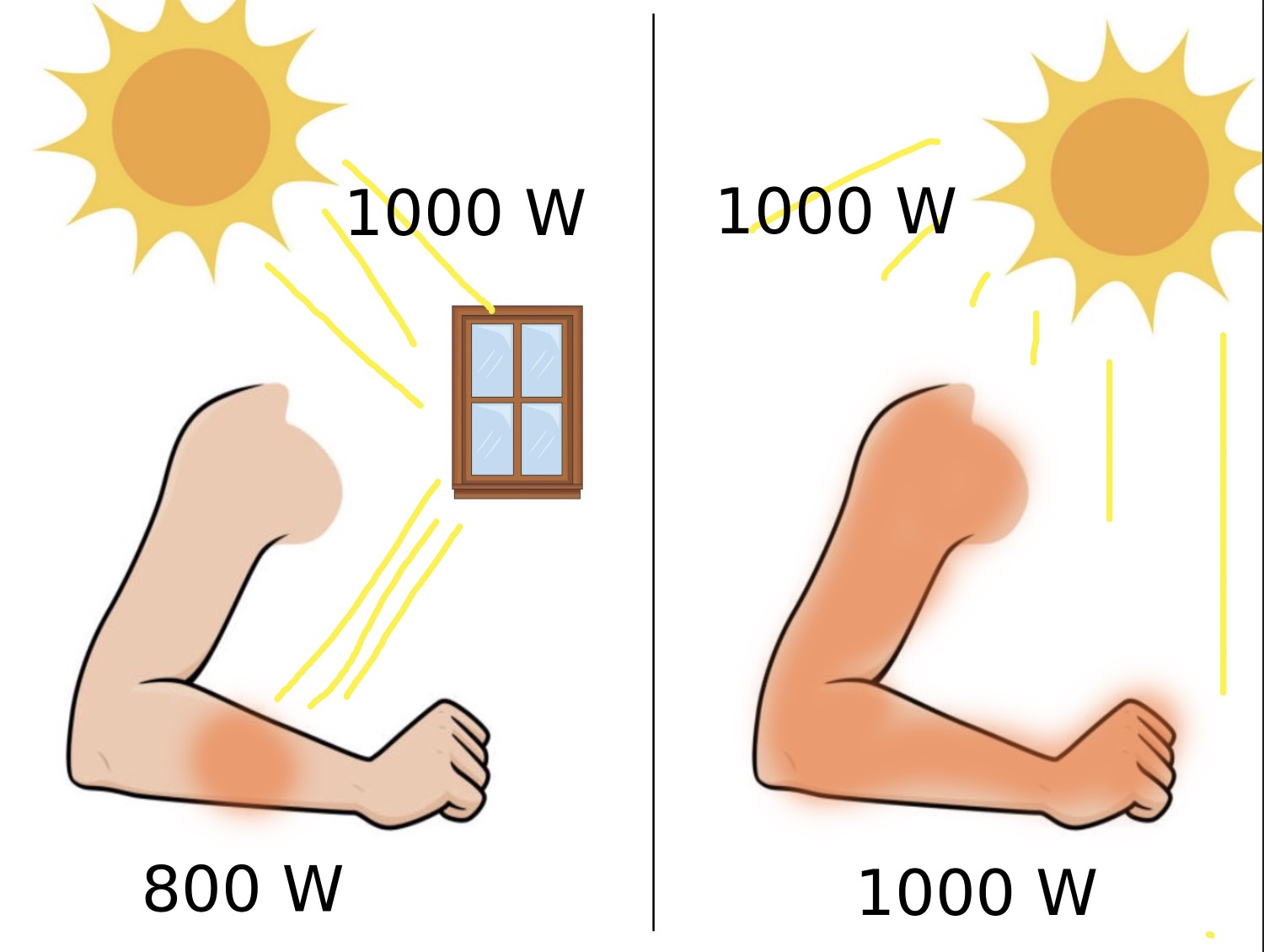
On my morning dog walk, there’s a place where I’m in the shadow of a house to the east but I’m hit with the light from the sun reflecting on a window from a house across the street on the west. Something like this:
At point A I’m in the shadow of the east house. If I look at the sun beam reflecting off the window, it feels very warm on my face. At point B, I’m in the sunbeam itself. If I look at the sun directly, it doesn’t feel as warm on my face as it does when it’s reflected off the window. This surprises me since I would think the sun from the window would be less intense. Some light is lost by going into the house and the reflected light is scattered more. It seems like the beam of sun directly hitting my face at point B should feel warmer than the reflected light at point A. But instead, it feels like the sun light is being magnified when it’s reflecting off the window. What would explain this apparent temperature difference that makes the reflected light feel warmer than the direct light?
Maybe the house on the right is helping to trap heat at point A, but once you’re at point B you’re now exposed to colder air that’s (north?) of the house on the right.
I didn’t think to look at the shadowed face of the east house to see how the light hits it. If the light is being scattered from a flat window, then the face of the east house should be bathed evenly in light. If the window is curved and focusing the light, then I should see a bright spot. I’ll check tomorrow and see what the reflected light looks like.
If you’re going to be out there anyway, maybe download a light sensor app for your phone beforehand? Then you can actually measure the light intensity in both scenarios to see if it’s an actual difference in lighting or a perception thing from your body.
Looking at the reflections from most house windows, I’ve noticed that virtually all of them are curved, and appear to be concave, viewed from the outside. It’s by no mean a regular spherical curvature, but it will tend to focus light into smaller spot than a mirror would give, at a certain distance (beyond a certain point, after afocal region, th light will tend to disperse again. So this will only work over relatively short distances.)
The windows of the Vdara hotel and spa in Las Vegas, collectively, act as a giant cylindrically concave mirror and concentrate sunlight. It’s been known to melt plastic bags left by the pool.
The so-called “Walkie Talkie Building” (officially “20 Fenchurch Street”) in London was designed by the same architect, and has been known to melt the bodywork of cars and used to fry eggs.
Sunlight contains ultraviolet light, visible light, and infrared. About 40-50% is in the infrared (heat) portion. Window glass transmits some light through the glass, and reflects some back.
Possibly this glass is reflecting more of the infrared portion back to you, so you are feeling both the direct infrared sunlight plus the reflected infrared light from the window?
This was my thought as well. The large wall of the house on the left has been warming up in the sun and is radiating infrared back at you, and you feel that heat when you’re at point A. combined with the reflection from the Sun. This effect would be particularly acute if the house is painted a darker color.
Some questions to test this hypothesis: Do you feel any additional heat from the house before you get to point A? Is the east-facing house of the wall exposed to the Sun (even though you’re in the shadow of the other house)? If the answer to both questions is “yes” then I’ll bet that’s what’s going on.
That too, but I was thinking about heat generated inside the houses, at least some of which will leak out through the walls.
100% is the heat portion. Heat isn’t just infrared. All light, of any wavelength, will heat up any object that absorbs it. We only think of infrared as “heat” because most Earthly objects that we think of as warm or hot (animals, fire, etc) mostly radiate in the infrared range, but the Sun is much hotter than most Earthly hot things, and anyway that’s only relevant to the generation of the light, not its absorption.
But that doesn’t really answer the question, because it’s an absolute certainty that the window can’t reflect more light than is hitting it, and in the spot the OP describes, the direct sunlight is blocked.
Therefore, the OP must have an erroneous perception when he feels he is receiving more heat radiation when in point A than in point B.
Or the house is reflecting the reflected light again, so point A gets light from the left (reflected once) and from the right (reflected twice). But the OP would surely have noticed this.
At Point A you are between the houses, which block the wind. Once you step out to Point B, you are subject to a breeze. Even a slight wind could manifest a noticeable temperature difference.
I was able to get some more info this morning. Here I am standing in the reflection:
The window reflecting the sun:
I installed a light meter on my phone and it registered about 40k LUX in the reflection and 100k when pointed straight at the sun.
One thing is that the windows look to be upgraded and are probably IR blocking. It may be letting the visible light pass while reflecting the IR.
When I was taking the first picture of me in the reflection, I could definitely feel the heat on the back of my neck. It feels like a point heat source. If I move slightly away from that spot, it’s not as hot. That might be an indication the window is actually magnifying the reflected light.
Interesting. Assuming the light meter was oriented the right way (i.e., the side of the phone with the sensor was pointed at the window), I would think that reading means there isn’t some sort of “focusing” effect going on, like from a concave or slightly parabolic window. The orange tint on the lower window does make it look like it has some sort of high-R reflective coating on it, but even if so, that shouldn’t “focus” the reflected light from the whole window into a single point… especially not only in one part of the spectrum (like infrared) but not in the visible. If it were focusing, I’d expect the light reading to be higher than ambient.
Wanna test it again with three thermometers (or cups of ice), one in the direct path of the window reflection, one in the area directly adjacent to it between the two houses but not in the path of the reflection, and one under the open sun? That would answer whether it’s an actual difference in heat or a perceptual difference. FOR SCIENCE!
I do still wonder if it’s a perception thing, almost like the thermal grill illusion where fluid-filled cold and warm copper tubes individually feel cold or warm, but if you put your hand across several at a time, it feels like it’s burning.
That gives some credence to the idea that the body reacts to heat + cold in proximity in weird ways…
Actually, now that I think about it some more, if the window truly were coated, that alone could be enough to make the visible reading lower, even without focusing. Many of those films are engineered to let visible light through while blocking some IR and UV.
So a lower visible lux reading might not in and of itself be enough to determine whether there is a focusing effect going on. It could be the case that the window is concave enough to be focusing light, but most of the visible passes through into the house while the IR is being focused and concentrated in the reflection.
But a thermometer or cup of ice should be able measure that. It’s all just heat.
It’d be a little hard to do extended experiments since it’d be in the street and the light is moving as the sun rises. Since the hot spot was relatively small, it does seem like some sort of magnification to me. Perhaps the window installation is curved or maybe the temperature difference between the warm house and the cold outside is causing the window to warp slightly. I’ll be on the lookout for other similar reflections on other windows to see if they have the same effect.
I was walking by this window in the daylight and realized that I can actually see the distortion in the window pane. The reflection of trees in the window is not flat like a mirror. Rather, the reflection has a circular distortion in the middle. This is probably causing the reflected sunlight to be focused on a spot rather than scattered in all directions. Thanks for all the input. Nice to be able to figure out what’s going on.
Yeah. The pattern of light reflected off a window is sometimes called a ‘caustic’; it is one of a class of different light patterns caused by reflection and/or refraction. Here is a picture of caustics caused by square windows in a street in Oxford - you can see quite clearly that there is a pattern of concentration in the reflection, which would make the heat vary significantly over the surface of the reflection.