My SiLabs programming adapter:
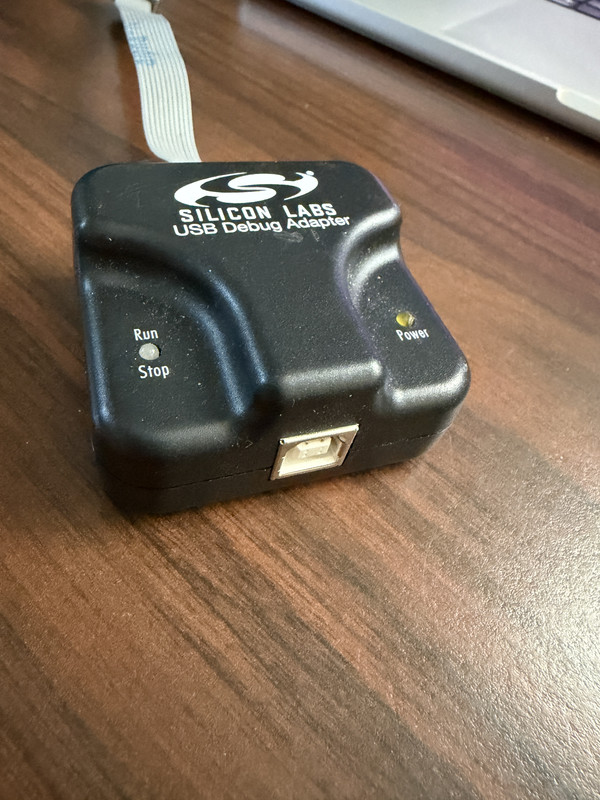
My SiLabs programming adapter:
The music I wouldn’t know, but I find the external drive usage interesting. I still have a couple of those cables in a box, so I think I’ll keep them around on the off chance someone asks for one.
I mentioned it earlier, but USB 1.0 and 2.0 hubs also used a full-sized B port for the cable from the PC to the hub’s input.
Seems less common now. USB C dominates the current hub market, and most of the 2.0 hubs out seem to have a short permanently wired USB A cable dongle, probably because hubs are more of a laptop thing now.
I think the only reason it’s not more common for non-printer devices is that most computer peripherals (like mice and keyboards) have their cord (if they have one at all) permanently attached to the device.
I’m a bit shocked at the apparent confusion here. Full-size USB-B connectors are the original peripheral-side connector for USB (along with USB-A on the host side) starting with the USB 1.0 standard in 1996. The Mini-B variant came out in 2000 to connect with compact electronic devices, and Micro-B in 2007 for even thinner devices. USB-B and its mini and micro offspring all carried the same signals, just in ever decreasing form factors. No nefarious plot to make more money by requiring different cables.
USB1.x and USB2.x defines a four-wire interface - a pair of pins carrying +5V power and ground and a differential pair carrying bidirectional data. Since the +5V is always live, connecting two hosts together using a USB-A to USB-A cable would result in unpredictable and likely very bad things to happen when the two +5V supplies are hooked together. That is why a different connector was specified for the host side and the peripheral side. Like many others here, I have never seen a USB-A to USB-A cable - such a cable would only work for modified, non-standard compliant interfaces.
30 years is a long time and still with the 30-year-old plug?
The full-size USB-B plug is far more robust than the mini or micro versions (I have designed boards that have used all three variants and speak from experience). For a use case like a printer I would greatly prefer the full-size plug - if I grab the printer to move it but forget to unplug the USB, I have high confidence that a full-size USB-B plug would just pop out of the socket without damage. I would also not be surprised if a micro-B socket would be damaged.
Just because someone makes and sells such cables doesn’t mean they are compliant with the USB standard. They are usable in very niche applications with equipment specifically designed outside the USB standard.
Yeah, I’d rather have USB-B for music equipment, too, just like most pro music equipment still uses quarter-inch jacks, not 1/8 inch.
Speaking of music equipment and old connectors, the midi cable is still in common use, and good music equipment will still have midi in and out, along with the newer USB method of using midi.
You said you have never seen a USB-A → USB-A cable. I just showed you one.
Whether it is good or useful I have no idea. But it exists. My local Home Depot is 10 minutes away. I could get that and be back in less than an hour (website says it is in stock). I would guess you could do the same if you are in doubt such things exist.
Ok…but that is so rarely done (picking up and moving the printer) I cannot imagine why I need an unusual plug for it for the once in ten years I move the printer. Who moves printers around often?
It’s neither.
As to USB-B on e.g. printers, I wonder how much of Corporate (or Government) America still has their printers wired into their LANs rather than being WiFi-ed?
If I was IT management for some big company that had 5 or 10 thousand wired printers and suddenly new printers started coming with USB-C sockets instead of USB-B, I’d be really annoyed. Now I need to start provisioning both kinds of cables in quantity.
Nope; I’d rather stick with what I know works and that I’ve already provisioned for.
Why would they change for the printers, anyway? A printer draws enough power that you’re not going to power it from any USB, so the greater power capacity of USB-C is moot. You unplug them seldom enough that the symmetry of the C plug doesn’t matter. You’re not using the USB at all, if you’re connecting it via Ethernet cable or WiFi, which is the common use case now, so it usually doesn’t matter what kind of USB port it has. It’s easily big enough that you don’t need the small size of mini, micro, or C. There’s just no benefit to changing, and at least some benefit of keeping the same kind of cord that printers have consistently used for decades.
OK, but there’s never not a time you will have to manage two cables and that time period is dictated by the maximum longevity of printers. Kicking the can down the road doesn’t solve the ultimate magnitude of the problem, just how much of the pain you experience in the moment.
It’s odd to assert A-to-B is unusual while non-compliant A-to-A is not. Can’t you get an A-to-B at your HomeDepot?
The standard B connector is the most robust of all USB connectors. Why do you think they should switch?
I just checked one of the new Epson printers and it still has a USB-B port.
USB-C cables are everywhere. Europe standardized to them. How many of your friends will have a USB-B cable on hand if you need one?
It’s a 5V version of the 120V suicide cables mentioned upthread several times.
But since it only carries 5V the main danger is frying the devices it you connect them improperly. One of the links in this thread to one of these non-standard (and non-compliant) USB-A to USB-A cables has a disclaimer that says something like “not for connecting PCs.”
If you use devices and cables that follow the USB standards this risk is mitigated.
As many as have ever owned a printer.
What I think most people mean is that they haven’t seen such a cable in physical form. Even if it exists in a warehouse somewhere, chances are that most people have never had a device which required one. With all the USB devices most people have had over the decades they’ve been in existence, most people never had a A<–>A cable. There may be devices that use them, but they are likely so rare and niche that most people would never have be in that odd situation where they would use such a device or cable.
It’s the same with the suicide electrical cable. Most people have never seen one because they haven’t been in the rare situation where that kind if electrical cable would be useful. But someone who is improvising providing electricity to their house with a generator would be in that rare situation and would seek out a suicide electrical cable.
And even that HD cable isn’t actually in their stores. It’s in their warehouse or provided by a 3rd party seller. Companies often have lots of products like that. They want to be a one-stop shop for their customers and will list things on their website that they don’t have in their own stock. Walmart does it as well. Lots of things sold on the Walmart website are from 3rd party sellers.
Assuming they are willing to unplug their printer so you can use yours.
I have a box of USB-C cables on hand collected over a few years. If you need one I’d just give it to you. I might have a USB-B cable in my big box-of-crap in the closet but I’d have to dig for it.