Why don’t you lift weights?

More suggestion that with aging emphasis should be on strength more than hypertrophy. I’m still not convinced there is a practical difference, and am of the opinion that varying it up is best yet. But still, gift link:

https://www.nytimes.com/2026/01/24/well/move/muscle-strength-versus-mass.html?unlocked_article_code=1.G1A.j95Q.aNLYGz3g2wpN&smid=nytcore-ios-share

Again real world training for strength will result in more muscle mass - not all is neuromuscular adaptation and possibly preferentially increasing fast twitch fibers - but muscle mass does matter too. It is a glucose sink. That isn’t to say huge, but avoiding age related loss.

So I have been lifting weights. I worked out with my trainer today and then I cleaned both of my bathrooms and that was all I had in me. I laid down and stared at the ceiling for most of the rest of the day. I’ve been feeling shaky, can still feel my heart beat, even nine hours later. (Also I just checked and my heart rate is still pretty elevated 100bpm.)

This has happened to me before. Is there a way to avoid it?

Also while we’re on the subject, why doesn’t a strength workout lead to cardio gains if it causes my heart to beat so fast? It’s working the heart muscle, isn’t it? Never understood this.

If a fast heart rate is accompanied by new symptoms of chest pain or pressure, difficulty breathing, nausea, vomiting, feeling light headed, severe sweat or a new irregular rhythm it should be checked out urgently.

If the rhythm is regular, they used to say the upper heart rate limit of normal for exercising is 85% of 220 minus (your age). But the above symptoms still apply. Regular rhythms without symptoms and a heart rate below 120 generally settle down. This can be exacerbated by caffeine, alcohol, dehydration, deconditioning, heart or lung or kidney disease, and several medications including salbutamol.

A strength workout can lead to cardio gains depending how it is structured. A heavy lift might involve five seconds of hard work and uses the efficient anaerobic pathway. Cardio gains generally use aerobic energy metabolism, less intensity for much longer periods. If you did long “circuits” of machines at moderate intensity, this would be more aerobic and help more with cardio. The heart rate by itself might vaguely (and not very well) reflect VO2 max but is a poor proxy for oxygen consumption, or saying which energy metabolism pathways are being used.

Bodybuilding legend Franco Columbo agreed with you!

Hmm. My money’s on dehydration. I’ll try drinking more water.

That sounds scary, i hope you resolve it.

I sometimes feel wiped out after a training session, and don’t get much done the rest of the day. But I’ve never felt shaky or had an elevated heartbeat later. More the reverse, if i exercise excessively, i feel cold and tired afterwards. Like my metabolism is really slowed down.

A bit more on energy metabolism versus workout type.

But wait there’s more! :grinning_face:

Those are the energy systems in the muscles and which ones adapt more to which stimulus. The heart itself is experiencing different demands …

During aerobic exercise the heart is experiencing sustained volume overload, delivering more blood to muscles against normal or even decreased vascular resistance. Over a matter of just a few months of training the heart adapts by increasing stroke volume, all chambers enlarge and specifically the left ventricle wall thickens.

Resistance training is a pressure overload rather than a volume overload state. It does not tend to increase stroke volume and the heart remodeling is modest thickening of all walls concentrically.

Combining both approaches is most effective.

In conclusion, among individuals at an increased risk for CVD, as little as 8-weeks of combined training may provide more comprehensive CVD benefits compared to time-matched aerobic or resistance training alone.

Not sure what happened to you @Spice_Weasel but I’d give yourself a good recovery day and then a lighter active recovery exercise day in any case.

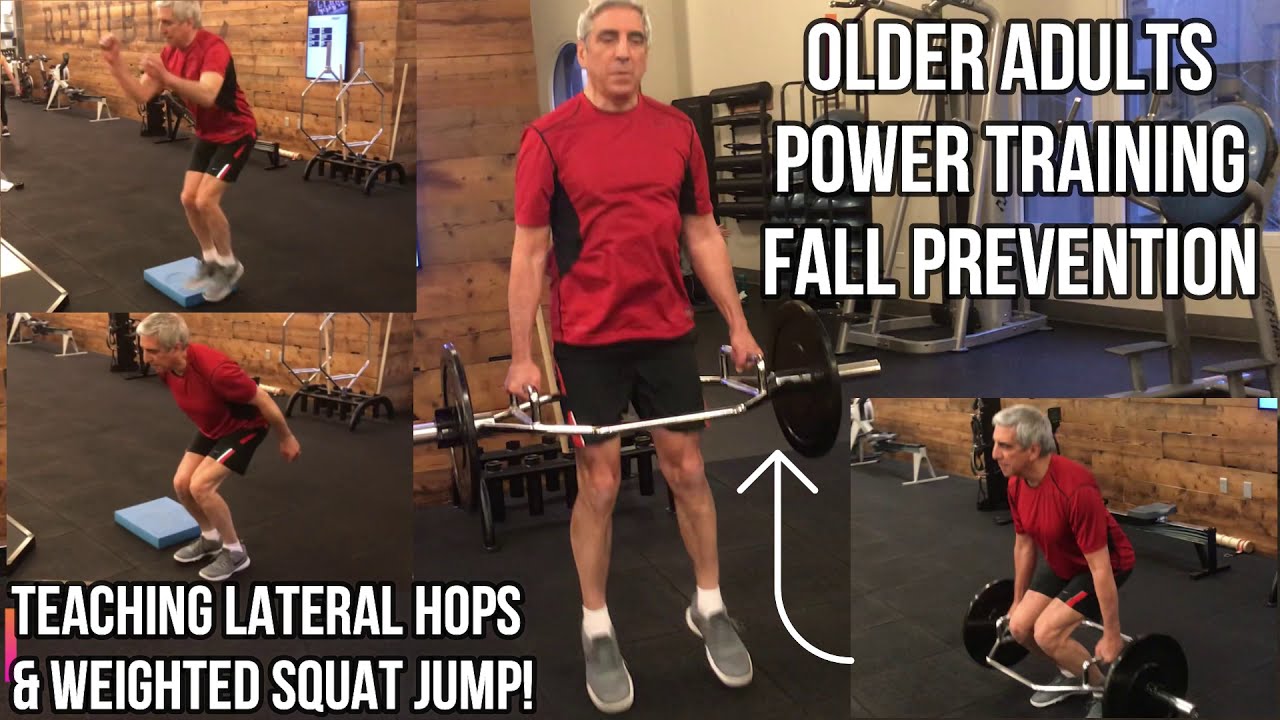
thx, @DSeid … I am closing in on 60 and do a bit of physical exercise (low threshold, w/ my body as weight) … so I found that POWER (=fast twitch fibers) vs. STRENGTH (=slow t.f.) very enlightening and extremely helpful.

It makes completely sense from the “avoid tripping/falling” POV of older persons (where you need explosive power to counteract). I plan to do more of that explosive-jumps thingy in my future.

Here is a short TY-vid with some exercises for the 50+ crowd (annoying musica alarm):

could you break/dumb this down some? …

I have trouble visualizing the 2 types of training: aearobic vs. resistance training … isn’t there a huge overlap (I always thought thats +/- the same … which might be a reason for my confusion)?

any examples for aer. … and resist. trainings to make this easier to understand?

thx!

Yes there is much overlap.

But let’s start with examples that overlap the least. This specially from the POV of heart demands and how the heart physically changes in response to those demands over time:

Running, cycling, cross country skiing - the classic aerobic demand exercises - the big deal there is the demand to get oxygenated blood to, and waste products from, the muscles over a prolonged period of time. That’s increasing flow, increasing volume, of oxygenated blood, literally VO2. Taps wide open including generally in the muscles themselves. Heart is pushing huge amounts to, through, and back from, the muscles for duration. It gets better at doing that: it increases how much blood it can pump every stroke. “Stroke volume” increases. All heart chambers develop an ability to hold more maximal volume and the heart gets better at completely emptying it (a larger ejection fraction during demanding activity). With the big demand on the chamber that has to push the blood to and back from the skeletal muscles, the left ventricle, so that chamber’s wall specifically gets thicker, stronger. That is a large part of why endurance athletes often have low resting heart rates (bradycardia), not unusually in the low 40s or even upper 30s bpm, each stroke does more.

Now consider the other end case, lifting heavy for strength: deadlift; squat; and bench. Picture yourself doing it. Muscles are contracting hard, pressure in the muscles, in the abdominal cavity, spikes, squeezing on all the blood vessels. The heart has to work to deliver against that pressure. Not huge increases in volume of oxygenated blood (VO2), more pushing similar volume through squeezed-down tubes. Acutely the heart is working much harder pushing against that resistance, beating faster, but not pushing much more volume around. The heart doesn’t adjust by getting better at pushing more volume around, it adapts to working hard briefly against high pressure. To do that the demand is for all chambers to get thicker, “concentric hypertrophy.”

They are both working the heart muscle but in very different ways. Just like they work different metabolic pathways, different sets of skeletal muscle fibers, and induce different sorts of neuromuscular adaptations.

Yes real world exercise exists in a spectrum. And exercise across the entire spectrum may be the ideal.

thx, very clear explanation …

I got a rowing machine about 6 months ago (b-day present to self) … and I use it mostly in Zone-2 (around 120-130ish HB) for 30-60 min x session - so that would qualify as aerobic as per your example …

So it now seems I need to do a bit more of “explosive” exercises (pushups, jumping-squats) … which seems to be your 2nd example … which also aligns very nicely with slow-vs-fast-twitch-fibers …

Again, THX! … it does help me targeting (as in: make more relevant) my - rather casual - exercise regime.

This isn’t an area of fitness that I’ve dived into deeply.

My understanding is that cardio is a much different monster from weight training.

In weight training, you increase the amount of stuff that you can move and, generally, if you encounter something lighter to move then that’s no issue since you’re training for much more.

In cardio, you might develop your cardio metabolic system to be able to handle a set of squats of 8 reps @ 500lbs, but you try to jog for 5 minutes and you’ll keel over.

Likewise, with weight training, if I’ve been training to lift this crazy amount for a long time, but haven’t been able to work out for a month or two, I can probably still lift most or all of that crazy weight. Whereas if I take 1-2 months off from cardio training then my body will revert to full couch potato mode and it’s like I’d never trained at all in my life.

In general, the cardio metabolic system is very persnickety. It very closely adapts to what you actually do regularly and it only keeps it for an long as you’re doing it consistently on a pretty tight schedule.

Further, it seems likely that your best bet for health is to work it out at different levels of intensity, where “intensity” is on three separate scales of time, static effort, and dynamic effort. You can do low effort dynamic activities for a long time, like walking, and that’s great for you; but also medium effort dynamic activities like a fast lap around the block; which might or might not be different from an isometric activity for the same duration like planking. The one general rule is that the faster the heart rate and harder the breathing, the less long you should maintain the activity.

I believe (but again, I haven’t delved into it), that all evidence is that “being well rounded” appears to be the ideal state for long term health. We’re adapted to do things like walking a lot, running a little, carrying heavy shit around for several grueling minutes, etc. and training for that variety is ideal.

I don’t know that I personally have the time to do that so I just figure that if I walk the dog, wrestle and run with the dog, and do heavy workouts then probably that’s hitting a decent number of spots on the chart. Probably, it’s not quite enough, but more is better than less so I should still try to get what I reasonably can, and not sweat that ultimately there is a limit to how many hours there are in a day.

As to the question of why cardio is so weird, no idea. My sense would be that, say, building a very heavily muscled heart helps to make it able to spray blood like a super soaker water gun. That’s not really what you need to handle most fitness tasks. You’re trying to get the blood to pump faster, for more oxygen to get pulled into the blood, to pull more exhaust elements out of the blood and get them into the output systems, etc. Much of that deals with things more like maintaining a roster of specialized cells, enzymes, signaling proteins, hormones, etc. and having your body adapted to adjusting then specifically for the level and type of activity that you’re doing.

Maintaining a stressing activity for a long time isn’t just a simple variable like the cross section of your muscle fibers or, in terms of a car, how much horsepower your engine can put out. If you want to race a car for 24 hours, you need to get your gas right, your lubrication right, have spare tires, have a fire extinguisher ready, etc. it’s a lot more logistics than just one thing.

But that’s just my theory.

IMHO … definitely a great plan! And maybe some intensity variety within the two groups!

FWIW I also have an erg (rowing machine). I keep meaning to use it more than I do, especially as part of my wintertime mix when I don’t ride my bike and run outside less.

The erg is a device hard for me to categorize? Definitely it can be done slow and steady and be significantly in the endurance camp. But the “pull”, especially as I am trying to increase my effort, especially if doing intervals, seems plyometric to me? And of course effort related it can be base to anaerobic and anywhere between.

Another puzzler to me about it is that usually, for most exercise, my perceived effort (generally how hard I am breathing) and my zone by heart rate (got a Garmin when I was marathon training) are in agreement; less so on the erg. I perceive myself to be working harder, in a higher zone, than I am by heart rate. For impact I trust my perceived effort more than the monitor. But I do not get why this activity has a mismatch that running, biking, elliptical, even jump rope, does not. Maybe just because I do it least and the novelty of different muscle activation patterns? Don’t know.

video did not work

I don’t think it worked. I don’t think my video worked

I

Thanks everyone this is helpfully clarifying.

So an activity like rucking - walking or hiking with a weighted backpack - is that more cardio or more endurance?

It would be more accurate to say power is very fast twitch, strength fast twitch, and endurance slow twitch. At least for muscle fibers.

one thing on the erg-rower (Concept2 ?) I noticed:

I am doing my workout (low-med. intensity) to - say - 130hb … and then I stand up, and after 30sec. standing my HR is way above 130 (even when doing nothing) …

My “rationale”: given that on the rower you are pretty horizontal, all your body is more or less level with your heart , but standing up your siluette turns vertical … and that might impact HR - heart have to work harder to keep status quo (donno if that makes any sense).

I think cardio is a more medical term and endurance is more of a colloquial term.

I’d probably use them in the sense that you should be able to do basic things for reasonable amounts of time. E.g. you should be able to stand from a sit without feeling light headed, you should be able to run with your dog, you should be able to walk with 30-50 lbs for 5 miles, and you should be able to squat with a goat on your shoulders, etc. These are things that should be relatively comfortable for a human being to do, if they’re relatively healthy and active. That’s “good cardio”.

Being able to push a car up a hill, then swim the English channel, then pull a bag of sand up the cliffs of Dover is an amazing show of endurance but clearly not an average and normal level of cardio metabolic fortitude. That’s just being a athletic freak with a passion to destroy themselves and have every joint replaced by the age of 45 with titanium.

If your cardio is below what you need to be normal then you’d train endurance - the ability to keep going longer and harder - but eventually you just end up with good cardio unless you keep pushing it into the extreme.