I think I’m doing well on endurance because of all the hiking I do. Not so sure about power–I’m afraid my bladder might fall out if I do too many explosive movements! TMI, I know, but jumping isn’t going to happen.
Thanks again for your insights!
I think I’m doing well on endurance because of all the hiking I do. Not so sure about power–I’m afraid my bladder might fall out if I do too many explosive movements! TMI, I know, but jumping isn’t going to happen.
Thanks again for your insights!
The study.
https://bjsm.bmj.com/content/60/12/874
The method of assessment:
participants were asked to report average weekly time spent in resistance training (weight machine/resistance training). There were 10 response categories ranging from none to >11 hours/week. Participants also reported average time spent performing aerobic leisure-time physical activities (walking, jogging, running, bicycling, lap swimming, tennis or squash, other aerobics, heavy outdoor work and climbing stairs) in the same questionnaires
I think most people would report the time they were in the gym and include the rest periods. I would.
The figures:
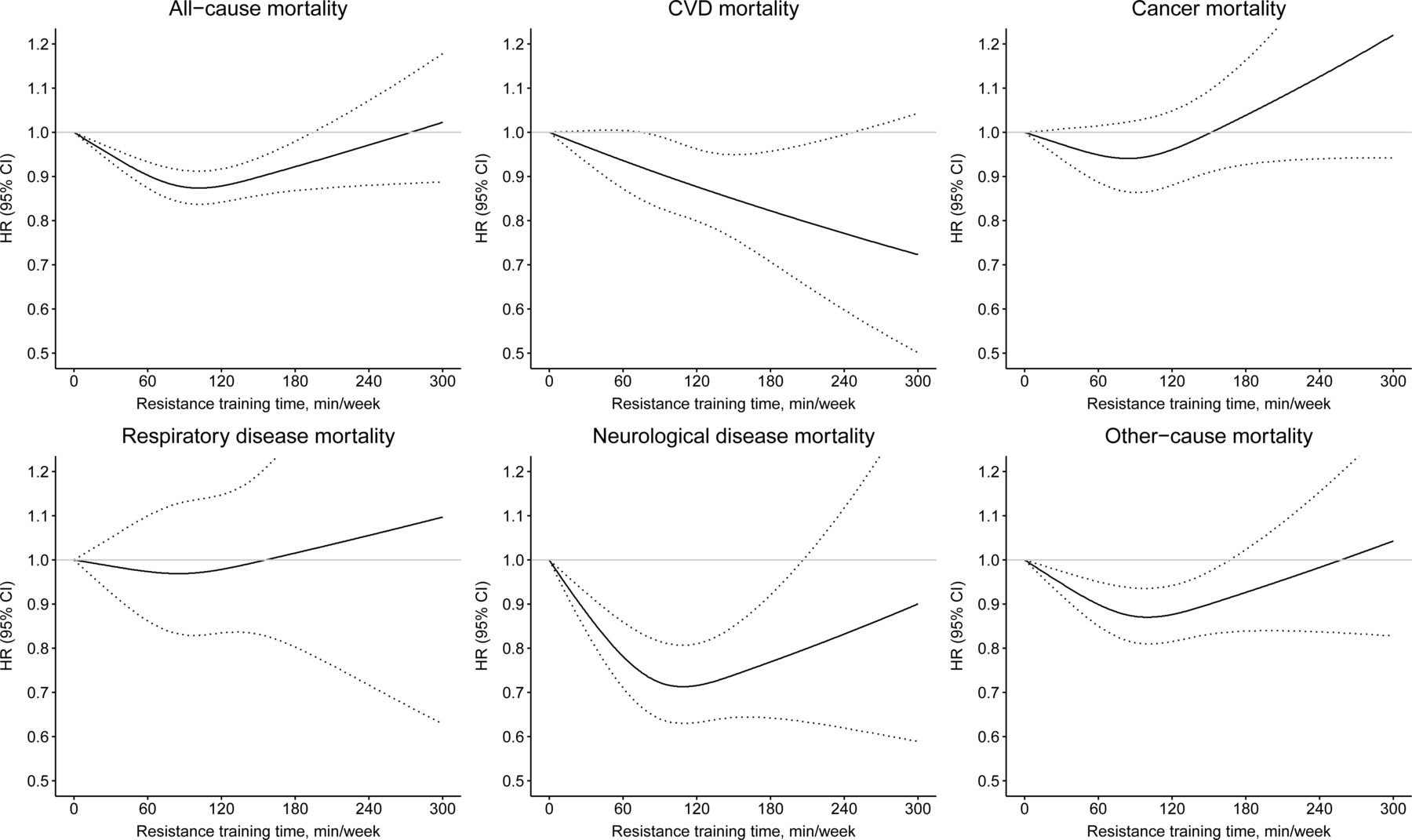
I wonder if they are confusing cause and effect.
Seems hard to believe that exercising more that 120 minutes/week actually causes cancer…
I get they likely are including self-reported “time spent in the gym”. But for many people this includes socializing, spotting, resting, changing weights… a much higher number than actually spent lifting.
I also believe people who spend a great deal of time lifting are perhaps more likely to be using dubious things, have inadequate recovery, have dysmorphic issues or just work in a gym. But none of these would apply to a majority of people. Lots of younger people go to the gym four or five times a week to socialize, as well as lift periodically.
Lifting more has continued cardiovascular benefits but increased cancer and respiratory risks raise mortality? How does that make logical sense? I don’t see people vaping on the Stairmaster.
First off the increase for cancer mortality is not within statistical significance, not outside the error bars. Could be no impact or slight decrease or moderate increase …
Second, mortality not incidence of. Not just a pedantic thing.
Which gets to possible mechanisms if true.
That much resistance training can be enough of a stress signal as to result in dysfunction of inflammation pathways: “chronic systemic inflammation.”
That much resistance training elevates IGF-1 both acutely and chronically. Part of how hypertrophy happens but IGF-1 also promotes cell proliferation and activates the PI3K/Akt/mTOR pathway — a central oncogenic signaling cascade.
And it can, at those levels, even cause immune dysfunction of parts of the system that kill cancer cells, such as T cells, by way of chronically elevated cortisol.
So not causing more cancer necessarily but less effective at containing it when it occurs. Hypothetically. But might not be real and if is could be other behaviors those who weight train that much engage in - a confounder.
The self reporting twice a year is a problem. But the bigger problem is not differentiating between light and heavy resistance training, and properly quantifying its duration. They assign presumed MET scores to aerobic exercise - which shows more benefit at longer durations - but not to resistance training. I can reach a MET of 10 by jogging, but approach a MET of 40 for shorter durations of using the rope-pulling climbing machine. I don’t know where Olympic lifting lies.
Inflammation and its ilk certainly affects the immune system. But why would people who do a lot of cardio, run marathons, etc. be spared systemic stressors? mTOR and AMPK nutrient sensing pathways are important - insulin probably more so - but have more dietary factors than ones related to exercise. They must be other pathways we don’t know about yet. “There are more things in heaven and earth than are dreamt in your philosophy”…
Instead of inflammation, if this is a real issue I think it is more related to growth. This has negative effects on mTOR, implies a need to grow and replicate cells and so creates more opportunity for error. In my gym, there is a moderate correlation between size and tanning, and size and tattoo prevalence. 
Different stressors. In many many ways. In particular resistance at that level hits IGF-1 to chronic high levels and the oncogenic cascade that such is a stimulus to; high levels of endurance training do not. Instead high levels of endurance training causes a cascade that is is anti-tumorigenic.
In any case we have now multiple large studies that come to the same conclusion: reported time spent strength training is correlated with mortality benefits peaking at one to two hours per week. Apparently beginning to move the other direction after that. There is biological plausibility for such.
I think strength and endurance training can be a bit of a false dichotomy if you do a lot of it. You can increase your METs and VO2 max with both depending on structure. If I carry 300 pounds while walking for a minute, how is that not also cardio analogous to a 400m dash?
Still, there is clearly a point where recovery is inadequate. And to increasing VO2 max and fitness, which is better and more meaningful measure than “time spent ostensibly lifting”.
A subject we’ve discussed!
Not all METS are the same.
Yeah Attia … oy.
First complete agreement that VO2max is a great predictor. But look at that figure. Poor VO2max clearly bad. The difference between elite to even just “above average”? Not very big. No need to chase “elite”.
Second if you want to increase VO2max cardio, especially some hard cardio, like intervals and threshold, in the mix, is the most effective way. Resistance training less so although circuit training with short rest periods can be moderately effective.
That’s the dogma. I’ve seen studies looking at bikers and runners in “Zone 2”, etc. I’ve seen far fewer studies looking at VO2 in strongman or CrossFit - and I certainly believe these increase metabolic capacity. There are plenty of ways to get out of breath lifting weights with intensity and without circuit training.
FWIW a source about resistance training compared to aerobic:
In direct comparisons, resistance training was less effective in improving VO2max than aerobic training, HIIT was slightly more effective than aerobic training, and no difference between aerobic and combined aerobic plus resistance training was found.
CrossFit compared to a polarized endurance training approach:
I’d expect to outperform circuit training for VO2max improvements.
Again not all out of breath is the same.
I think a lot of these exercise studies are clunky. I would not apply the results very rigidly.
A few months ago I had a routine eye exam. This involved a few images. The optometrist looked at one, said I was at risk of getting a stye due to a blocked Meibomian gland, and suggested buying the microwaveable eye pads his office sold, applying them daily ten minutes before going to bed (“My patients say this feels wonderful”).
Although introducing a bedtime routine in perpetuity requiring a subscription to eye pads has its obvious appeal, I pointed out styes could easily be treated, should one arise, with warm washcloths and gentle compression . The optometrist replied that there was a study showing ten minutes of heated pad at 40 degrees Celsius had solid clinical evidence behind it. I don’t doubt it, but I’m still going to treat styles should they arise, using a flannel in water of unknown temperature that feels warm, yet not uncomfortable.
Heh. You know what temperature likely “feels warm, yet not uncomfortable”? 40 degrees C! 
Of course we should be critical consumers of all things, and people quoting studies that support what they sell are always reacted to with an extra eyebrow raise. And we should watch ourselves that we don’t dismiss studies primarily because they don’t say what we expect to hear …
@beowulff … I am reassured that by my third time trying I can get a few full ROM windshield wipers done! I think it was a different enough sort of movement that my muscles were initially fighting each other. They still ain’t pretty and only a few, but they are!
Of course people prefer studies that confirm expectations. But these guys sent out a survey every two years (I originally misinterpreted “biennial”). A nutrition survey sent out monthly is inaccurate - most don’t know what they ate last week. On top of the problem that most time lifting in a gym is actually resting, which I can do for up to 80% of my workouts, I have trouble taking its measurement of time seriously. I do think there are limits, that the curves might be the right shape, that there are trade-offs between growth and longevity which can be mitigated, and that recovery, sleep and nutrition play important roles. Exercise is a stressor but also alleviates stress, so much depends on context.
Congratulations!
They are difficult, and an excellent core and upper-body exercise.
To recap -
This huge study following long term.
A previous meta analysis:
One specific to older women.
All basically find a sweet spot of people reporting about a hour a week spent as resistance training, with either little mortality gain or possibly even negative impacts going significantly much above that.
Yes the actual time lifting to achieve that gain is likely less than the hour, given much of that reported time is likely between sets.
My big critiques are different than yours.
One these studies are the opposite if the usual bias: more women studied and few men. May not extrapolate to both genders. But I am convinced by now that mortality benefits in women peak at about an hour per week, with even a little doing a lot, and a lot doing at most a little. Probably true in men also.
Two is these are mortality benefits, important to be sure, but not answered is if further improvements in healthspan accrue with more resistance training. Personally I care more about healthspan than lifespan.
What I can find there is similar: small amounts deliver most of the gains. For example:
https://jamanetwork.com/journals/jamapsychiatry/fullarticle/2680311
Resistance exercise training significantly reduced depressive symptoms among adults regardless of health status, total prescribed volume of RET, or significant improvements in strength
One can question the J or U shaped claims but it is pretty clear that the benefits on both health and lifespan can be hit pretty maximally at just a hour a week in the gym doing resistance training, of which a fair amount of the time is between sets.
It’s an impressive ROI.
FWIW a men only study.
Smaller benefit than in women but still significant and possibly a narrower window.
Among participants without type 2 diabetes, 1-59 and 60-149 min/week of long-term weight training were associated with 14% (HR 0.86; 95% CI 0.82-0.89) and 8% (HR 0.92; 95% CI 0.85-0.99) lower mortality versus no weight training, respectively, after adjustment for aerobic activity. However, ≥150 min/week of weight training was not significantly associated with mortality
I don’t have a problem with the shape of the curve, the number of participants, the statistical power. I do suspect if too much strength training is unhealthy and stressful for you, too much running and biking is as well. I don’t think the specific time of 90-120 minutes per week means much, but there certainly is a specific time that does, for reasons below.
The questions asked about cardio activities and the study worked out an approximate MET score, reasonably correlated with VO2. Individual data would be weak, but many of these errors would wash out. People are much more likely, intentionally or not, to overreport how much time they spent exercising. But if you run for an hour, you were running for an hour. If you lift for an hour, that says nothing about intensity or rest; and they did not ask more. And if you were to sum that up every two years, that data is going to be pretty inaccurate, even for people who rarely change their schedules.