The reason why people are black is because of melanin production which guards against skin cancer in areas with high UV radiation. Thus, people from equatorial regions were usually darker than those from europe. But why is it that people from Tasmania, New Zealand, Argentina and South Africa which would have had similar climates to, say, France were populated by people significantly darker that those of a similar latitude up north?
I’ll say because they migrated from somewhere with a hotter climate. eg. South africans from north africa, tasmanians mainland australia.
cheers
engine
That white skin functions in a relatively low UV environment does not guarantee that all of those in such environments will be white. Black skin also functions in a relatively low UV environment and if only genes for black skin are present, well you see the result.
Tasmania is an isolated island without any in-migration except possibly from Australia and New Zealand were the people are also dark skinned.
Evolution is a little bit more than lots of sunshine = darker skin.
Skin colour is indeed controlled by melanin production. This in turn is controlled by specific genes. Unless you have appropriate genes to produce dark (or light) skin, you’ll have to wait for Mother Nature to produce the mutation and hope that it sticks. It could be a very, very long wait.
I don’t know why you included Argentina in this group of places. The native inhabitants are no darker or lighter than any other group of American Indians (i.e., native (South) Americans or whatever else you want to call them) and thus are not much darker than the average resident of France. Nor should you have included New Zealand, where the native inhabitants, the Maori, are Polynesians, and thus not much darker than the average residents of France. It appears that melanin loss only occurred once, as certain groups of early humans migrated out of Africa into Asia and Europe. It appears that there was no melanin loss among those who migrated from northern and central Africa (where mankind presumably originated) into southern Africa. It also appears that there was no melanin loss in the aboriginal Australians as they migrated from northern Australia to Tasmania. Melanin loss requires a genetic mutation. It occurred once in the inhabitants leaving Africa for Asian and Europe, and it stayed in the gene pool because it was useful in northern climes. It just didn’t happen to occur any other times in populations that ended up further from the equator.
Vitamin D is naturally produced through an interaction between certain kinds of cholesterol and sunlight. If one had darker skin (back before the days of vitamin-fortified foods), one had to have greater exposure to the sun to avoid rickets.
Now suppose there are two tribes living in some Neolithic backwater. If one tribe’s warriors are riddled with rickets, how likely is that tribe to win in battle? So darker-skinned peoples, to some extent, couldn’t move further north out of Africa. I mean, they could, but they were less likely to succeed, due to their resulting drop in health. So the causation may not be “lots of sun causes dark skin” but “dark skin causes the need for lots of sun”.
Why could aboriginals move down from Australia into Tasmania? Presumably, they found some way (something in the food?) to get around the lowered exposure to the sun. But note also that there were no lighter-skinned tribes to compete with.
Just my $0.02.
Eliz.
I thought that dark skin was mainly a protection against skin infection.
Light skin, whilst losing this protective factor has the benefit of, as stapel notes, providing more vitamin D in low sunlight. Tasmania is the same littitude as the north of Portugal, so its not as if sunlight is scarce.
Tasmania was first colinised from darker people from closer the equator. France from people all over the place, but many from closer the pole.
I’m confused as to why you’ve singled out Tasmania. Is there an indigenous population in Tasmania that is significantly different from the rest of Australia?
Maoris are relatively pale, there are even some red headed tribes who look much like tanned red headed white people :).
Ok, disregard that post, it’s because Tasmania is a southerly part of Australia well removed from the equator.
I cant say ive seen too many ginga Maoris round our way... :dubious: Certainly not an entire tribe of em… Maybe it`s different in Oz 
I see no one has mentioned folic acid’s role in skin color yet. Dark skins prevents UV light from destroying folic acid in the body; folic acid is very important for pregnant women, making dark skin an evolutionary advantage in high sun light areas.
You obviously haven’t come across my tribe then.
Current conjecture is that Australian Aborigines have their distant origins on the Indian subcontinent*, and were able, during a glacial period, to paddle/row/wade or otherwise island-hop their way through the Indonesian archipelago, and wind up in both mainland Australia and Tasmania.
Given that the estimated time of first arrival was a mere (in evolutionary terms) 40 000 to 15 000 years ago, and that there were no fair skinned peoples with whom to intermarry, and further given, as pointed out above, black skin isn’t ideal for high latitude areas, but it’s also no major problem, it’s probably not so surprising we haven’t seen any white Tasmanians.
*As ever, this is a topic open to much debate. To my untrained eye, it seems to be quite plausible though. There does seem to be a similarity.
I’m not sure whih South America or which New Zealand you are referring to Wendell, but before European colonisation those landmasses in the southern hemisphere were both populated by people very much darker than the average Caucasaian resident of France.
This is a Maori for example : http://www.zomerzondagen.nl/images/180-2003/maori%20tattoe%201%203%20aug.jpg

As are these people: http://savvytraveler.publicradio.org/show/features/1999/19990508/images/maori-header.gif
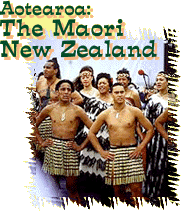
Considering that most most, if not all, Maori now have some admixture with Causcasians that gives a pretty good impression of skin colour. As you can see it’s not in an way comparable to the typical Caucasian skin tone even in southern France. Certainly muchg darker than the aveage skin colour in France. 200 years ago it would have been notably darker.
This is a South American Indian: http://www.underwatercolours.com/amazon/GirlC.jpg
So are these people: http://www.panda.org/graphics/amazon_Kayapo_Indian_MauriRAUTKARI.jpg
These people are Argentinian Indians: http://daphne.palomar.edu/marguello_students/Summer_2003/arvizu/images/Pampas%20Indian%201.jpg
As you can see there is no way you can descrbe these people as “not much darker than the average residents of France” unless you were being facetious and including Negro Frenchmen in your calculation of average.



O.K., I’ve looked at those pictures you linked too. I’ve seen other pictures of Maori and of the Indian population of Argentina. It’s hard to tell in some cases because of the face painting and the fact that they have heavy tans. They don’t look that much darker than any average resident of France to me.
Maori folk are definitely, on average, darker than the typical Frenchman. For mine, an Asian / Hawaiian look, and a southern Mediterranean complexion, or possibly a Thai / Burmese one (with an often quite large build) will be a reasonably good description.
Maori might be considered fair in Africa, but no way can I see that being the case in France.
The Maori originated from a more equatorial country - Papua New Guinea (crossbred with Taiwanese). And are definitely more darker olive-toned skin. As I am Maori myself, I ought to know.