Nope, I’ve got it, and was going to suggest it. It’s a great ‘intro’ to a bunch of phenomenal players, as well as to the instrument in general.
Interestingly, Mr. Hammond was originally very much against the combination of his organ (heh) and the speakers made by Leslie (two separate companies, though the combination of the two products is a huge part of the ‘Hammond’ sound).
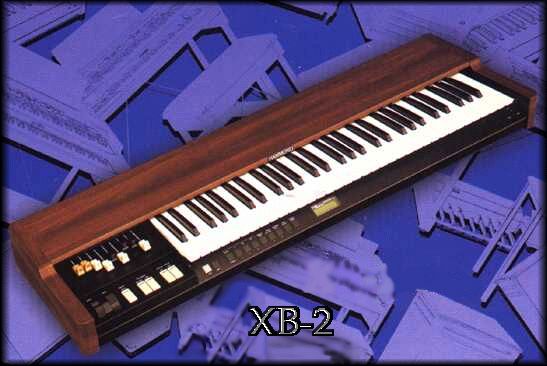
The B3 “emulators” out there are quite good. It’s been years since I’ve played one, but I remember playing a Hammond XB-2 about 10-15 years ago, and I’ll be damned if I could tell the difference between it and the real thing. Korg also make some decent B-3 sounds with their BX3 and CX3.
I believe mostly on the Hammond M3 (at least I know “Green Onions” was definitely played on that model of hammond). Think of the M3 as a B3 junior. They’re both tonewheel organs and produce similar timbres.
Normally I don’t like to resurrect a thread that’s a month old, but I would be remiss if I didn’t acknowledge your recommendation for this Ike Quebec collection. I was able to finally find it at a good price and it’s been a constant on the CD player for about 3 days now. Frankly, I’m more of a Quebec fan than I am the Hammond B-3 and I don’t know how I managed to miss this one. But then again, Earl Van Dyke and Sir Charles Thompson are always worth a listen in their own right.
It seems to me that this is the 2nd or 3rd time that you’ve sent me scampering over to either CD Universe or Amazon, credit card at the ready. In fact, my CD collection is quickly taken on a life of its own.
Oh well… I’ve always maintained that food, clothing, shelter and utilities are vastly over-hyped.
I have played both a Hammond B3 and a Hammond C3 both with leslie cabinets and drawbars and foot-pedals. I fail to really discern any difference between the two organs other than the woodwork. Why does the B3 hold so much more prestige than the C3? Can anyone explain?
How do their respective weights compare? If the B3 is lighter, that would explain a lot. When you have to transport the thing from gig to gig and move it up onto and down off of stages, weight is important.
Two names not mentioned yet are Bobby and Eddie Buster. They pretty much originated the B3 sound in jazz - Bobby had B3 serial #2, Eddie had serial #3, and I’ve played both of them.
Eddie playing the B3 can be heard on a couple of Gene Ammons and Sonny Stitt albums, and on at least one B.B. King album. Don’t ask me which ones … I don’t remember.
I got outbid for Eddie’s B3 when he passed on . . . I could only go as high as $5k for it . . . it ended up going for about 3x that. Not sure who got it, but it came complete with the original Leslie.
On that note (no pun intended), there was actually a foot switch that activated/deactivated/slowed/sped up the horn on the Leslie while playing. Took a bit of coordination to play the pedal board and fool with that switch at the same time.
True about streamlining the size of the combo, but in all of the jazz recordings in the classic Jimmy Smith style, by far the bulk of the sound of the bass is coming from the left hand. Pedals are used, but they’re not the main source of the sound, generally, except in ballads or some other special circumstances. Scott “Organfreak” Hawthorn has probably written more about this than anyone else, but it’s certainly no secret, at least to those who may have attempted to sound like Jack McDuff while reproducing his lines using the pedals. It doesn’t work.
I don’t know that the C cabinets are that much less prestigious than the style of the B cabinets. The average fan may simply be unaware of much beyond the mantra “B3 = Hammond.” While the B3 is more likely to have had a hard life as a touring instrument, including flaws like spindly, wobbly legs and such, this is partly due to the desire of the audience to “look at Jimmy Smith’s feet!” Maybe there is some performance advantage to the design of the B2/3 after all. I don’t think there’s much difference at all in their weights.
Off the top of my head, I don’t know but doubt there is much if any difference. At a minimum, it takes four adults to move a B3 and even then it’s a pain in the ass.
A quick search turned up this bit of info from Wikipedia :