The span measured roughly 1,500 km at their closest points, compared to nearly 3,000 km today. Still, around 900 to 1,000 miles is nothing to sneeze at. One thing that did surprise me was this bit I read:
I was under the impression small animals like shrews, for example, needed to eat more frequently than larger animals.
And I also learned a rodent family known as caviomorphs, ancestor of the South American capybara, the world’s largest rodent also made the journey.
None that I’m aware of. There are some monkeys in Trinidad, but those were brought from Africa by sailors. Those are the only wild monkeys in the Antilles. That’s just nuts. The Columbus Channel is only about five miles across.
Sure ..about 1000 miles narrower maybe? Still about 1000 miles wide though. I wouldn’t think primates would be able to float that far on a raft or anything.
Small animals may need to eat more often, but their total calorie consumption is likely less.
From what I’ve read, ocean currents at the time favored a fairly rapid crossing from east to west, with the crossing happening in as few as 15 days. Also, the rafts could be quite substantial, including multiple whole trees. If one or more of the trees was fruiting, that would be at least some of the food the monkeys needed. They could also eat insects.
A bit off topic, but there was one domesticated plant that made the Atlantic crossing. The bottle gourd was first domesticated about 12,000 years ago in Subsaharan Africa. It spread from there to other parts of the Old World by diffusion. But it was also domesticated in the New World. At one time it was thought that the ancestors of Indians brought it over from Asia, but they’ve now found that the gourd could float across the Atlantic and still have viable seeds. So the thinking now is that it floated across and was redomesticated in three areas: South, Central, and North America.
Based on shared similarities with the three other Caribbean monkeys, Xenothrix mcgregori, Insulacebus toussaintiana, and Antillothrix bernensis, MacPhee and Horovitz have proposed that the Caribbean primates are part of a monophyletic radiation which entered the Caribbean at the Oligocene–Miocene boundary.
That’s 23 Mya. So why didn’t they get to Florida? Maybe because:
Analysis of postcranial morphology suggests that Paralouatta was at least somewhat semi-terrestrial, making it the most terrestrial platyrrhine genus known.
That is, they were more vulnerable to terrestrial predators than other New World monkeys.
The word “Raft” is perhaps not conveying exactly what’s being discussed. “Floating island” is perhaps a better descriptor - many hectares in size, with full-grown trees and soil.
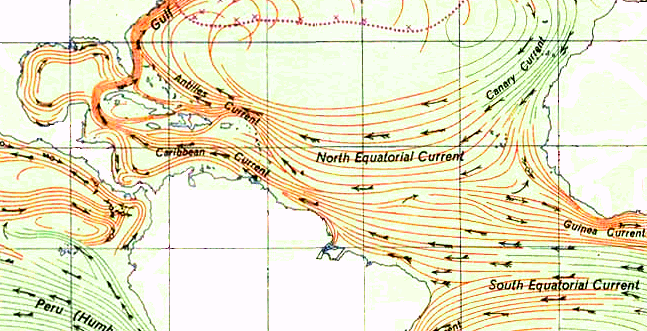
Can you explain? Mine understanding matches the wiki page below, that the general current from the Caribbean runs along the Florida coast. Furthermore, any hurricane in the Gulf of Mexico will drive rafts north from Cuba towards Florida.
This map clears up a lot. That Caribbean Current looks like it would send any raft from Venezuela straight to the Yucatan. That must be why so few monkeys reached the Antilles. Cuba to Florida is a similar matter. The Gulf Stream is a very powerful current. I grew up in South Florida in the early '70s. The sheer number of Cuban refugees who would get swept out to the Atlantic was staggering.
That’s the normal ocean current. You said tropical storms. Those don’t follow the same pattern - they don’t go South America->Florida in a gyre. The ones that brush northern South America go on to make landfall on Central America.
And before 3 million years ago, even those Caribbean gyres didn’t exist like that - the current just flowed westward through the Central American Seaway.
Now, why didn’t the extinct Cuban/Jamaican monkeys mentioned above raft to Florida in their nearly 11 million years in the Antilles? Two part answer - a few might have anyway but not enough to act as a founder population or be fossilized, or else pure chance never let it happen.
More telling, I think, is that none of the other Floridian terrestrial mammals originate in the Caribbean either (manatees and seals are a different kettle of fish[1])
fish classification only applies to medieval Catholics! ↩︎
Actually, a BUNCH of primates gave up the trees, took up bipedalism, and vastly extended their range (H. habilis ranged all the way into Asia, the Denisovans were Asia, as were the “hobbits”. Neanderthals evolved and lived mostly in Europe but even before genus Homo was a thing there were other upright apes in Africa).
It’s just that we’re the last species standing.
So it’s not that primates couldn’t do such a thing, a lot of them did, it’s that the monkeys were a branch of that evolutionary tree that didn’t go down that route. They stayed in the trees. Which limited where they could live to where there were suitable trees.