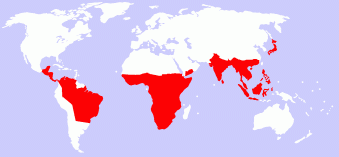
Wondering why there is such a limited range of new world monkeys. The usual reasons given is because it’s too cold and their specialized diet. But when they first arrived in the new world the flora and fauna were quite different, and yet they adapted.
I understand that a specialized diet, for example, restricts migration to a certain extent, especially in the short term but estimates I’ve read that they have been here for 35-40 million years. That’s a bunch of time to adapt.
In fact, the range of all monkeys are about the same geographically. See here.
Not so with some other animals. Take bears, for instance. Polar bears split from a common brown bear ancestor roughly 350,000 to 500,000 years ago. The isolated brown bear populations underwent rapid physical and metabolic changes to be able to handle the extreme marine arctic environment. They changed their diets and resistance to cold relatively rapidly.
Same for arctic foxes and others. The adaptations happened fairly quickly.
Monkeys have had almost 40 million years but nada.
Further north is desert. Further south is savanna. Further west are the Andes. Monkeys obviously had no pressure to move out of the trees and into these areas.
“Many were increasingly of the opinion that they’d all made a big mistake in coming down from the trees in the first place. And some said that even the trees had been a bad move, and that no one should ever have left the oceans.” ― Douglas Adams
Yeah, probably trees. It’s obviously not cold preventing them from living in Florida if there’s wild monkeys in Japan, and they have a pretty broad diet range. Monkey body plans are great for climbing, but not so amazing for running on flat land, compared to most predators. Their ability to escape being et relies on having something to climb up, where they can outmanoeuvre most things that would like to eat them. For the most part, primate distribution is a really close match with the distribution of tropical forest.
The African savannahs obviously aren’t solid woodland, but there’s enough acacia patches and trees, especially around water holes, tall enough for this strategy to work for baboons. Geladas, which live on grassland- mostly eating grass- without many trees up in the Ethiopian highlands, instead live at the top of big cliffs which they can climb but local predators can’t, and run down those every time a predator shows up.
Outside their range in the Americas, they’d need to spread through big areas with more shrubby growth or mountain ranges where this climbing strategy wouldn’t be very effective; nothin’ much to climb that local predators can’t also climb. I suspect if a decently sized group of monkeys had made it to a large area of forest elsewhere, they probably could have adapted - at least if they didn’t die off in the first winter- but they had no way to get there.
After all, the one primate that got absolutely everywhere is the only one that pretty much gave up the whole climbing thing and came up with alternative predator defences.
Bears, on the other hand, don’t need to worry about avoiding predators, because that’s them.
Speaking of which, you can still see hundreds of wild rhesus macaques roaming free in Silver Springs State Park near Ocala, FL, thanks to an entrepreneur who brought over half a dozen in the 30s and didn’t realize they could swim.
Seems like there are plenty of arboreal critters in North America? Squirrels honestly don’t seem all that functionally different than some primates. Not convinced that in all that time climates weren’t varied long enough to have some forested corridors.
North America wasn’t even connected to South America until relatively recently: prior to roughly 3 million years ago there was no land connection in Panama. The Great american interchange, of North American life moving south and South American life moving north, is still ongoing.
So they managed to colonize South America from Africa which is separated by this vast expanse of ocean, something I think of as just as uninhabitable to monkeys as desert, but were stopped by the deserts of Mexico.
What surprises me is that in all the time since the isthmus opened climate variation never created any period of contiguous forest from Mexico to the forests north. But seems to be the case.
I’m somewhat surprised that primates were never rafted by tropical storms from South America to North America. How many Caribbean islands have indigenous primates?