This is a local issue, not a Federal issue. This is why you see disparity between different places across the US.
I’ve commuted on the Minuteman, but had to hop off onto Mass Ave for the final leg. I’m about to start commuting on it but in the opposite direction, going all the way out to Lexington and beyond.
Somerville and Cambridge are getting a bit more serious about dedicated bike lanes after a few recent bike/car deaths. Beacon St will have a dedicated separate lane away from the street, but it’s only for a small part of most riders’ commute.
To re-iterate some things:
Most people on bikes also own cars and pay gas taxes
A lot of road funding comes from the general fund (which people on bikes pay)
Bicycle lanes are (in general) cheaper to build (because they are narrower) and cheaper to maintain (because bicycles don’t wear the road as much). They don;t carry as many people – though they could carry as many if not more than single occupant cars
There are definitely scofflaw people on bikes, but how many people in cars obey the speed limit? Run yellow/red lights?
I bike to work fairly often – luckily the busy highway I sure has wide shoulders.
for the record I stop at stoplights and signal all of my turns. I admit not coming to a complete stop at stops signs if there isn’t cross traffic.
Brian
A lot of cities in the early 90’s plopped down a bunch of bike lanes without much thought beyond how much paint was needed. The result was a bunch of slapdash lanes with dangerous features (most were in the dooring zone or parking pulloutzone) and often did not actually go anywhere. More recent efforts had a bit more thought put into them and in Center City Philadelphia the sacrificed a single lane in each direction for bike transport. The car drivers squeal like the priveleged pigs that they are since now they only had 17 lanes devoted to them in each direction instead of 18. They are still squealing and demanding the bike lanes be removed since said lanes are not constantly packed with cyclists wheel-to-wheel. These folks have often grossly exagerrated the cost of the lanes to rile up drivers. (For example, they complained about ‘multi-million dollar bike lanes’ on the South Street Bridge while ingoring that the multi-million dollars was spent on rebuilding the entire bridge).
Anecdotally, I have noticed that the bike lanes calm drivers bit as well. THere was an intersection I often have to cross that now has a bike lane. Trying to cross this street as a pedestrian was ‘fun’ because cars would turn right in front of you , one after the other, each pretending they didn’t see the pedestrians trying to cross. Now? They seem a little less inclined to plow through everyone since they only recently merged to turn and are perhaps a little more concious of their surroundings.
The Idaho stop law is a great thing: Idaho stop - Wikipedia
I use it often.
On topic: There are very few bike lanes in this region and they tend to be afterthoughts: Hey, this is a wide shoulder filled with sewer grates, gravel and broken glass…let’s make it a bike lane! Genius!!! :smack:
Not sure how it would work for Boston, but around here we have a pretty good network of rails-to-trails routes that can get you close to work, depending on where you work and live.
Again, I don’t know how it would work for a big city, but in the burbs I think entirely separate bike trails are a much better idea than bike lanes. We need separate infrastructure devoted to bikes and pedestrians. Not only for safety reasons, but cost and comparative advantage, too. There’s no reason to widen a road designed for 20-ton trucks so that a 150lb person can ride a 20lb bicycle on it. Not to mention things like curbs, street parking, storm drains and other aspects of roads designed for automobiles are completely contrary to the needs of cyclists and pedestrians. If anything, I think adding bike lanes to sidewalks would be superior to adding them to roads themselves.
Bike lanes aren’t always a good solution. Here’s a link to a page which contains discussion and links on both the pros and cons of bicycle lanes:
Bicycle Lanes: A no-brainer?
A small sample:
Because bike riders dont use them, they use the sidewalk instead.
First, no, it is too late to retro-fit into existing architecture that was not designed to accommodate it. In the Netherlands and Denmark, everyone has bicycled since before the roads were built. .
Second, it is not for “The US” to do, it has no authority. Such design priorities can only occur at the state/local level. Some cities have good bile lanes, some don’t, but it’s their call.
Third, the use of bicycles is not likely to increase significantly in the future, enough so to mandate bike lanes for future construction. Climate and distance are two factors that militate against year-round bike dependency in the US
Fourth, in most cities, a commute can be rerouted to include streets that do not have heavy traffic, which might not necessarily be the shortest route, but would be safe and workable. Google maps will yield a recommended bike route, but I’m not a biker, so I don’t really know what criteria Googlel maps uses to judge bike suitability. I just looked at the map for my town (70,000), and the bile route as far out as the bypass sticks to residential side streets, with very few difficult bottlenecks. If I walked the bike route, I’d just walk down the middle of streets, and step aside if a car came along.
But usually only to or from fast food restaurants.
In London, the growth in commuter cycling has been spectacular. Even at this time of year, at lights, the front vechiles are surounded by cyclists by the time the lights change. In summer it’s difficult to believe.
As the OP says, what has made a huge difference latterly is dedicated cycle lanes - usualy a regular car lane curbed off. But London did need a critical mass of commuters that started at grassroots to build the momentum.
Now it is totally awesome 
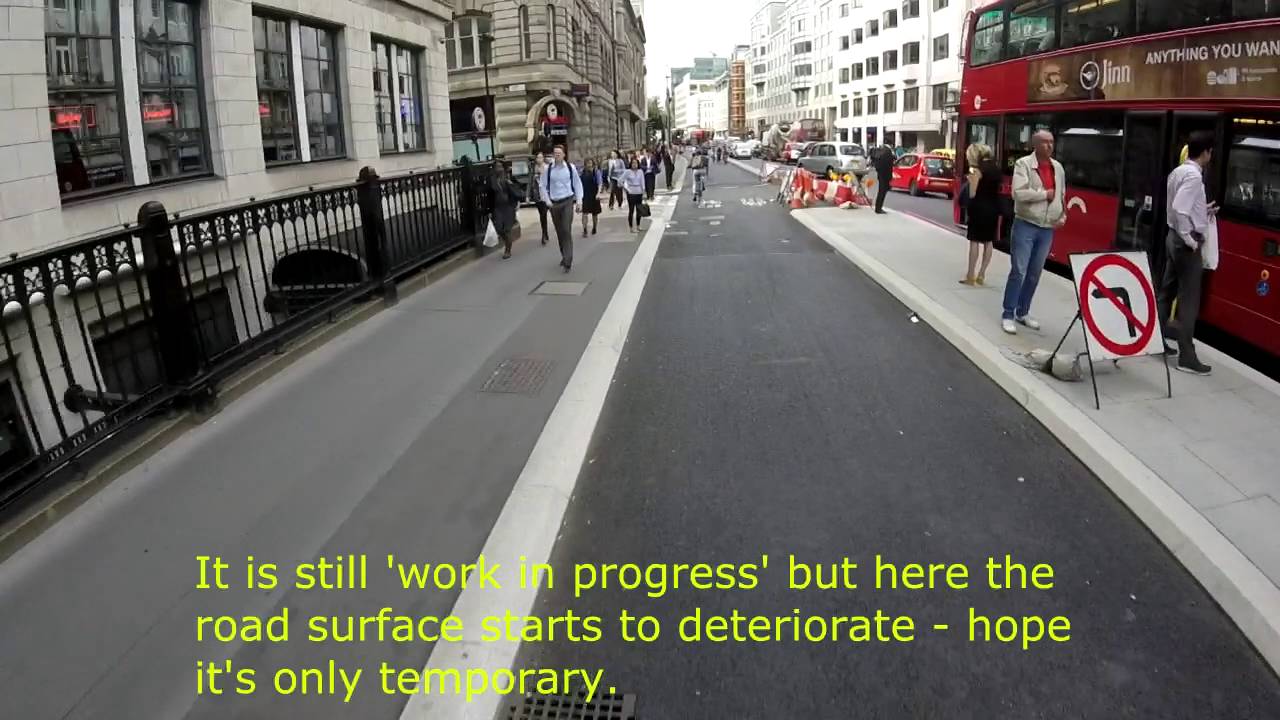
Not sure where you are but I rarely see that around Boston or NYC. If anything they just ignore the bike lanes and just take a lane in the street.
I try to cover several topics with one post. There’s an art to it.
But still a long way to go before we reach Dutch standards of everyday utility cycling. It’s the point about thinking all the way through a consistent re-planning, in all the details, as in those videos, and sticking to it over decades.
Well, yes, both.
So, why then spend the money and slow down traffic for a useless and not used lane?
Because … if you build it … etc.
A lot of interesting points have been raised. I didn’t realize urban bicycling presented so many challenges. A lot to think about.
I’m at an age now where a nasty spill off a bike could be quite serious. I don’t need anyone opening a car door in front of my path. I’ll stick to the occasional scenic path my city offers. Sharing the path with speed racers is scary enough. I rarely go over 12 mph and that’s downhill. A lot of bikes (younger riders) go by me.
Having dedicated paths completely separate from roads would be the best solution. There’s still the problem of getting to & from a specific address. That requires jumping on a bus or riding on the road.
Dedicated paths could serve as the main arteries to get across the city. Then have exits onto streets to get to a specific address. That minimizes how much street travel is required.
New York City has added tons of bike lanes since the start of Bloomberg’s administration. Also, bike-friendly accommodations such as bike-parking racks and “Citibike” bike-rental stations.
The majority do use the bike lanes, except when cars park in them and the cyclists are forced to take a full lane of traffic. I bike commuted for several years into Cambridge and you have to keep your head on a swivel for bad drivers (and other riders), and the same was true when I was driving in. Bike lanes are heavily used here, and they take many cars off the streets. More could and is being done, and the number of bike commuters continues to grow here.
Because in many cities when bike lanes are properly designed they can actually help recude traffic.
Cyclists do use bike lanes and that is patently obvious to anyone who looks either at the surveys or just looks at any city with recently added bike lanes.