One of my sisters worked on a geriatric floor in a hospital decades ago, and they regularly referred to patients as O’s and Q’s.
We have lots of technical terms of course, but I’m struggling to find too many that really don’t relate to more common usage.
One that comes to mind is “ceiling”. For us, a ceiling is the bottom surface of a mostly solid layer of clouds. So ceilings only exist outdoors. Which is the one place you won’t find a ceiling in ordinary usage.
Of course the underlying broad meaning is the same: “Mostly flat surface somewhere overhead.”
You just say, “four tenths” if you are machining. Thousandths of an inch (.001) happens to work out to a very reasonable degree of accuracy for most work. One thousands over on a shaft is a light press fit. One under is a snug sliding fit. Tenths are for more critical machining. I know, it all depends on what you are machining but thousandths are the way most machinists talk.
As for metric, a millimeter is 40 thou, worthless. A tenth of a millimeter is till 4 thou, not good enough. Hundredths of a millimeter is 4 ten thousandths, too fine for much of the work. I’m sure if you are a metric machinist the English system looks silly.
We used to do a test, we asked people to say the first thing that came to them when they thought if this word:
MOLE
A small mammal- and a person who works in the dark (related)
A breakwater
a “beauty mark”
A chemical unit of measurement
A spy who has deeply infiltrated.
A Mexican sauce with Chilis and chocolate
A medical term for a abnormal mass in the uterus
In my business a “smurf” or “smurfing” means to break up a large amount of cash into several smaller units, each then sent or transported by a different guy.
There is also “Nesting” where one bank offers services to another, but the other bank isnt conducting due diligence
Toll gates .
I still remember the first time I had to wrap my head around the concept of a historiography. Wait a minute, I have to write a history about the history of history?
And now I’ve got a new way to use smurfing! Thank you, DrDeth!
‘rivers’? Don’t know that one
Yep would have to be “pedo” to work in Aus. English
I work in the legal side of the maritime industry. So many. So many. And the odd thing is that the maritime industry is so old, much of the time the maritime usage is actually far older than current usage ie it is not that a specialised usage has split off from English, it’s the other way around.
“Floors” are structural elements of a ship that are vertical.
A “head” is a toilet.
A “road” is a place ships anchor
A “rode” is the line that connects a ship to its anchor (which is probably where “Road” comes from I guess)
A sheet is a line for controlling a sail.
Rope is not a line, it’s what lines are made out of.
A boat is (outside of submariners and the Great Lakes) a craft small enough to be part of the equipment of a vessel or ship.
A tonne or ton when used in ship’s measurement is a measure of volume not mass (deriving from the space taken up by a “tun” or urn").
A “master” is the most senior member of the crew of a commercial ship. “Captain” is an honorific not a title.
“Average” relates to insurance, not statistics. The statistical term derives from the maritime term and comes from to “aver” ie damage to shipped goods.
In engineering, BOM stands “bill of materials”, basically the list of all the parts used something. Although not spelled the same, it’s pronounced pretty much the same as “bomb”. You have to be careful not to say it at the airport.
In lighting, you don’t eat the cookie.
Bias and Discrimination.
Phrases like ‘racial discrimination’ still give me an immediate WTF? moment: that’s a bad thing? Discrimination is a good thing: If there’s no discrimination, the radio doesn’t work, and in a high performance radio receiver the reason for a second intermediate stage is to get more discrimination.
The same for “bias”. Bias is how transistors work. You need bias. Circuits that aren’t biased correctly don’t work.
Not my area, but I’ve talked to people about ‘resolution’. Screen Resolution and Printer Resolution and Resolving and Optical Resolution aren’t each or all the same thing. But they’re sort of the same thing, right? Actually, not so much: it’s the same word, but they aren’t just different numbers: they describe different things, they aren’t comparable, one doesn’t imply the other. If that satelitte lens has a “resolution of 10’ at the earths surface” it doesn’t mean “they can see 10’ objects” – it – doesn’t mean that.
In statistics, “predict” does not mean saying what will happen in the future (even though the word looks to me like its roots mean “say before”. It means to explain one thing on the basis of others, typically in the past. To say anything about the future, in statistics, is to “forecast”.
I’ve always found the term “ship’s boat” amusing.
And repos aren’t just for your car.
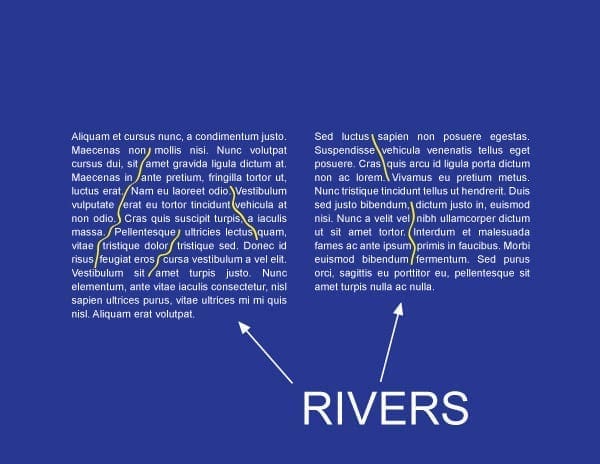
It’s white space in text that flows down the page reminiscent of rivers. I think it usually happens in fully justified text (where both the left and right ends of the text are aligned to the margins) and you get extra spacing in the text. They are undesirable.
Let’s find a visual example:
Another printing term is “register” (or “registration”) which has nothing to do with wedding gifts, dog licenses, or voting
-A “pot” is a control used by professional audio operators to turn something up or down (i.e. volume). It is not something to smoke until perhaps after the gig is done and you have left the job site.
-“Over/under” is the preferred method of coiling cable for transport or storage. It is not a sexual position.
-The “suck knob” is a mythical control on an audio control board. In a perfect world it could be used to “pot” down a band that sucks.
Let’s see, back from my newspaper days. I remember: “Hammer” for a type of very short, large font headline, usually above a sub-head (or “deck”) with the fuller explanatory headline. “Slug” – a very short name used to identify a story in pre-production. (“Slug” also has another meaning in printing that I forget.) “Rim” - the area where the copy editors sit, so-called because in newsrooms it used to have a semi-circle shape to it. “Slot” - the head copy edtior. “Cutline” - caption to a photo or illustration. “Morgue” - the archives. “Flag” - the newspaper’s name on the front page, a.k.a. “nameplate.”
In electronics, a “flip-flop” is not something you wear on your feet, nor is it a politician who changes their mind. It’s the most basic unit of storage, a circuit that can store a value of either 0 or 1.