Whenever a southern person walks in the room and greets everyone, I look around to try to find the ketch.
I’m confused. if “for-tay” means strong, why would using it to describe a person’s strength be a problem? In the UK I’ve never heard the term “fort” used for that person.
Americans tend to, british do not. We pronounce it “coo-pay”
OK. You’ve got forte the adjective and adverb, which is mostly used with reference to musical tone. It’s one of a bunch of adjectives/adverbs which are borrowed from Italian for use with reference to music, and is in BrE always, and in AmE I think mostly, pronounced as a two-syllable word in a way that nods towards its Italian origins.
Then you’ve got forte the noun, meaning strength, strong point, and usually used with reference to some skill or ability in which a person excels. This comes from French, and it as adopted into English well before the Italian adjective was. In French it’s an adjective, meaning “strong”, but English has a habit of turning French adjectives into English nouns and when it does so it often borrows the feminine, not the masculine, form of the adjective (locale, morale). It may have come into English in the context of fencing; the forte and the foible are respectively the strong and weak parts of a sword-blade, and the earliest recorded usages in English have this sense.
According to the Oxford English dictionary, the dominant pronunciation of the noun in BrE has is the the same as for the adjective, but “fort” also occurs, whereas in AmE it’s the other way around.
Nope. I wonderhow the heck it got in there.
The name comes from the Connecticut River, from Mohegan quinetucket ‘long tidal river’, from Proto-Eastern-Algonquian *kwən- ‘long’ + *-əhtəkw, ‘tidal river’.
I’ve no idea what the sounds of the Mohegan or related languages are, or the conventiond adopted for rendering them in the Latin alphabet. But I note a -h- in the word signifying “tidal river”, which (willd speculation) could indicate a gutteral or breathy sound. Add to that the first Europeans to settle in the area were Dutch, and I think we could possibly be seeing the origins of that intrusive -c-.
It was required as part of my 9th Grade Spanish. Still is for current students. Only as it applies to Spanish, and there’s much of it I don’t remember well, but would you also limit mathematics to mathematicians?
MAY HAS TWO FUCKING VOWELS! TWO!
A lot of you guys don’t just “not know IPA”, you don’t even know the most basic concepts of phonetics.
.
No, of course not. But if I’m in a thread about, say, the US national debt, I don’t need to use scientific notation to denote “3.5x10^12” when I would be understood just as well with “3.5 trillion”.
Two vowels? “May” as I (and most Americans I know) pronounce it, is either one long vowel or, in the South, a diphthong; in some rural parts, even a triphthong.
Almost all English speakers pronounce “May” as a diphthong. While pronouncing the so-called “long a” (/ei/) in English, the tongue commonly moves from the position indicated by the blue dot to the red dot as shown in this diagram. Different English dialects will have somewhat different starting and ending points.
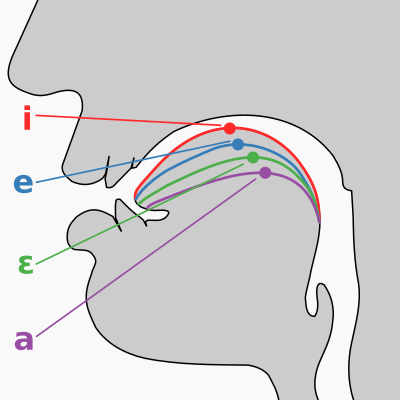
Triphthongization can also occur – often starting with a centered vowel like schwa, then forward to the blue dot, then up to the red dot.
This is English. We spell poorly and some of our vowels get ignored. “Bite” has two fucking vowels, they just use a different position for the vowel fucking.
But at least we are not the French, who just scrape up dirt off the floor and throw it into their words so casually that you can never tell which letters are going to be used at any given time.
What really hurts American English speakers in understanding phonetics is having to unlearn the “long/short vowels” scheme many of us learned back in elementary school. IPA /aɪ/ (bite), /eɪ/ (bait), and /oʊ/ (boat) are all diphthongs used by virtually all American English speakers, but we learn from a young age to parse them as single vowel sounds.
IPA is a supplemental tool based on the Latin alphabet that you learned as a child. It’s nothing like learning to read and write English from scratch or to use a completely different sensory medium like Braille. What makes you think that learning IPA is comparable at all?
We all use some form of pronunciation aide. Most of the people here have employed ad hoc pronunciation indications. I daresay the vast majority of people here have looked in a dictionary for pronunciation guides. At some point you added the ability to use such symbology to your knowledge of English. What makes you think that IPA is anything more than an extension of that skill that you already have?
(Recognizing and acknowledging that SMV withdrew the snark, still …) The strawmanning in comments like this really reveal that the anti-IPA position has little substance behind it.
I just came across this 2016 poll on use of the IPA on the boards – https://boards.straightdope.com/sdmb/showthread.php?t=800880 – and it reminds me that FTG has been propounding this pro-ignorance position for a long time.
Look, this is perfectly fair. I have tried very hard to say that IPA is a very useful tool and would make participation in pronunciation discussions easier and more enlightening for each individual who learns it and for everyone participating in a thread. It reduces ambiguity and repetition and misunderstanding. However, I have not said that IPA should be mandatory and that anyone who doesn’t know it should keep out of threads.
What I find to be inexcusable is FTG’s blatantly false assertions about IPA. On a board dedicated to fighting ignorance, it’s disheartening to see someone maintain this kind of ignorance-based position over many years.
Look, I have offered on more than one occasion to help people learn IPA well enough that basic discussions about English pronunciation are more understandable. It wouldn’t take long. At least one person has taken me up on it, and I hope has not regretted it. I would gladly extend the same offer to FTG and Kaylasdad to help overcome what to me is an inexplicably irrational resistance to it. If we try and fail at a sincere attempt, then failure I shall have to accept.
There is another issue here, illustrated by these threads –
American education in phonetics is quite poor, and this might create a small speedbump to those encountering IPA for the first time, but it’s still quite a small hurdle to overcome.
Y’all are a bunch o’nerds. Jus’ sayin’.

Maybe their spelling it “aks”.
I’ll get me hat.
To be clear, the consonantal cluster in “ask” has two pronunciations, the standard one being /sk/ and the non-standard one being /ks/. Both pronunciations have been present in English for many, many centuries.
Why do American newscasters accent the first syllable in harassment instead of the second? I recognize that the British accent the first syllable, but Americans accent the second.
Because we giggle like 12-year-olds when we say “ASS.”
It is more than a change in accent, it is a change in vowel shape. The British pronunciation is like “HAIR-us-m’nt”, while the Americans mostly say “huh-RASS-m’nt”.
I’ve noticed this too but I don’t recall it having always been that way. Perhaps they don’t want to say “ass” 
<raises hand> Ooh Ooh, that’s me! It really does makes sense when someone breaks it down for you. Not saying that I’ll be able to memorize the whole alphabet(?) but at least I’ll be able to understand when it’s discussed here or when I read some foreign word in the news I’ll know how to pronounce it.
Chaucer uses “aks” in the Canterbury Tales, IIRC.