I love 'em, so…
Ellipsis haters are warned - if I can’t use ellipses, I’ll use dashes. Do you want that?
Thanks, I will adopt that usage!
Hmm. I wouldn’t know what to make of a short text ending in ellipses. But i do use them in texts, between statements, where i intend them to mean “i would have paused if i were speaking aloud”. Maybe i should stop. I mostly text to people much younger than i am.
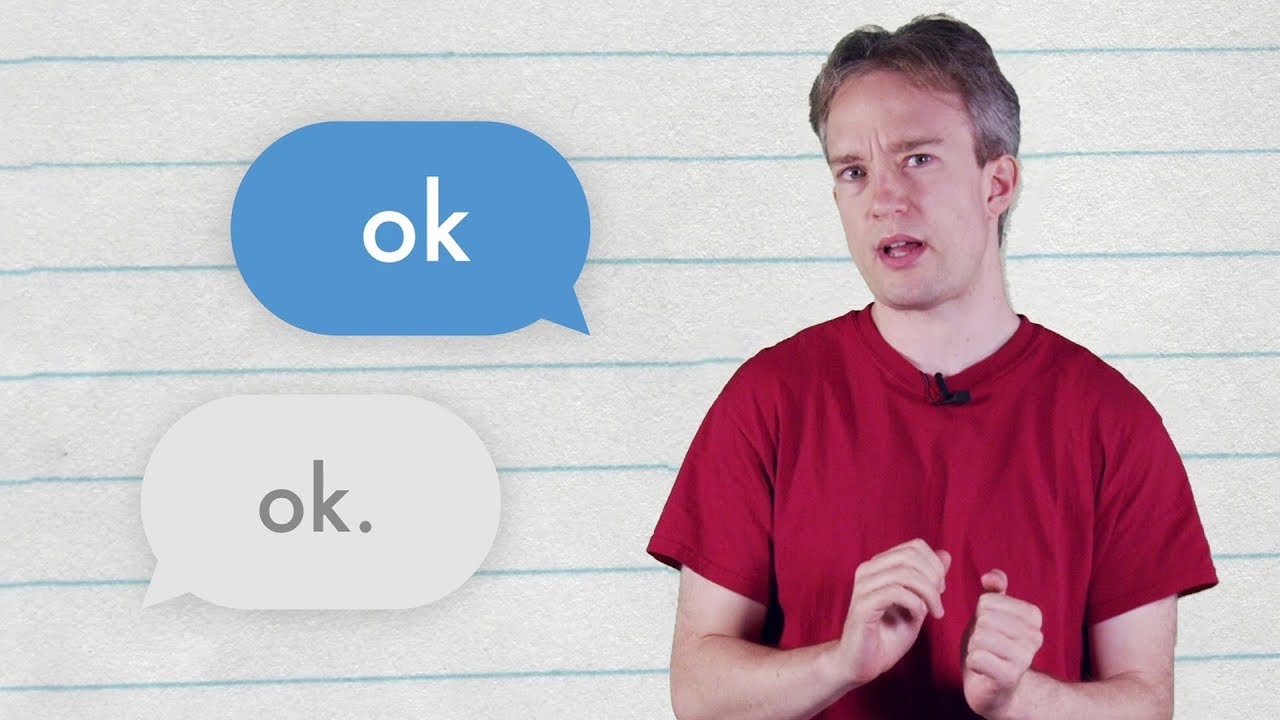
When you made that comment about ALL CAPS IS SHOUTING, I realized why final periods sound odd to me in a text message. It sounds like when someone is talking and ends the sentence by speaking the word “PERIOD.” As if they’ve said everything there is to be said, and are ending the conversation.
The text medium is more like talking than writing a letter, so it’s not surprising it should have different conventions.
I also realized this is why emails from familiars can be so jarring. It’s an instant medium, but the formality range runs from moderate to high. So when I get an email from, say, a family member or co-worker that I constantly text or Slack, the sudden upshift in tone can seem distant, affected, even imperious.
I thought of it as indicating whether the person finished or not. Sometimes you start a sentence and it peters out, or not.
I had no idea… (Writer has abandoned saying more, use four. Discourse insists on rendering it as three in the preview, however)
I had no idea…but I’ll look into it. (paused, then completed, use three)
If I quote you above but leave out some parts, I use three. Astute readers will wonder if I might be omitting things that would be important to context.
I discovered this is not true. All ellipses are supposed to have three dots…What I thought was a four dot ellipsis was actually a three dot ellipsis followed by a period.
I hadn’t thought of it that way, but it makes sense.
I’ve seen the question mark usage, but never the exclamation mark one.
The OP’s cited article states, “An ellipses is [sic] not a period.” Typo? Then it says, “No ellipses is [sic] really created equal.” Ellipsis-singular, ellipses-plural. “An ellipsis is…” or “Ellipses are…” blah, blah, blah.
If Mrs. L texts me, “Pick up the dry cleaning, put gas in the car” I notice the punctuation error but I know what she means. OTOH sometimes people text in a business setting, so it’s sometimes important to use good punctuation.
ISTM that there are a lot of people who use commas to indicate a pause. Splicing independent clauses together is a common error, of course. Some stop trying, just stringing everything together with a comma, often simply placing them where they would take a breath. They know the comma fest is wrong, though and they’ve been criticized and/or shamed for it. What are the alternatives?
A few get fancier, go for a semi-colon. I remember seeing a poster in an English classroom referring to them as “compers” (comma + period, IOW). That indicates a longer pause than a comma but shorter than a full stop. And you can join independent clauses with them if you’re confident. But most people aren’t.
There are two periods in a colon: buddy, that’s a speed bump and we’re stopping, not pausing. “Look right now: look at what I said! It’s important: I’m ordering you to notice it!” I think people understand it’s too bossy, so it’s off the menu.
So…that brings us…back…to ellipses are…they so…wrong? Done poorly I keep hearing William Shatner in my head. I guess we should give points for trying rather than refusing to insert any kind of punctuation and just making the reader figure it out you know they might even abandon capitalizing words except I which everybody knows is always capitalized unless you’re e e cummings that’s all I have to say about it.
Don’t recall Herb Caen but it seems to me that newly-departed Larry King had a newspaper column that was just a string of random thoughts separated by ellipses. Howard Stern used to do some great riffs on it back in the day.
I have an old friend with whom I exchange emails with (this started back with actual letters) and - based on feedback from her about enjoying what and how I write - I take time to try to use well-crafted sentences and paragraphs.
The responses I get are a series of generally relevant, sequential thoughts, all separated by…ellipses. It’s…maddening to read.
Just writing that made me realize that I use them to indicate where I am pausing, as if I were speaking and pausing to Indicate that I was trying pick the right word.
The usage that I’m familiar with (from traditional writing) is to assume that any ellipsis is NOT part of the original; that’s the reason for using an ellipsis–to show that (for whatever reason) you’ve left out part of the original. In the fairly rare instances where the ellipsis IS in the original, you add this-- “[ellipsis in the original].”
Does anyone bother using the actual ellipsis character U +2026 … rather than just three periods?
For me, it was several years of Colbert quoting the, “dot dot dot dot, dot dot dot,” of a certain prolific Twitter user.
Discourse is your friend! … When you type two (or more) dots, Discourse auto-corrects it to become the true ellipsis of which you speak, just as it auto-corrects two hyphens to become an en-dash – (I think that’s an en-dash) or (c) become the copyright symbol, et many c.
But what type of dashes? I’m partial to the em dash (when used correctly, of course).
That’s’ it.; From now, on it’s’ going to be punctuation by gue’s’s’ work. Entirely random, comma’s’ and apostrophe’s’ in front and behind, every ‘S’…
@Ike_Witt: I’ll ‘s’ee your &po’s’trophe’s’ &nd r&i’s’e you ‘s’ome &mper’s’&nd’s’.
I’vê déçided Î’m góing tõ štárt üsiñg rãndòm äçcént mårks.
The entropy in this thread is getting out of control.
This might be of interest:
No! It CAN be Actual English, and it needs to be! The closer it can stay to that, the less misunderstanding there’ll be.
A decade ago, I sent my millennial daughter a text using ‘abbrevs’, and she texted back: “I’ll reply to you when you can use English.”
A tear came to my eye… someone raised that kid right.
(see, that was a pause there, hence… ellipses!)
Thank you. That was quite helpful
Well argued but that train has left the station. English itself is changing all the time, and the way we use it in different modes of communication changes too. You can’t stop progress. I am wondering if people had similar conversations about English when telegrams were invented.