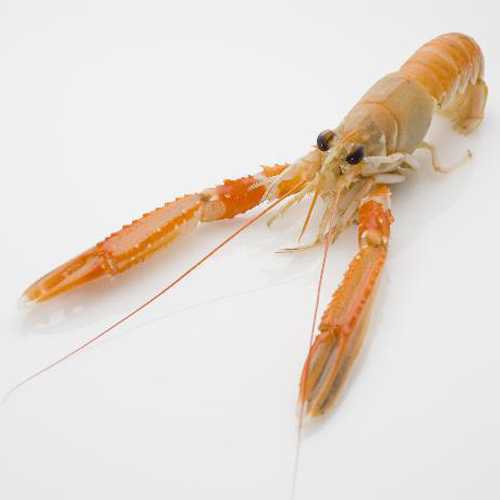
Some time ago I was a reading a book by a restaurant reviewer about his fine dining experiences around the world, and languoustine came up quite a few times. It’s a crustacean that’s larger than shrimp but smaller than a typical lobster, and is apparently considered a fine delicacy. To me it’s a hideous looking thing. I might eat it if expertly prepared in a fine restaurant, but it’s not something I’d voluntarily order.
It’s related to crawfish but not the same. Langoustine lives in saltwater and comes from the ocean. It’s larger than a crawfish and supposedly prized for its delicate flavour. Google informs me that in some parts of the Caribbean and southern US, crawfish is sometimes referred to as “langoustino”, but it’s not a true langoustine.
Langoustine was a fairly common item in California restaurants when I was a kid in the 1970s. Still is, I think. I remember the commercials for “all-you-can-eat langoustine” at some seafood chain restaurant. It’s also an extremely common substitute in pasta dishes that might otherwise feature shrimp or lobster.
If that was the Venezian version, there’s a big difference: The Iberian dish is made from salted and dried cod (bacalao/bacalhau/klippfisk), while the Venezian version is made from dried, unsated cod (stoccafisso/tørrfisk AKA stokkfisk). The latter is bland, the former can be quite tasty if it’s soaked just enough, leaving the right amount of residual salt
And it’s my favorite version of fried crustacean besides soft shell crab. I imagine that if you’re not excited by langustino or crawdads, eating a soft shell crab is akin to eating a tiny deep-fried Eldritch horror.
I’ve had lengua (tounge) tacos many, many times. Very nice when it’s done right, but it can be like rubber bands if it’s overcooked or cooked too fast. So I usually only get it when I’m at a taqueria that I’ve been to a few times and was happy with their other fillings.
Buche (pig stomach) tacos are awesome when done right. Almost too soft and tender to believe. When I first had them, I asked what buche was. The nice lady at the (sadly now closed) No Te Levantes Honey taqueria explained “The pig has an organ like the gizzard, it’s made of that.” Now, I know that the pig has quite serviceable teeth, so I knew was probably getting stomach. Man, sliced thin and fried just right, it’s one of my favorites now.
One that I plan to have is chapulines (grasshopper) tacos. By chance (trying new taqureias), I finally found a taqueria that serves them near-ish to me, but I had already made my order before I noticed them on the menu. I have one co-worker in Mexico City that says they’re his favorite, and another who says they’re ok, but they don’t really taste like anything. Even on the direct route, I have to drive past at least six other taquerias to get to it, though (Oak Cliff is taco heaven), so it will probably be a week or two before I get back there.
I remember Gordon Ramsay trying Surstromming on one of his culinary adventures. A tiny, tiny sliver of the fish on your tongue is apparently how it’s supposed to be eaten, and he seemed to like it once he got past the overpowering odor of ammonia.
Have you ever read the story of how Carver attended a meeting of prominent agronomists in (I think) Washington, DC? He was (of course) ignored at first because he was “just a Negro” from a small college in the South. But he stole the show when he got up and began his presentation on the use of the peanut. If I recall correctly, he was allotted only 15 minutes once he got on stage, but the demonstration lasted at least an hour at the insistence of his colleagues.
I read the story when I was in junior high and have never forgotten it.
In case you’re concerned about getting a steady supply of chock-full-of-goodness (and microbes) raw milk, fear not. Amos Miller’s Amish farm in Pennsylvania, in spite of being shut down in PA (a lawsuit by the state is apparently still grinding on), is still shipping raw milk and cheese to out-of-state customers via Fed Ex and UPS (their drivers are having a bit of trouble adjusting to delivery by horse and carriage). There’s plenty of nutritional goodness in Miller’s dairy and other products! (those who were sickened probably did something wrong or deserved to become ill).
If you were wondering how an Amish farmer could operate a (relatively) sophisticated website, wonder no longer. Oh, and Amos Miller will sell you raw camel’s milk too, “straight from the udder”.
In the last two months, 11 Louisianans became sick after drinking raw or unpasteurized milk — two of those patients were hospitalized. There have been no reported deaths.
The Louisiana Department of Health is investigating the illnesses, reportedly coming from three different “milking operations” in Louisiana.
If you’ve ever read Up Front by Bill Mauldin, the Stars and Stripes cartoonist of WWII, you’ll remember his story of how he showed a French (or maybe Italian) farmer how to milk a cow in “the best New Mexico fashion” in exchange for a bucket of milk. Quoting from memory, he ended it by saying “He was well satisfied, as was I, since it was the first fresh milk I’d drunk since I left the States.”
In nearly 120 posts, I don’t recall seeing something else I love but makes my wife cringe: gristle and cartilage. It especially grosses her out when I describe the little bits of cartilage in ribeye steaks as ‘beef gum’.

 Man, sliced thin and fried just right, it’s one of my favorites now.