The Straight Dope

Go Back   Straight Dope Message Board > Main > General Questions

Reply
 
Thread Tools Display Modes
  #1  
Old 06-25-2011, 06:03 PM
Fiendish Astronaut Fiendish Astronaut is offline
Guest
 
Join Date: Jan 2001
Why So Many Nuclear Tests?

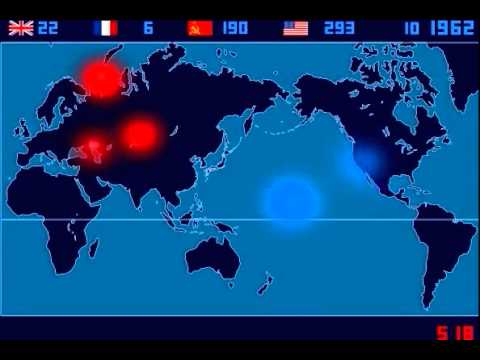
I've just been watching this video by Japanese artist Isao Hashimoto. The video is a time-lapse representation of every nuclear explosion on Earth between 1945 and 1998.

http://www.youtube.com/watch?v=LLCF7vPanrY

It's 16 minutes long but according to this the United States exploded 1032 nuclear devices and the Soviets 715. Why was it necessary to conduct so many tests? Was this just Cold War posturing or was there a scientific reason behind each one? Surely if the UK and China could attain nuclear capability from just 45 each (albeit, no doubt, with some help from their more nuclear capable friends) why couldn't the US and Russia?

Extra question: is the 45 tests each figure for China and the UK merely a coincidence?


Thanks!
Reply With Quote
Advertisements  
  #2  
Old 06-25-2011, 06:18 PM
Cheshire Human Cheshire Human is offline
Guest
 
Join Date: Jan 2010
It really only takes 1 successful test to acquire a nuclear capability, just to see if your design works. Most of the tests were to study weapon effects on various things, and to help refine designs to be more efficient.
Reply With Quote
  #3  
Old 06-25-2011, 06:24 PM
Absolute Absolute is offline
There are no absolutes.
Charter Member
 
Join Date: Apr 2000
Location: In flight
Posts: 3,669
Quote:
Surely if the UK and China could attain nuclear capability from just 45 each (albeit, no doubt, with some help from their more nuclear capable friends) why couldn't the US and Russia?
Only one test was necessary to "attain nuclear capability", for the US at least - the Trinity test prior to the bombings of Hiroshima and Nagasaki.

Subsequent tests were used to test new weapon designs. Literally hundreds of designs were developed, to achieve various goals. Some weapons were designed to have a configurable yield, meaning the operator could configure them to produce a certain amount of explosive power. Some were designed to be fired out of artillery cannons, or submarines. Some were designed to be launched into space and then survive re-entry. Some were designed to be especially compact or lightweight, others designed to have a certain shape so that they could fit in a re-entry vehicle with the proper weight distribution. And so forth.

All of these designs required testing in order to achieve confidence that they would work properly. Remember that essentially all weapons were designed before the computer age, when predictive capabilities were fairly low compared to what we have now. And regardless of how much computer power you have, there's no substitute for experiment - dragging a bomb out into the Nevada desert, pointing a bunch of diagnostic equipment at it, and then watching what happens when it goes off.

As computers became more and more widely used, data from nuclear tests was used to calibrate the computer models used to design new weapons, and model the performance of existing ones.

None of this is unusual for the development of any class of device, weapon or otherwise. You wouldn't be surprised if you heard that, in total, the US had conducted 1032 tests of air-to-air missiles from 1945 to 1990, or that the Soviets had conducted 715 tests of various kinds of parachute. Nuclear weapons are not any different.

Last edited by Absolute; 06-25-2011 at 06:27 PM.
Reply With Quote
  #4  
Old 06-25-2011, 09:01 PM
Henrichek Henrichek is offline
Guest
 
Join Date: Jul 2007
Interesting video.

I had no idea the UK tested their nukes in Australia and also Canada (?), or that France performed tests on the African continent. Neither that the US performed so many tests near Japan (which seems quite insensitive).
Reply With Quote
  #5  
Old 06-25-2011, 10:08 PM
Trinopus Trinopus is offline
Member
 
Join Date: Dec 2002
Location: San Diego, CA
Posts: 4,725
Isn't subsequent testing also supposed to be necessary, to check if older weapons are still good? Plutonium decays with time, and there is some question (isn't there?) about how long a weapon can go without replacing the Pu and still remain viable.

(In fact, one of the "strategies" of people who oppose nuclear weapons is to oppose testing, in hopes of increasing the uncertainty of the weapons' viability, in order to reduce the likelihood of anyone actually *using* one! The game-theoretic response, alas, might simply be for a war-maker to launch twice as many, figuring that if a few are duds, he's compensated for that........)

Trinopus
Reply With Quote
  #6  
Old 06-25-2011, 10:19 PM
Absolute Absolute is offline
There are no absolutes.
Charter Member
 
Join Date: Apr 2000
Location: In flight
Posts: 3,669
Quote:
Originally Posted by Trinopus View Post
Isn't subsequent testing also supposed to be necessary, to check if older weapons are still good? Plutonium decays with time, and there is some question (isn't there?) about how long a weapon can go without replacing the Pu and still remain viable.

(In fact, one of the "strategies" of people who oppose nuclear weapons is to oppose testing, in hopes of increasing the uncertainty of the weapons' viability, in order to reduce the likelihood of anyone actually *using* one! The game-theoretic response, alas, might simply be for a war-maker to launch twice as many, figuring that if a few are duds, he's compensated for that........)

Trinopus
The weapons labs refer to this as "stockpile stewardship". They burn through billions of dollars each year developing computer simulations of how warheads age, and performing sub-critical nuclear tests to calibrate the computer simulations (meaning tests in which a nuclear explosion does not occur).

See the following:
IBM RoadRunner Supercomputer
LANL's DAHRT Facility
LLNL's National Ignition Facility

Last edited by Absolute; 06-25-2011 at 10:19 PM.
Reply With Quote
  #7  
Old 06-26-2011, 06:37 AM
EvilTOJ EvilTOJ is offline
Guest
 
Join Date: Sep 2008
Why so nuke sites? Because it's the only way to be sure.
Reply With Quote
  #8  
Old 06-26-2011, 07:01 AM
kanicbird kanicbird is offline
Guest
 
Join Date: May 1999
Intersting video, and that none are in South America.
Reply With Quote
  #9  
Old 06-26-2011, 08:27 AM
Raguleader Raguleader is offline
Guest
 
Join Date: Mar 2003
Since nobody else has posted it, Cecil Speaks regarding nuclear testing.
Reply With Quote
  #10  
Old 06-26-2011, 09:31 AM
Mk VII Mk VII is offline
Member
 
Join Date: Nov 2003
Location: England
Posts: 2,021
The US would not share its atomic data with Britain, thanks to the perceived leakiness of British security, so we had to discover the stuff ourselves with our own tests.
Reply With Quote
  #11  
Old 06-26-2011, 11:18 AM
MikeS MikeS is offline
Charter Member
 
Join Date: Oct 2001
Location: Williamstown, MA
Posts: 3,040
Quote:
Originally Posted by Henrichek View Post
I had no idea the UK tested their nukes in Australia and also Canada (?), or that France performed tests on the African continent.
Agreed, interesting stuff. For those who are interested, I dug up some further Wikipedia links about the tests in more "unusual" locations:Nothing in Canada, though the USSR did once accidentally crash a nuclear-powered satellite there.
Reply With Quote
  #12  
Old 06-26-2011, 11:38 AM
Henrichek Henrichek is offline
Guest
 
Join Date: Jul 2007
Quote:
Originally Posted by MikeS View Post
Nothing in Canada, though the USSR did once accidentally crash a nuclear-powered satellite there.
Ahh. I was just surprised to see the pink blip on the North American continent and made a guess.
Reply With Quote
  #13  
Old 06-26-2011, 12:23 PM
Cheshire Human Cheshire Human is offline
Guest
 
Join Date: Jan 2010
Quote:
Originally Posted by Trinopus View Post
Isn't subsequent testing also supposed to be necessary, to check if older weapons are still good? Plutonium decays with time, and there is some question (isn't there?) about how long a weapon can go without replacing the Pu and still remain viable....
Plutonium has a half life of 200+ thousand years. In 200 years, about 5/100 of a percent will have decayed. That will make 0 difference in the bomb working. The age factor is because of all the other materials in the bomb. They have to have precise physical properties, and stability in long-term storage is far down on the list. Testing old ones is more about "does this metal piece corroding a bit cause a problem?" or "does this plastic bit oxidizing change its required properties?"
Reply With Quote
  #14  
Old 06-26-2011, 02:19 PM
JoelUpchurch JoelUpchurch is offline
Guest
 
Join Date: Dec 2009
What I find amazing is the Soviet Union did over 700 tests, yet antinuclear activists blamed so many problems on Chernobyl. For that matter, the western United States should have been depopulated from our tests.
Reply With Quote
  #15  
Old 06-26-2011, 02:29 PM
MikeS MikeS is offline
Charter Member
 
Join Date: Oct 2001
Location: Williamstown, MA
Posts: 3,040
Quote:
Originally Posted by JoelUpchurch View Post
What I find amazing is the Soviet Union did over 700 tests, yet antinuclear activists blamed so many problems on Chernobyl. For that matter, the western United States should have been depopulated from our tests.
Anything you see from the US, UK, or Soviet Union after 1963 (though not from France or China) is an underground test. Underground tests, of course, are much less likely—though not guaranteed—to have an effect on people on the surface.

Last edited by MikeS; 06-26-2011 at 02:30 PM.
Reply With Quote
  #16  
Old 06-26-2011, 03:34 PM
Stranger On A Train Stranger On A Train is offline
Guest
 
Join Date: May 2003
Quote:
Originally Posted by Cheshire Human View Post
Plutonium has a half life of 200+ thousand years. In 200 years, about 5/100 of a percent will have decayed. That will make 0 difference in the bomb working. The age factor is because of all the other materials in the bomb. They have to have precise physical properties, and stability in long-term storage is far down on the list. Testing old ones is more about "does this metal piece corroding a bit cause a problem?" or "does this plastic bit oxidizing change its required properties?"
Although the composition of plutonium may remain the same, even subtle changes in the crystalline structure can render nuclear grade material more sensitive to decay or create localized pockets of greater neutron capture which may result in a partial or complete "fizzle" (incomplete detonation). Highly enriched uranium is especially sensitive to this due to the slow rate of the supercritical reaction, but plutonium, which always has small proportions of 24-Pu (with a similar thermal neutron capture cross section but much higher rate of decay) can result in both unintentional detonation or "poisoning" the pit by breeding 241Pu and other radioactive isotopes with lower yield. The modulated neutron initiator is also a component that undergoes aging degradation. It is true that the non-nuclear materials are also subject to age-related degradation, especially the chemical explosive lenses, and exploding bridgewire detonators or slapper detonators, as well as non-reactive structural polymers. Mechanical corrosion is not typically a concern as the weapons are stored and processed in a controlled environment and materials are selected for low sensitivity to electrovalent interaction.

However, aging surveillance is mostly performed on subscale articles and, when Arrhenius relationships can be established, temperature-accelerated aging. Aging trends for nuclear weapons require many more test articles and much longer time frames than are typically useful for establishing aging trends, especially establishing the threshold after which weapons may "fall off a cliff" in terms of stability or reliability, which generally can't be established analytically with any precision and have to be established by letting the weapons achieve that age, which is obviously problematic. Testing of weapons is usually done on new or modified weapon designs to ground analytical simulations and provide refinement for estimates of yield. This was especially critical with the first boosted fission and thermonuclear fusion devices, as the rate of reaction was far in excess of the ability to simulate reactions computationally in the 'Fifties and early 'Sixties. (The reasons for this are complex, but basically fission reactions can be calculated on a purely stochastic basis, while fusion reactions require more direct simulation "random walk" type approach that is much more computationally intensive.) By the 'Seventies and the advent of scalar supercomputers it was much easier to simulate fusion reactions, and today you can run sophisticated nuclear "hydrocodes" capable of modeling a fusion device on a desktop computer in a few hours.

Prior to modern computing capability, the only way to obtain any realistic estimates of yield and reliability were to perform testing. Plus, aboveground testing was visually impressive and made for good propaganda in the early days of the Cold War.

Stranger

Last edited by Stranger On A Train; 06-26-2011 at 03:37 PM.
Reply With Quote
  #17  
Old 06-26-2011, 05:02 PM
JoelUpchurch JoelUpchurch is offline
Guest
 
Join Date: Dec 2009
Quote:
Originally Posted by MikeS View Post
Anything you see from the US, UK, or Soviet Union after 1963 (though not from France or China) is an underground test. Underground tests, of course, are much less likely—though not guaranteed—to have an effect on people on the surface.
I know that, but if you look at the timeline, there were a couple of hundred tests done by the Soviet Union before the test ban treaty and over three hundred done by the United States.
Reply With Quote
  #18  
Old 06-27-2011, 11:17 AM
Buck Godot Buck Godot is offline
Guest
 
Join Date: Mar 2010
Quote:
Originally Posted by JoelUpchurch View Post
What I find amazing is the Soviet Union did over 700 tests, yet antinuclear activists blamed so many problems on Chernobyl. For that matter, the western United States should have been depopulated from our tests.

The radiation and nuclear material involved in a sustained reaction is actually quite large compared to a nuclear blast. Nuclear bombs work because they release all of their energy in an instant. A kiloton of energy is 4.184 Terajoules, and each reactor at Chernobyl was putting out 3.2 gigawatts of thermal power, so the energy equivalent of a Hiroshima bomb every 4 Hours 45 minutes.
Reply With Quote
  #19  
Old 06-27-2011, 11:27 AM
Really Not All That Bright Really Not All That Bright is online now
Guest
 
Join Date: May 2003
Quote:
Originally Posted by Henrichek View Post
I had no idea the UK tested their nukes in Australia and also Canada (?), or that France performed tests on the African continent. Neither that the US performed so many tests near Japan (which seems quite insensitive).
(Not very) fun fact: Japanese were the first victims of the atomic bomb and the hydrogen bomb.
Reply With Quote
  #20  
Old 06-27-2011, 12:38 PM
md2000 md2000 is offline
Guest
 
Join Date: Feb 2009
IIRC the US tests did kill quite a few shep in the Nevada - Utah area, and the consensus is they also killed John Wayne. The fliming of his Genghi Kahn epic (The Conqueror) was going on downwind from one of the tests, and odds are it casued the cancer which did him in a few decades later.

The last few French tests in the South Pacific were also done underground.
Reply With Quote
  #21  
Old 06-27-2011, 01:19 PM
JoelUpchurch JoelUpchurch is offline
Guest
 
Join Date: Dec 2009
Quote:
Originally Posted by Buck Godot View Post
The radiation and nuclear material involved in a sustained reaction is actually quite large compared to a nuclear blast. Nuclear bombs work because they release all of their energy in an instant. A kiloton of energy is 4.184 Terajoules, and each reactor at Chernobyl was putting out 3.2 gigawatts of thermal power, so the energy equivalent of a Hiroshima bomb every 4 Hours 45 minutes.
That is an interesting explanation, but this graph indicates that you are incorrect.

http://en.wikipedia.org/wiki/File:Bo...einopenair.png

It indicates that a single fission bomb puts out more radiation than Chernobyl, at least for the first 1000 days and we are talking about 200 bombs. The difference appears to be short lived isotopes, most of which have already disappeared in a reactor, so only the most recent formed isotopes are dangerous.

You should also consider that the Soviet Union was setting off bombs as large as 50 Megatons before the partial test ban treaty.
Reply With Quote
  #22  
Old 06-27-2011, 01:35 PM
aruvqan aruvqan is online now
Charter Member
 
Join Date: Feb 2004
Location: Eastern Connecticut
Posts: 13,344
Quote:
Originally Posted by Really Not All That Bright View Post
(Not very) fun fact: Japanese were the first victims of the atomic bomb and the hydrogen bomb.
And one poor guy got hit with both ...
Reply With Quote
  #23  
Old 06-27-2011, 01:47 PM
Snarky_Kong Snarky_Kong is online now
Guest
 
Join Date: Oct 2004
Quote:
Originally Posted by aruvqan View Post
And one poor guy got hit with both ...
Neither of those was a hydrogen bomb.
Reply With Quote
  #24  
Old 06-27-2011, 02:08 PM
MEBuckner MEBuckner is offline
Charter Member
Charter Member
 
Join Date: Aug 2000
Location: Atlanta, Georgia, USA
Posts: 9,760
Can you imagine, though, if poor Tsutomu Yamaguchi had said "Screw this! I'm going to become a tuna fisherman!" after the war.
Reply With Quote
  #25  
Old 06-27-2011, 03:59 PM
LSLGuy LSLGuy is offline
Charter Member
 
Join Date: Sep 2003
Location: St. Louis, MO USA
Posts: 6,155
Quote:
Originally Posted by Really Not All That Bright View Post
(Not very) fun fact: Japanese were the first victims of the atomic bomb and the hydrogen bomb.
What you probably meant was that one was a uranium-based bomb and the other a plutonium-based bomb. But both were fission, AKA atomic, bombs. Not fusion, AKA hydrogen, bombs.
Reply With Quote
  #26  
Old 06-27-2011, 04:08 PM
LSLGuy LSLGuy is offline
Charter Member
 
Join Date: Sep 2003
Location: St. Louis, MO USA
Posts: 6,155
Quote:
Originally Posted by MEBuckner View Post
Can you imagine, though, if poor Tsutomu Yamaguchi had said "Screw this! I'm going to become a tuna fisherman!" after the war.
The redoubtable and honorable Tsutomu would probably have survived that just fine. Having done so, he would've eventually joined the crew of Ehime Maru and finally met his match: http://en.wikipedia.org/wiki/Ehime_Maru

Sometimes you're just out there minding your own business trying catch a few fish and the strangest stuff happens.
Reply With Quote
  #27  
Old 06-27-2011, 04:26 PM
mlees mlees is online now
Guest
 
Join Date: Oct 2006
Car manufacturers still crash cars every year, despite having hundreds of "real world" wrecks to examine.
Reply With Quote
  #28  
Old 06-27-2011, 04:45 PM
XT XT is online now
Agnatheist
Charter Member
 
Join Date: Apr 2003
Location: The Great South West
Posts: 24,884
Quote:
Originally Posted by mlees View Post
Car manufacturers still crash cars every year, despite having hundreds of "real world" wrecks to examine.
And despite having also crashed thousands of cars themselves in testing. They do that to refine their data and engineer better solutions or test new ideas or systems. Same with the folks who were working on nuclear weapons. They wanted to build them smaller (to put them on missiles or fire them from submarines), more durable, able to be used or stored in more varied conditions, with higher (or lower) yields or with variable and settable yields, etc etc. To do that took a lot of testing. Also, like any weapon, you have to test it periodically to make sure what you have will actually work if you ever need to use it. Right now the Russians have a lot of nuclear weapons but I'm unsure how confident they (or anyone else) are that the things will work if they need them...which rather takes away from the credibility of the threat they might pose.

-XT
Reply With Quote
  #29  
Old 06-27-2011, 05:05 PM
GreasyJack GreasyJack is offline
Guest
 
Join Date: Feb 2008
Of course some of these were so-called peaceful nuclear explosions that tried to find civilian uses for nuclear explosives. The US did a few dozen of these that experimented with using nuclear explosives for excavation and 3 tests (in New Mexico and Colorado) that tried using them for stimulating natural gas reservoirs. The Soviet program was a lot more extensive, to the point that some of the explosions were no longer considered "tests" but were actually applied uses. 239 of the 715 explosions the USSR set off were part of this program.

Now, granted, there's some question as to how serious these programs really were or if they were just ways of continuing research on nuclear weapons in the face of potential weapons-test bans. I think in reading the history of nuclear testing that this is sort of a common theme-- every single test had some stated goal or other, but the actual timing and numbers of tests undertaken often had more to do with sabre rattling than actual scientific or technical necessity.

Quote:
Originally Posted by MikeS View Post
Agreed, interesting stuff. For those who are interested, I dug up some further Wikipedia links about the tests in more "unusual" locations:
Another obscure nuclear test location was Mississippi.
Reply With Quote
  #30  
Old 06-27-2011, 05:23 PM
t-bonham@scc.net t-bonham@scc.net is offline
Guest
 
Join Date: Mar 2003
Quote:
Originally Posted by Really Not All That Bright View Post
(Not very) fun fact: Japanese were the first victims of the atomic bomb and the hydrogen bomb.
Payback's a bitch, ain't it?
Reply With Quote
  #31  
Old 06-27-2011, 05:56 PM
Stranger On A Train Stranger On A Train is offline
Guest
 
Join Date: May 2003
Quote:
Originally Posted by t-bonham@scc.net View Post
Well, except for the fact that virtually none of the people directly affected by either the atomic bombs on Hiroshima and Nagasaki, or the cities that were virtually incinerated by the firebombing campaign by the 20th Air Force, had any direct responsibility or choice about the bombing of Pearl Harbor. The damage at Pearl, while a terrible and underhanded blow, was almost entirely limited to legitimate military targets, while Hiroshima and Nagasaki, while both being of industrial importance, suffered massive civilian casualties. Whether the attacks on Hiroshima and Nagasaki were necessary to bring about the surrender of the Japanese government can be debated--there is at the persuasive argument that the United States was so eager to have the Japanese surrender prior to a Soviet invasion of the Home Islands, which would have resulted in the same kind of uneasy division seen in Central Europe, that they felt pressed to use atomic weapons to bring a quick resolution--but that many tens of thousands of people who committed no wrongful act other than to be living in those cities lost their lives and others horribly maimed and psychologically scarred by the experience is unquestioned. This sort of gloating response is beyond thoughtless and insensitive.

Stranger
Reply With Quote
  #32  
Old 06-27-2011, 07:19 PM
Spoons Spoons is offline
Charter Member
 
Join Date: Sep 2000
Location: Lethbridge, Alberta
Posts: 9,058
Quote:
Originally Posted by Henrichek View Post
Ahh. I was just surprised to see the pink blip on the North American continent and made a guess.
Although Canada has never experienced a nuclear explosion of any sort, it has tested nuclear-capable missiles. In 1983, the United States asked Canada's permission to test cruise missiles over northern Canada. As I recall, the Americans were interested in testing over northern Canada, because it approximated the terrain of the northern USSR. At any rate, tests occurred, as the Wikipedia entry on Canadian Forces Base (CFB) Cold Lake, Alberta, notes:

Quote:
During the 1980s, CFB Cold Lake was thrust into the international media spotlight when CLAWR was used as the target for testing of the newly-developed AGM-86 air launched cruise missiles by the USAF. These missiles were launched from strategic bombers over the Beaufort Sea and travelled down the Mackenzie River valley, closely following the terrain at elevations of several metres above ground level.
It should be noted though, that none of the missiles tested in Canada carried a payload or warhead--tests were merely to determine how well the missiles could hug the terrain.
Reply With Quote
  #33  
Old 06-27-2011, 08:22 PM
Dr. Strangelove Dr. Strangelove is offline
Guest
 
Join Date: Dec 2010
Quote:
Originally Posted by Absolute View Post
Only one test was necessary to "attain nuclear capability", for the US at least - the Trinity test prior to the bombings of Hiroshima and Nagasaki.
Actually, zero tests were necessary. Trinity was a test of the plutonium design dropped on Nagasaki. No test was performed or required for the uranium design dropped on Hiroshima.
Reply With Quote
  #34  
Old 06-27-2011, 08:34 PM
Really Not All That Bright Really Not All That Bright is online now
Guest
 
Join Date: May 2003
Quote:
Originally Posted by LSLGuy View Post
Quote:
Originally Posted by Really Not All That Bright View Post
(Not very) fun fact: Japanese were the first victims of the atomic bomb and the hydrogen bomb.
What you probably meant was that one was a uranium-based bomb and the other a plutonium-based bomb. But both were fission, AKA atomic, bombs. Not fusion, AKA hydrogen, bombs.
No, I meant what I said. Fallout from the Castle Bravo test contaminated a Japanese fishing boat (also linked to by someone above) and killed at least one of the crew, albeit not until six months later.
Quote:
Originally Posted by t-bonham@scc.net View Post
Reported.

Last edited by Really Not All That Bright; 06-27-2011 at 08:35 PM.
Reply With Quote
  #35  
Old 06-27-2011, 08:57 PM
t-bonham@scc.net t-bonham@scc.net is offline
Guest
 
Join Date: Mar 2003
Quote:
Originally Posted by Stranger On A Train View Post
Well, except for the fact that virtually none of the people directly affected by either the atomic bombs on Hiroshima and Nagasaki, or the cities that were virtually incinerated by the firebombing campaign by the 20th Air Force, had any direct responsibility or choice about the bombing of Pearl Harbor.
They chose the government that plotted this attack. That is where their responsibility comes. If you don't want to suffer in wars, don't choose a government that starts wars.

As an American, I despise George Bush, and fought hard to prevent him from becoming President. But once he was President, I (and all the other Americans) must bear blame for all the evil things he did in our name while President.
Reply With Quote
  #36  
Old 06-27-2011, 09:34 PM
Stranger On A Train Stranger On A Train is offline
Guest
 
Join Date: May 2003
Quote:
Originally Posted by t-bonham@scc.net View Post
They chose the government that plotted this attack. That is where their responsibility comes. If you don't want to suffer in wars, don't choose a government that starts wars.
I'll be charitable and assume that you are unaware that the government of Japan was essentially under martial law from 1936 through the end of the war. Even when the government was elected, only a small fraction of the population was eligible to vote, and military and industrial influence served to tightly control the activities of the resulting government. The vast majority of the people killed in the atomic attacks on Hiroshima and Nagasaki had absolutely no influence on the government which elected to attach the US Navy base at Pearl Harbor.

Stranger
Reply With Quote
  #37  
Old 06-27-2011, 11:36 PM
cckerberos cckerberos is offline
Guest
 
Join Date: Jul 2001
Quote:
Originally Posted by Really Not All That Bright View Post
No, I meant what I said. Fallout from the Castle Bravo test contaminated a Japanese fishing boat (also linked to by someone above) and killed at least one of the crew, albeit not until six months later.
Well, kind of. Kuboyama died of viral hepatitis contradicted via blood transfusion. Radiation from the Bravo test was indirectly responsible but really, he was a victim of poor medical care.

(that wiki article is really a poster child example of the flaws of wikipedia)

Last edited by cckerberos; 06-27-2011 at 11:39 PM.
Reply With Quote
  #38  
Old 06-28-2011, 06:22 AM
Sailboat Sailboat is online now
Guest
 
Join Date: Aug 2005
Quote:
Originally Posted by cckerberos View Post
Well, kind of. Kuboyama died of viral hepatitis contradicted via blood transfusion. Radiation from the Bravo test was indirectly responsible but really, he was a victim of poor medical care.

(that wiki article is really a poster child example of the flaws of wikipedia)
It looks like that's disputed...do you have a more reliable cite?

Was the blood transfusion part of his treatment for being contaminated? If so, it seems like saying he was not a victim of the bomb but only of "poor medical care" is the equivalent of saying every US Civil War soldier who died after amputation was not a war casualty.
Reply With Quote
  #39  
Old 06-28-2011, 02:30 PM
LSLGuy LSLGuy is offline
Charter Member
 
Join Date: Sep 2003
Location: St. Louis, MO USA
Posts: 6,155
Quote:
Originally Posted by Really Not All That Bright View Post
No, I meant what I said. Fallout from the Castle Bravo test contaminated a Japanese fishing boat (also linked to by someone above) and killed at least one of the crew, albeit not until six months later.
...
Aaah, I see. Sorry to have misinterpreted your point.
Reply With Quote
  #40  
Old 06-29-2011, 02:16 AM
cckerberos cckerberos is offline
Guest
 
Join Date: Jul 2001
Quote:
Originally Posted by Sailboat View Post
It looks like that's disputed...do you have a more reliable cite?
My statement was a bit less GQ than it should have been.

I agree that it was disputed at the time. But I don't think that's currently the case. Simply put, I don't know of any doctors who still subscribe to the theory of "radiation-induced hepatitis" as the cause of death. Kuboyama's own attending physician walked back from his initial cause of death claims in later years. This journal (in Japanese, sorry) also includes statements by Dr. Akashi Makoto, director of the Japanese National Institute of Radiological Sciences, attributing the death to viral hepatitis an explicitly .

English internet resources for this aren't great; it's not a topic of great interest and even newer publications tend to rely on the same older sources rather than introduce new scholarship (note that your link only has one reference, from 1958. 50 years later, Lapp's is still the only full-length account of the incident in English). Elements of Controversy: the Atomic Energy Commission and Radiation Safety gives what I feel is a fairly neutral (if brief) take on the cause of death (disclaimer: the book is by a respected academic, but was written under Energy Department sponsorship).

My doctoral dissertation is on the Lucky Dragon incident, so I've read a lot of primary documents from the archives. Virtually none of these are on-line, unfortunately.

Quote:
Was the blood transfusion part of his treatment for being contaminated? If so, it seems like saying he was not a victim of the bomb but only of "poor medical care" is the equivalent of saying every US Civil War soldier who died after amputation was not a war casualty.
Now this is something that I would agree is actually in dispute. If I had to summarize the mainstream academic position on this issue it would be: "Kuboyama either died of viral hepatitis contracted during the course of necessary medical treatment or he died of radiation. Either way the US is responsible so the actual cause of death is immaterial." Generally speaking, that Kuboyama died is more important than how he died to most studies of the incident, so most authors side-step the question.

But while I agree that the US government is ultimately responsible for his death, I don't accept the mainstream position because I dispute that all of the treatment he received was necessary. Kuboyama, a man with a history of liver problems and a severely compromised immune system, was given daily blood transfusions over a period of nearly six months without being placed in isolation. That's a recipe for infection. And I can't accept it as the best that contemporary medicine could do because I've read statements by US doctors from both before and after his death saying, essentially, "WTF were they thinking!?"

But my earlier statement was a bit too strident. I should have said that his death was "probably" the result of poor medical care. There is, of course, the possibility that he would have died even if better precautions against infection had been taken.
Reply With Quote
  #41  
Old 06-29-2011, 10:13 AM
Sailboat Sailboat is online now
Guest
 
Join Date: Aug 2005
Thanks for the well-thought-out response.

Quote:
Originally Posted by cckerberos View Post
My statement was a bit less GQ than it should have been.

I agree that it was disputed at the time. But I don't think that's currently the case. Simply put, I don't know of any doctors who still subscribe to the theory of "radiation-induced hepatitis" as the cause of death.
Yeah, "radiation-induced hepatitis" does sound far-fetched to me (although I am not a medical person).

Quote:
Originally Posted by cckerberos View Post
And I can't accept it as the best that contemporary medicine could do because I've read statements by US doctors from both before and after his death saying, essentially, "WTF were they thinking!?"

But my earlier statement was a bit too strident. I should have said that his death was "probably" the result of poor medical care. There is, of course, the possibility that he would have died even if better precautions against infection had been taken.
That put it into some perspective -- not just "poor" but "controversial treatment methods," so to speak.
Reply With Quote
  #42  
Old 06-29-2011, 11:14 AM
Really Not All That Bright Really Not All That Bright is online now
Guest
 
Join Date: May 2003
Quote:
Originally Posted by cckerberos View Post
My doctoral dissertation is on the Lucky Dragon incident, so I've read a lot of primary documents from the archives.
I love the Dope.
Reply With Quote
  #43  
Old 06-29-2011, 03:21 PM
Raguleader Raguleader is offline
Guest
 
Join Date: Mar 2003
Quote:
Originally Posted by Really Not All That Bright View Post
I love the Dope.
Cite?
Reply With Quote
Reply

Bookmarks

Thread Tools
Display Modes

Posting Rules
You may not post new threads
You may not post replies
You may not post attachments
You may not edit your posts

BB code is On
Smilies are On
[IMG] code is Off
HTML code is Off
Forum Jump


All times are GMT -5. The time now is 09:33 AM.


Powered by vBulletin® Version 3.7.3
Copyright ©2000 - 2013, Jelsoft Enterprises Ltd.

Send questions for Cecil Adams to: cecil@chicagoreader.com

Send comments about this website to: webmaster@straightdope.com

Terms of Use / Privacy Policy

Advertise on the Straight Dope!
(Your direct line to thousands of the smartest, hippest people on the planet, plus a few total dipsticks.)

Publishers - interested in subscribing to the Straight Dope?
Write to: sdsubscriptions@chicagoreader.com.

Copyright © 2013 Sun-Times Media, LLC.