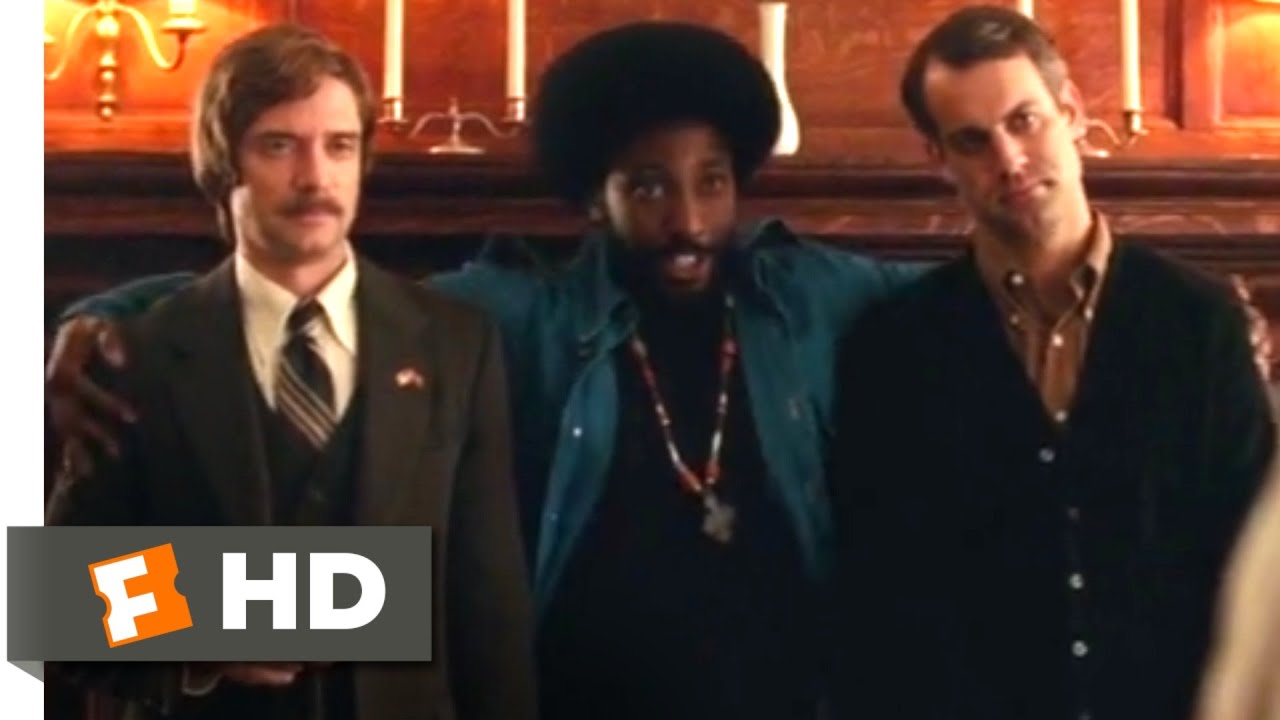
In a movie I saw recently, a black cop (henceforth referred to as “BC” for brevity’s sake) is assigned to provide security to an openly-racist public figure (“RPF”) while he’s in town. BC is, of course, not at all happy about it, nor is RPF, but both men agree to treat each other with the barest bare minimum of professional courtesy in order to get through the day.
At one point, BC decides he wants to pose for a picture with RPF, for the lulz, and RPF agrees. When they pose, BC stands between RPF and RPF’s henchman. But then just as the shutter is about to snap, BC puts his arms behind both men and pulls them close to him.
RPF freaks the fuck out and starts obliquely threatening BC. BC dares RPF to touch him and see how it ends for him. Then cooler heads prevail and the narrative continues.
My question: from where I sit, RPF has a legitimate complaint. I don’t agree with his motivations, but he was grabbed and slightly manhandled by someone to whom he’d not given consent to grab and manhandle him, even if it was for something as mundane as a prank photo op. What’s more, there was no legitimate police-related action taking place that would have necessitated BC manhandling RPF.
I imagine that if RPF had opened up an assault case, he’d have been laughed out of any courtroom outside of the South, particularly in the early '70s, when this took place. But, had this happened today, would he have a case?
There’s the old urban legend, “he poked me with his finger, that’s assault because he touched me!” As I understand it, (IANAL) for there to be an assault from unwanted touching the person actually has to feel threatened; in this case, very difficult to show any evidence this was threatening or could be perceived as physically threatening - size difference, intimidating language or actions leading up, expressions of anger, body language, etc. The exception would be I guess if the person touches sexual areas uninvited, making it sexual assault. None of these apply in this case.
And I’ll note these men were not strangers, voluntarily at a private event. If this guy could sue the cop you could sue your aunt who keeps planting a wet one on you at every family event.
While that scene (the close hugging) in Spike Lee’s recent movie was one of the high dramatic points of the movie and for a big laugh, I highly doubt that it actually happened in the character’s real life.
The common law tort of battery required (1) intent (2) to make harmful or offensive contact with a person, (3) without that person’s consent. The criminal standard is usually higher.
In your example, the cop indisputably intended to make contact with the racist. The racist consented to the photograph. It’s customary when taking a photograph to squeeze in together. So, one issue might be whether by consenting to the photograph, the racist implied consent to the normal amount of personal contact that comes with a photograph. If he didn’t want to be touched, the racist could have said so. For example, celebrity meet and greets often have explicit “no touching” rules just to eliminate any ambiguity.
The second issue is whether the contact is harmful or offensive. Under the OP, there is seemingly no harm. So, it comes down to a determination about whether momentary contact with a black cop while taking a picture could be considered offensive contact. There’s no suggestion that this contact was meant to be offensive. For example, the cop didn’t grope the racist’s balls or hold a knife to his throat in a threatening way. This was just a regular casual contact.
So, I ask again, is the judge/jury sufficiently racist to consider casual contact with a black cop offensive? My hunch is that most American finders of fact would say no. However, Trump won the 2018 election despite his avowed racism. I might be unduly optimistic about how egalitarian any particular American judge or jury is going to be.
RPF is not a District Attorney or other prosecutor. He cannot open a criminal case against anyone. He can ask a DA (or equivalent) to do so, but once the DA understands the facts of this case, there would probably be laughing rather than opening of criminal cases (and this would be Battery not Assault in most jurisdictions, as I understand it).
As Tired and Cranky already said, RPF can sue for damages, and while BC is probably technically liable for any damages, it’s hard to imagine any sane court finding that the damages are enough to bother with.
Did Ron really take a picture with David Duke? Yep, while he was his bodyguard. The scene in “BlacKkKlansman” depicting one of the most awkward Polaroids in history happened almost exactly as it happens in Stallworth’s book. And he really did throw his arms around the shoulders of Duke and another Klansman just as Chuck took their picture. (Later, according to the book, Stallworth called Duke on the phone, again pretending to be white Klansman Ron Stallworth. Duke told him that his interaction with the black cop had been the only negative part of his trip to Colorado.)