Abe Lincoln's last check

It took Mary Lincoln years to get her pension started- Congress had never awarded one before to a President’s widow, and of course they knew that once they awarded her one they’d have to award one to other Presidential widows. They awarded her $3,000, even then not a LOT of money (very comfortable, perhaps $60,000 in today’s money, but you weren’t going to be spending summers in Newport on it). They later increased to $5,000 on the basis that nobody could annoy the living crap out of you until they got their way like Mary Lincoln could.

In fairness to Congress they were not completely heartless for First Ladies whose husbands died in office. With Mary Lincoln, as they had done before for the widows of William Henry Harrison and Zachary Taylor and as they did later for Mrs. Garfield, they awarded the widow’s their husband’s entire salary for the year they died. Mary Lincoln, in spite of her very loud and very frequent cries that she was living in poverty, was actually fairly well provided for by Lincoln (who had made a good living in Springfield then managed to save a good bit of his presidential salary) and used whatever the balance of the $25,000 she was awarded to buy a house in Chicago, which she then spent one night in and checked into a hotel for whatever reason before going off to prove how fantastically disastrous she could be as a money manager.

Her son Robert took complete legal control of her finances after Tad died (which is when she really went off the deep end), paying her just bills and giving her an allowance. She hated him for this, badmouthed him every chance she got, swore that he was stealing her money (he wasn’t) and that she was indigent (in an age when most farmers wouldn’t see $1,000 in a good year she sometimes kept thousands of dollars in cash under her skirts) and that she was in danger of homelessness (utter rubbish- she still had full use of the house in Springfield and lived with her sister who never would have evicted her [though I’m sure she fantasized about it daily] plus many hotels never even charged her in honor of her husband).

For Mesdames Harrison, Taylor, and Garfield, however, the full year salary they were awarded was what stood between them and near destitution. (Harrison and Taylor had the Southern Disease of ‘lots of property, not a penny in cash’, and Garfield left a mortgaged house and some small accounts and a good many debts; Mrs. Garfield received more from his army pension.)

A lot of First Ladies received outright charity over the years; Dolly Madison, due to a total oxygen thief of a son (an embezzler, drunk, total ne’er do well, and con man) would literally have been penniless and living in the gutter were it not for the charity of old friends. Andrew Carnegie actually provided pensions for the former First Ladies that exceeded the relatively small amount Congress alotted; he also subsidized the widows pensions of some Union officers and other men of some renown who died either insolvent or with estates that generated no cash.

Julia Gardiner Tyler was something of an issue to Congress when it came to pensions. While she herself was from a very rich and well connected New York family, she’d been essentially disinherited when she married her husband who, many years after his presidency, became/died a member of the Confederate Congress. Her husband’s considerable plantation was of course near worthless after the war and her only means of support was selling some of her jewels and living with relatives in New York and whatever money she could guilt them out of (which wasn’t much for her own use). Add to this that her youngest children weren’t grown and the older ones needed educating (though here the relatives were more helpful), so she desperately needed the money. On the other hand many in Congress argued that this would be tantamount to giving a Confederate Congressman’s widow’s pension. Again Carnegie came to the rescue, giving her enough that she could say “no thanks” to the U.S. government.

Mary and the White House Budget is a really interesting story that involves the Prince of Wales and lots of really shady (and sometimes just flat illegal) acts. Contrary to popular belief, Lincoln ultimately did not pay for most of her disastrously overbudget redecoration; when he initially agreed to do so he didn’t realize just how much she’d spent. (Why he ever trusted her with it to begin with is a mystery; in 1856 he’d given her permission to add a wing onto their modest homein Springfield while he was gone on his debate tour and with his legal practice for several weeks; when he came back he stood outside the house speechless because instead of adding a wing she’d more than doubled in size, this being perhaps the first time the word “Doh!” was ever used in Springfield.)

First, I’d never heard the phrase “oxygen thief” before, and I really like it. Second, I didn’t know that about Carnegie, and now think even better of him. Thanks, Sampiro!

I bought, back in 1973, the oldest surviving batch of printed checks in the US. Written in 1789.

They were drawn on the Bank of North America(first chartered bank in the US). Philadelphia.

Oxygen thief is apparently a military term as I’ve heard it used most by former USAF friends.

Checked to verify that about Carnegie and learned something I didn’t know: he also gave full salary ($25,000 per year) pensions to ex-presidents. Cite. (I wonder if Grant’s indigence was the catalyst.)

Re: checks-
At one point I think any handwritten document was considered a check so long as the signature and bank account were real. In one of the Ripley’s Believe it or Not books there’s a story about a man who wrote a ‘check’ on an egg and it was honored, but I don’t know the validity of it.

There’s a story about an ambitious young banker who tried to convince Cornelius Vanderbilt, the richest man in the U.S. in terms of cash (his fortune today would be worth well over Warren Buffett’s in terms of percentage of the GNP), into using his bank. Among other things he told him how easy it was for people to forge checks on a rich man’s account. Vanderbilt smiled at him, took out one of his own checks, wrote it out to the man for a sum that was substantial for the time but insignificant for a man of Vanderbilt’s means (let’s say $100 or so), signed and dated it, did everything perfectly, and told him “This isn’t forged, it’s completely legitimate, and if you can cash this, I’ll switch to your bank.”
The man left at a run to make sure Vanderbilt wasn’t able to send a runner to stop payment on it, but when he got to the bank they refused to honor it. He asked “Does Vanderbilt bank here? Is the check good?” and the answer was “Ooooooh yeah” to both. He asked if they thought he was a forger and they said “We don’t know, that looks like his signature, but we’re not going to cash it or there’ll be hell to pay.”

The reason: Vanderbilt never used checks. When he wanted to write one to somebody he hand wrote an IOU on a blank or scrap sheet of paper with his name/signature on it and the bank’s name. What’s impressive is that every banker there knew this and knew to honor it but to disregard checks.

The Library of Congress displays the contents of Lincoln’s pockets at the time of his assassination. The only ‘money’ on him was a Confederate $5 bill (Virginia); it’s unsure why, but probably a souvenir from his recent trip to Richmond.

Regarding the White House expenditures, Congress paid for the most basic upkeep of the place and occasional repairs and roofing jobs, but we’re talking very basic. Thomas Jefferson famously brought some of his own slaves from Monticello to attend him (Sally Hemings not among them, though she had relatives who were) to supplement the free servants and cooks. He was given an allowance by Congress when he had to entertain but he always surpassed it and Congress balked at paying his exorbitant wine and food bills, thus he had to dip into his pocket for a great deal of it. It’s doubtful he saved much if anything from his salary due to his famous extravagance.

A lot of presidents accepted gifts for the White House that ranged from a set of chairs to a one ton cheese given to Andrew Jackson for his famously disastrous “party at my place!” inauguration party. The White House was badly damaged at that party but only cosmetically repaired.

By the 1840s the house’s disrepair began being mentioned by various chroniclers. Varina Davis, wife of Jefferson and frequently a hostess there from 1850-1856 (she got along well with Zachary Taylor’s family [they were Jefferson’s parents-in-law from his first marriage] and along with Jefferson became BFFs with the Franklin and Jane Pierce) mentioned in a letter to her mother that she had to patch several curtains and then switch them around to keep the mending from being noticed because Congress was too stingy to approve new ones (plus Franklin Pierce was drunk too often and his wife too busy writing letters to her dead sons [and too socially phobic] to much care about pressing the matter).

James Buchanan, “the Bachelor President”, presided from 1857-1861. His usual hostess was his niece and he wasn’t much of an entertainer any way so little was done. Until…

In Fall of 1860 Albert, Prince of Wales (the future King Edward VII) visited Canada and the U.S., the first member of the British royal family to do so, and of course it was a MAJOR event. Obviously it was expected he should be entertained, literally, royally, and that meant very expensively. Congress squeezed out a few hundred dollars which even then wasn’t nearly enough to entertain in the style expected for the highest-of-the-high born dignitary like the prince (especially considering that everybody who was anybody and their wife and their brother-in-law expected invitations). Buchanan’s niece asked for more, which Congress balked at (not all of them, but enough of them- remember how relatively tiny the national income was at the time) and James Buchanan basically said “I’m not seeking re-election, so whatever happens in the election a few weeks from now I’m out of a job come March, and any money I personally have is going to need to last me til the end of my life when I want to leave it to my relatives and church, and besides this isn’t my personal house and the Prince isn’t my personal guest, so I hope he likes baloney sandwiches and Kool-Aid”. Finally they appropriated a bit more, but it was so late they weren’t able to do much besides pay for the food and the entertainment and- true story- buy some new sheets for the Prince’s room because there wasn’t a sheet to be had in the White House that didn’t have stains or rips or a stench.
The Prince was gracious, but papers on both sides of the Atlantic referred to the shameful condition of the White House. It was a national embarrassment, so much so that in 1860 Congress actually appropriate $20,000 for new furnishings/china/fabrics/etc. for the White House, with the job of spending and overseeing it going to whoever became First Lady in 1860.

Enter Mary Todd Lincoln. When Buchanan gave her the tour of the White House he told her he was delighted the house would finally have a full time lady (his niece and other she-relatives frequently traveled back to Pennsylvania and, as mentioned, he didn’t entertain that much anyway- he was old and fat and sickly, had become far less social after the death of his long-time [del]lover[/del]roommate [Polk’s VP, though he never set foot in D.C. as he died early in his term]), and that he hoped she would make the house a top priority. And she took that and ran with it.

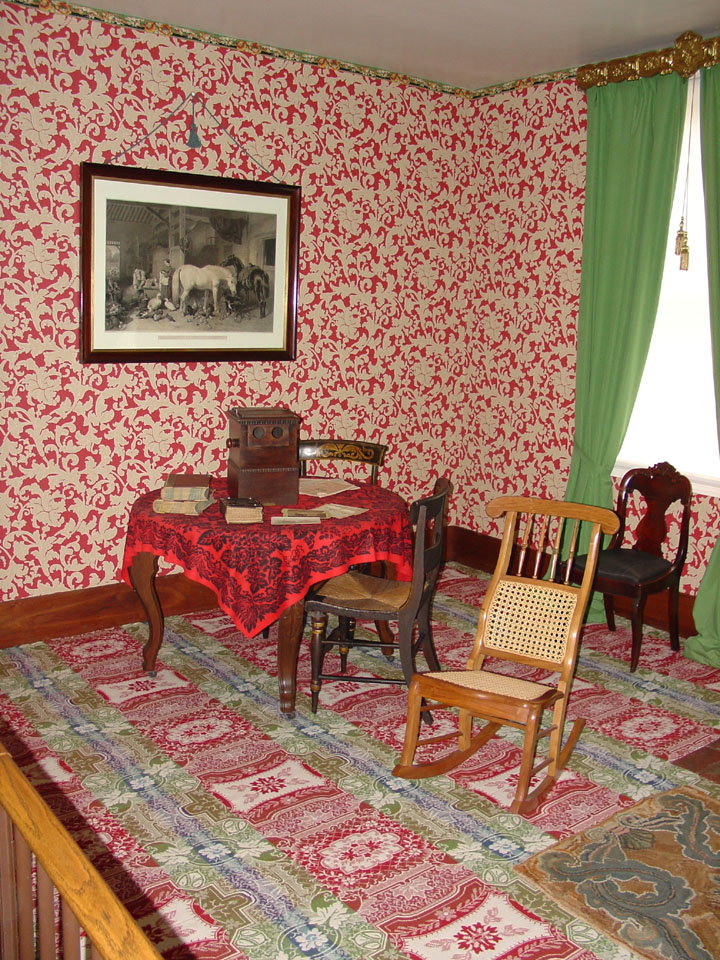
Mary Lincoln was known to be a woman of great taste. It’s one of those times when you really have to remember how much tastes change over the centuries, because a look at the parlor or the bedroom of her Springfield house would make you hoark, but it was considered the height of fashion (at least for a provincial house) at the time. Lincoln knew all too well that working on a budget wasn’t something Mary did well, but he was probably a bit more preoccupied at the seceded states and the situation in Charleston Harbor to make it a really high pri concern.

Pity he didn’t override the decision to let Mary do it though. She went to it with a manic vengeance, but without any kind of ledger. By all accounts the purchases she made were lovely, really looked great, gave an air of sophistication the place had never had, and people wondered how she did it on $20,000, which of course she didn’t. Bills started coming in daily, then threats to sue, and along with the drunk corrupt butler she befriended she did some antics worthy of Lucy and Ethel to keep Lincoln from noticing (and of course the war helped). In something that makes generations of later curators and antique lovers cry a collective “Nooooooooooo!” she held a huge yard sale (well, not yard so much as empty warehouse near the White House sale) of the old displaced furniture; admittedly much of the furniture she sold was damaged or in poor condition but still, when you think of items that had been in the White House since John and Abigail Adams going for a couple of dollars here and five dollars there [and they actually did sell for more than they’d have been worth because they were White House cast-offs, though provenance would be hard to prove as many people who claim to have items bought at this time have learned] and paid a few bills, but nowhere near enough.
Another trick of hers was to not report it to the accounting office when maids or footmen resigned or were discharged but to keep their salary coming, just now directly to her or the butler. Helped a little, but servants made shite in those days, so again not much.
Ultimately [del]Ricky[/del] Abraham found out that she was over budget, then asked her how much, and she responded “Not a lot… just… sixty…eight…”
“Sitty eight dollars! Aye yi yi…”
“Sixty-eight hundred… and fifty eight dollars…”
“DIOS MIO!” and Lincoln had one of his few fits ever with her in front of witnesses, yelling about how there were soldiers with holes in their shoes and no blankets and the gall of her expecting him to ask Congress to vote more money to buy “flub dubs for this damned old house!” which was already furnished just fine when they came here and certainly better than their home in Springfield and etc. etc… He agreed to personally pay the $6500, which he could afford to do though it would sting. (Her going overboard on the house in Springfield had wiped out much of their cash [which, in fairness, much of it was her’s anyway due to inheritances from her wealthy father, her grandmother, and an aunt, but as they didn’t have a prenup by the law of the time Lincoln could have claimed it all). Add to this that she had also paid a bloody fortune for new gowns and gloves (which she bought over 1,000 pairs of while First Lady) and clothes for their boys which had already made one hell of a dent in their first year’s salary.

Lincoln might would have even done it, except… that $6,858 was only the first overage he knew about. The real overage turned out to be closer to $20,000, or double the amount allotted. It’s unknown exactly how much he paid out of pocket, but it wasn’t most of it- he had a political ally quietly slip it in to a huge bill for war items and when you’re talking about millions of dollars a few thousand doesn’t get noticed much.

OTOH, she did a great job of decorating by pretty much all standards. Even Mrs. Grant, who loathed Mary with a passion (the reason U.S. and Julia turned down the invitation to Ford’s Theatre in fact) complimented it. (Julia Grant loved being First Lady, and late in her life after their husbands were dead she became very good friends with Varina Davis; they vacationed and went to theatre together and Mrs. Grant held her hand at the funeral when Varina’s daughter Winnie died.)

There are several detailed sites about Mary Todd Lincoln’s renovations. Here’s a more concise one that discusses some of her purchases.

That was…well wow. Thanks a lot.

All I knew of Julia Tyler is that she had seven or eight children with John. I’m guessing John’s first wife’s 7 or 8 children (he had 15 total) were much older and weren’t pressed for money as much as Julia and the youngins. In fact, wasn’t Julia just as old as John’s eldest son? And that folks had thought Julia was going to be introduced to his son, but that John made a beeline for her? Hearing her story, and thinking women have really come a long way…she today would have at least learn a trade/earned a degree and made a living rather than asking for handouts after being disinherited, oh, and perhaps having fewer children. (made a living: are we counting reality show stardom?) haha.

Stemming from checks being used for 200 years, how old is life insurance?

Speaking of John Tyler, his grandson, no, not great grandson, at least a few years ago, was still alive an operated Tyler’s home Sherwood Forest.

I have been to Tyler’s grave in Hollywood cemetery in Virginia. James Monroe and Jefferson Davis are buried there also. Tyler an Monroe are only about 25-30 feet apart.

Monroe’s casket is above ground and in open view, sealed in a steal/iron vault, but still visible.

You can view it and other famous people at findagrave.com.

History ignoramus here, popping in to say: Dang, Sampiro, I think I just fell in love with you.

glances down to check parts Dammit.

(In all seriousness, thank you for your posts in this thread. They’re the most informative and entertaining accounts I’ve seen on the subject – which are, uh, admittedly few – and if you decide to publish something similar, you have my money.)

Even older: Life insurance - Wikipedia