It used to be that headlights didn’t turn off with the key like everything else. So it was common for someone to inadvertently leave their lights on and run the battery down if it wasn’t caught. Why do you suppose it was like that?
Our Perfect Master addressed this. Short answer: nobody knows, but it was likely due to engineering inertia: early cars were designed that way and the U.S. car companies never bothered to – or were unwilling to pay the extra few bucks per vehicle – to fix the issue until foreign competition and the ubiquity of BCM’s forced their hand (and made it easier/cheaper to do so).
Times sure have changed. I remember decades ago my parents visited friends in Sweden, and marveled over the fact that Swedes drove with their headlights on during the day. It seemed exotic and stupid to us at the time. Now, I get mildly pissed when I see people driving with their headlights off.
BTW, I thought this was going to be a thread complaining about the “let’s permanently blind all oncoming drivers with burning-intensity-of-a-thousand-suns headlights” vehicles increasingly seen on the road, especially trucks. Normal (old-fashioned) headlights don’t do that, even if someone forgets to (or doesn’t have a car that does it automatically for them) dim their brights when a car is oncoming. What’s up with that?
This has been one of my big complaints ever since these LED abominations became standard equipment on most production cars. They’re dangerous and should be illegal!
As for the OP’s question, I think it was just a matter of cost. Every dime of extra cost on high-volume American mass-produced vehicles is subject to a huge multiplier, and things like automatic headlight turner-offers would have cost more back then than today, where mass production of automation makes it cheap and competition makes it mandatory.
My current car has always-on running lights which are separate from the headlights, and the headlights themselves can be set to turn on automatically at dusk or turned on manually. Most cars today turn off any lights that might accidentally have been left on after the ignition is off, including interior lights.
CMIIW, but all it would have taken would be a solenoid switch on the headlight power wire.
I wonder how many improvements could have been made earlier, but were doled out one or two at a time so that people would buy a slightly modified version every year or so.
Which automakers eventually added, but not after decades of a single switched circuit (and a beefy switch given the amp draw) being the norm.
I do have a vague memory of old-timers getting annoyed when headlights started turning themselves off automatically. See, you drive your truck out to the back corner of the farm at night and you’re clearing a downed tree so the cows can access the pasture in the morning. You shut your truck off but leave the headlights on so you can see what you’re doing.
Then at some point, headlights shut themselves off 2 minutes after the car turns off and you have to walk over in the dark and flip the switch on again (that’s how I remember things working in the early 90s, I could be wrong). That was a feature no one asked for and it left the headlight switch in a weird state.
I prefer headlights to be either completely manual (the warning chime is 99% a lifesaver, but even that would be nice to override for the 1% when you want your door open, the car off, and the lights on) OR completely automatic. The in-between stages in the 90s and 00s sometimes missed the mark.
Some cars had that, but usually you could leave the car key in an accessory position and leave the lights on with that. So it should have been a quick adjustment to a new norm for those farmers.
Most cars seem to come in a variety of models, from basic to deluxe. I assume that the basic model was only there to allow them to advertise a price – from £xxxx, knowing that few people would actually buy one.
The deluxe version will have leather seats and a whole raft of electronic and electrical goodies, many of which the driver will never use (or never find out how to activate).
I have also noticed that cars get bigger year on year. Each iteration of a model is slightly larger than its predecessor.
When did they start adding “sport” models that were actually slightly smaller versions of the original cars?
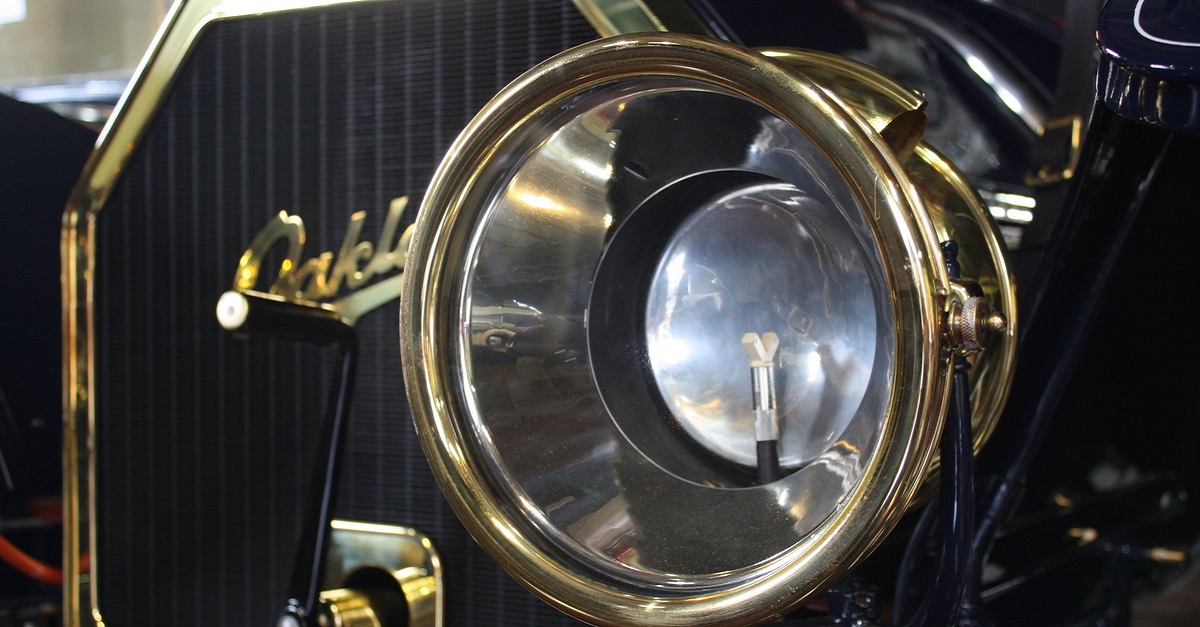
Yestertide they used those carbide headlights:
While the Ford Explorer Sport from the early 90s was a smaller version, it was just a 2 door Explorer. I’d say the first Sport model that was built on a different chassis was the Range Rover Sport in 2005(?).
Big Battery conspiring with Big Jumper Cable.
There is a joke, I am stealing.
Saw a guy leaving his car with the lights on, so I warned him. He said they shut off by themselves.
So do mine after 6 hours.
True, but consider yourself GM in the 70s. A solenoid setup like that would cost about a dollar or more per vehicle. GM built over 1.7 million cars that year. $1.7+ million dollars is a tough sell to the corporate bean counters.
It could have been an ad gimmick. Show a guy with a smirk on his face watch his neighbor in the rain, getting a jump. He smiles because his car has “Auto-Off” (patent pending).
Just to mention that my 2007 Honda lacks auto-off, although it does flash a warning.
When I was in college (~1980), a fellow student went round putting
notes under the windshield wipers of cars with their lights left on
offering to sell them a circuit to give an audible warning if the vehicle
was left with the lights on.
As one who has left their lights on back in the day, I appreciate the innovation. And yeah, it could have arrived sooner.
Does anyone else miss turning on the headlights by pulling that knob. I would find that oddly satisfying to do these days (insert joke about pulling knobs).
I thought the thread title was going to refer to the fact that cars used to all use the same replacement headlight, and it cost $3.49 to purchase.
mmm
I think all car models evolve toward the midsize sedan, to be replaced by a new model that takes the place of the original old one. E.g. compact cars grow year by year to full size, the change being advertised as an improvement, and eventually a really compact model appearrs under a new name; SUVs shrink to “hybrid” vehicles, to be replaced by a new full-sized SUV; etc. It looks like maybe the small hybrid is the new endpoint, although it’s hard to distinguish some of those from sedans.