[QUOTE=Una Persson]
I can’t find any archive of all surveys sent out to all new car buyers. In fact, I’ve never seen one in my life of nearly 40 years.
[/quote]
Really? Everyone I know who’s bought a new car has been buried under them, even my mother, who works for a new car dealer, get’s them by the metric assload whenever she buys a new car.
So? How about offering them as an option? Or just sticking them on there and telling people to deal with it like they do with many other features?
But even you have to admit that there’s no need for you to own a car like the Vette or your Mustang. A diesel or hybrid would serve your needs just as well, without using as much fuel. Of course, it wouldn’t be as much fun, and neither is the 'Vette’s skip shift fuel saving feature which you recommended being removed.
Yes, but we’re talking about people who think that they need a brand new car. Some certainly do, of course, but others could get by with what they have. And consumers have shifting away from the gas guzzlers, but Detroit, just like they were in the 1970s, is still enamored with the big vehicles.
[QUOTE=Throatwarbler Mangrove]
A V10 has 10 cylinders. Arranged in a V shape.
I think Bob Lutz also blames the “closed” Japanese auto market for the relative success of the Japanese competition. Yes, if only GM were allowed to open up some Hummer dealerships in Tokyo. (and factually speaking I don’t think there is actually anything stopping them, what with the WTO and all.)
[/QUOTE]
Are DRLs daytime running lights? I’ve never owned a car that had them. Are they bad? Or are Corvette people just really, REALLY opposed to changes in their cars?
I do believe that my buying habits dictate what’s available. It would be stupid otherwise. “Gee, EJsGirl just shelled out a TON of money for that luxury SUV, let’s stop making them!”
Oddly enough, my brand doesn’t even offer sedans or small cars, or high MPG vehicles (although their parent company does).
[QUOTE=Tuckerfan]
Everyone I know who’s bought a new car has been buried under them, even my mother, who works for a new car dealer, gets them by the metric assload whenever she buys a new car.
[/QUOTE]
I got once once, after I purchased an American car, about 15 years ago. It was my Jeep Wrangler. But only that one time. We had a Ford Explorer and a Mustang for a while, but never got a survey. Of course, I don’t buy the brands that are traditionally thought of as “American cars” anymore so maybe that’s it.
They’re not, as in GM is not allowed to sell Hummers in Japan? I started a thread with that very question not too long ago, you obviously have some kind of cite for this? Because I have seen used Hummers for sale on Japanese used car sites.
Also, I don’t think the comparative popularity (in theory, the guy in your link can’t even buy one due to lack of parking space) of the Hummer amongst a few Japanese hipsters quite measures up to the almost 50% market share that SUVs and Pickup trucks(another type of vehicle rarely seen in the rest of the world) have in North America.
[QUOTE=Tuckerfan]
But even you have to admit that there’s no need for you to own a car like the Vette or your Mustang.
[/QUOTE]
But I’m not the one complaining about a lack of high fuel-economy choices. I’m saying that the poor choices people make drive what is supplied by Detroit (and other auto makers). I accept that the choice of buying 700hp worth of power in 2 cars is not a super fuel-economy choice. I also accept that as long as we want to buy supercars that it’s going to encourage more production of those same cars.
That’s my contention - the market is the dog, and Detroit is the tail. GM, Ford, Toyota for that matter can always be proactive and try to lead the industry - at a risk. You can argue that they should be taking that risk, and I’ll agree. But I also have a lot of trouble finding fault with them for responding to the demand of the folks buying the cars.
[QUOTE=EJsGirl]
Are DRLs daytime running lights? I’ve never owned a car that had them. Are they bad? Or are Corvette people just really, REALLY opposed to changes in their cars?
[/quote]
Yeah, DRLs are Daytime Running Lights. They’re not bad, per se, however, I can think of a number of times when they’re not something you want to have on your car. Like if you’re trying to pull into a driveway late at night and don’t want to disturb anyone (because you’re turning around or don’t want to wake up the kids). Vette owners hated the idea of them because at the time GM introduced them, Vette’s had concealed headlights, and GM couldn’t afford to redesign the cars, so everyone was worried that their Vettes would suddenly become very unaerodynamic. Vette owners are passionate about their cars, and don’t like changes that they think are stupid, but will happily buy a new model if the improvements meet their expectations. (GM does very intensive surveys of Corvette owners, so it’s pretty rare for some thing 'Vette fanatics hate to actually make it into production.
But would you automatically turn your nose up at an optional feature which gave you better gas mileage? Say the choice was between your current Land Rover and one identical to it, save that the other one cost $400 more and had a feature which gave you 10% better fuel economy. Would you go for the slightly cheaper one, or pay the extra $400 to save money on gas?
Nothing odd about it That’s what “brand identity” is all about. Were they to offer a sedan, people would think they were nuts and refuse to buy it.
My mom works for a Honda dealership, and I know people who’ve bought foreign cars who’ve gotten them, so it’s not a US only thing.
“There’s not” as is there is no reason why GM can’t open Hummer dealerships in Japan because they already have them there. I had a Japanese penpal years ago who bought a new Saturn and she lived in Nagoya.
Say the choice was between your current Land Rover and one identical to it, save that the other one cost $400 more and had a feature which gave you 10% better fuel economy. Would you go for the slightly cheaper one, or pay the extra $400 to save money on gas?
[/QUOTE]
10% better fuel economy? So another 1.8 miles per gallon, if that? Doesn’t seem like much of a difference. They’ll have to do better than 10%.
Then again, I don’t buy the cheapest model so I would probably end up with the cool gadget anyway.
But okay, yeah, I would probably pay the extra $400 for it.
[QUOTE=Una Persson]
But I’m not the one complaining about a lack of high fuel-economy choices. I’m saying that the poor choices people make drive what is supplied by Detroit (and other auto makers). I accept that the choice of buying 700hp worth of power in 2 cars is not a super fuel-economy choice. I also accept that as long as we want to buy supercars that it’s going to encourage more production of those same cars.
[/quote]
But, in reality, a lot of what makes supercars 'super" isn’t that they’re technological bleeding edge machines (except in the case of the ultra high-end stuff at the top of the Ferrari, Porsche, Bugatti, etc. lines), it’s simply that they’re tuned slightly different. The Corvette engine usually winds up in a few different GM models shortly after it’s introduced. There’s some detuning involved, usually, but if GM wanted to, they could build all their models to be high powered rockets, and people would happily buy them. They don’t, however. Partly because they’re afraid of what would happen if sixteen year olds got behind the wheel of a car with 400 HP, but also because it would tarnish the prestige of their supercars, unless they did all kinds of exotic work on the cars (and already they’re having to use things like titanium in some models of Vettes to keep them in the performance class people expect).
So who’s saying that they have to give up making SUVs? You and I both know that there’s a lot they could be doing to improve fuel economy without cramming everyone into a tiny SmartCar. If car makers were truly serious about squeezing fuel economy out of cars, then they’d be doing things like installing idle cutoff switches on all their cars and not just the hybrids. If they’re concerned that the public won’t like the idea (and I’m sure that some of them won’t), make it an option.
Well, the 10% is an estimate based on old data, so it could be higher or lower. At $3/gal it wouldn’t take too long for it to pay for itself.
All cars in Canada have been sold with daytime running lights for years now, and it isn’t one single big deal ever. I not only have DRLs, but I turn my headlights on too, because apparently all those SUVs and trucks on the road need all the help they can get seeing my tiny little Corolla.
[QUOTE=Tuckerfan]
Yeah, okay, Bob. You’re the head of one of the largest corporations in the world, you help set policy and have considerable influence,
[/quote]
According to this article, he is the head of product development:
Anyway, it’s possible that he has thought critically, analyzed the evidence, and concluded that catastrophic AGW theory is . . . a crock of shit.
[QUOTE=brazil84]
According to this article, he is the head of product development:
[/quote]
Lutz has basically been given control over GM by Rick Waggoner. Waggoner brought Lutz in from Chrysler because Lutz had done a good job running Chrysler before Mercedes got their mitts on it. On more than one occassion Waggoner has stated that Lutz is the man who’s hand is on the throttle at GM.
And it’s also possible to be a snivelling little wanker who whines and ignores evidence when it’s right in front of them.
[QUOTE=Tuckerfan]
Lutz has basically been given control over GM by Rick Waggoner. Waggoner brought Lutz in from Chrysler because Lutz had done a good job running Chrysler before Mercedes got their mitts on it. On more than one occassion Waggoner has stated that Lutz is the man who’s hand is on the throttle at GM.
[/quote]
I did some news searches for “lutz” and “waggoner” and didn’t find anything. I would ask for a cite, but I’m not sure it matters very much.
True enough. Although those wankers who whine and ignore evidence will pay attention to evidence that confirms their political agenda.
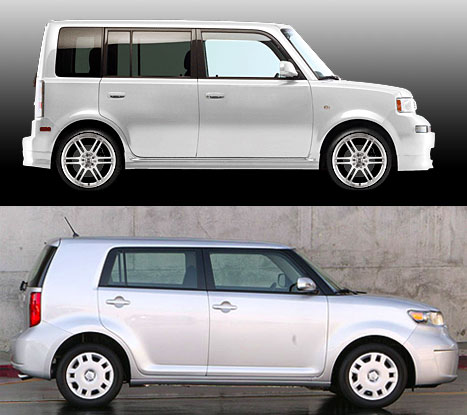
It’s not just Detroit creating low-mileage cars, folks. Even Japanese carmakers are bulking up the vehicles they sell into the American market. Case in point: I drive a 2006 Scion xB, a boxy little thing with gas mileage in the 30s. The current models are bigger, sleeker, heavier, with larger engines and lower gas mileage.
Damn thing looks like a PT Cruiser on steroids now. Gas mileage sucks compared to what I bought. But the new version’s been bloated up to appeal to the American market. I had an opportunity to talk about my dismay at the new models with a Toyota dealer, who explained that the changes were made in response to customer surveys.
I’m with Una: point most of the blame fingers at the people who demand gas guzzlers. The makers are meeting the demand; change the demand and the supply will change to meet it.
The majority of cars sold in North America by Japanese automakers are built in North America specifically for the North American market, and are not sold in significant numbers anywhere else in the world. American automakers sell very few of their North American offerings overseas, but do just fine with overseas-specific models. Chrysler’s Jeeps and minivans equipped with small turbo-diesel engines, for example, are generally well regarded and sell briskly in other countries, but are not sold in the US.
The Japanese home market for cars is in decline - Car ownership was never at the same level as it was in the US, the high cost of fuel and maintanance, aging population and the abundant availability of efficient public transportation makes car ownership mostly irrelevant. I believe the Japanese Dai-san now sell the majority of their cars in the US (and increasingly in China).
[QUOTE=brazil84]
I did some news searches for “lutz” and “waggoner” and didn’t find anything. I would ask for a cite, but I’m not sure it matters very much.
[/quote]
Try Car and Driver or the outher automotive presses. Their stuff tends not to come up in news searches.
Even if you don’t believe in global warming, don’t you want to screw the oil company or gas company or utility company?–Jay Leno
That’s about to change, nearly everybody is going to start selling diesels in the US in the next couple of years.
And the US market is also starting to not matter. By 2015 it’s estimated that the number of cars in China will equal the number in the US.