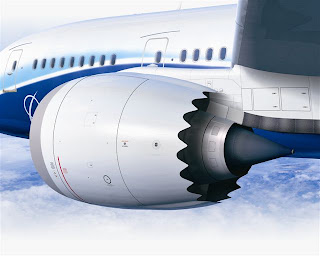
The sawtooth pattern on the trailing edge of the Boeing 787 engines’ ductwork (see here) is said to be an important noise-reducing feature. The latest version of the 747 is being fitted with the same technology.
So what’s the deal? How does this sawtooth feature help cut down on noise output?
Maybe this is clearer: A high-bypass turbofan engine, like the ones used on all modern airliners, has 2 main air streams - the hot, high velocity exhaust from the core, and the cool, slower discharge from the fan, which flows in an annulus around the core. Most of the thrust actually comes from the fan discharge, due to its much higher mass flow, even though it’s slower.
The noise from a jet exhaust comes from the shear and turbulence at the interface between the high-velocity core exhaust stream and the slow fan discharge stream, and to a lesser degree between the fan discharge and the ambient air. By mixing the two main flows, the shear and turbulence can be spread out over a much larger volume and are thereby weakened.
The problem is that the sawtooth feature is at the boundary between the ducted-fan flow and the ambient flow, which you describe as the lesser source of noise. If the larger source of noise is the boundary between the central exhaust stream and the ducted-fan flow, wouldn’t you want to have the sawtooth feature there instead/additionally?
Yes, but there’s much less volume available there to work on.
The sawtooth feature on GE nacelles is only a part of the noise reduction package, and not one of the biggest items. The biggest overall factor, one shared by Pratt and Rolls, is the bypass ratio itself - the larger the fan, higher the fan mass airflow and the higher the overall fuel efficiency, the slower the fan RPM and tip speed. Slower fans are quieter. That’s part of the concept of the Pratt geared-fan engines now coming online - not only can the fan and its drive turbine be optimized for RPM independently, but the slower fan is quieter, too.
While I’m at it, the buzzing sound you hear from older engines is mainly pure-tone and harmonic stuff from the frequencies at which rotor blades pass stator vanes, mainly from the fan but from other stages too. The manufacturers have been getting smarter about avoiding or weakening those interactions. You’ll also commonly see what look like a bunch of little holes inside the inlets - those are entrances into “noise-trapping” cavities (look into Helmholtz resonators if you care), but those are heavier and costlier bandages than eliminating noise sources up front anyway.
i live under the flight path between Paine Field (787 assembly) and Boeing Field - the difference between a 787 and other jets is very striking. Especially when the odd 707 flies over - that is a noisy old beast.