You’re that guy!
Do you know what a pain in the neck it is to be behind you at a light?!?
If you do not live in central Arkansas, please disregard the above rant.
You’re that guy!
Do you know what a pain in the neck it is to be behind you at a light?!?
If you do not live in central Arkansas, please disregard the above rant.
I only do that if I’m the only one on the exit ramp (though I have been in Arkansas quite a bit over the last year for work).
I downshift in an automatic. I just had new tires put on and the original brakes are at 60%. Truck will be 20 years old in 2027. Only 80K miles though.
While I learned to drive a stick in a VW with a balky gearbox and learned to double-clutch my downshifts from the start, you don’t need to double-clutch to rev match a slick downshift. The heel-toe blip technique needed only requires the single clutch stroke that a non-rev-matched downshift would need.
I did a ton of track days in my Lotus and damn near perfected my heel-toe technique and could bang out three or four perfect downshifts at the end of the straight before the 3a and 3b hairpins at my local track. Sadly, my current car, while fortunately still a manual, had that feature where it automatically does a rev matching blip on the downshift. It sounds cool and is slick, but it’s less fun.
In any case, as @LSLGuy says, as long as you’re not crunching the gears on the way down, there’s no appreciable wear from engine braking, and you have the advantage of being in the right gear at the right RPM the entire time in case you need to do something improbable and possible slightly heroic to save the day. Nothing more uncomfortable for me than coasting in neutral. You’re not driving then, you’re just rolling.
Goes double on a motorcycle where I have multiple times had to make that improbable, heroic move when a driver tried to take me out as we approached a stop.
It is not just hills. Truckers will often Jake brake anywhere. So much so I have seen signs on some highways saying, “No Jake brake.” It makes the engines rumble loudly which annoys people nearby.
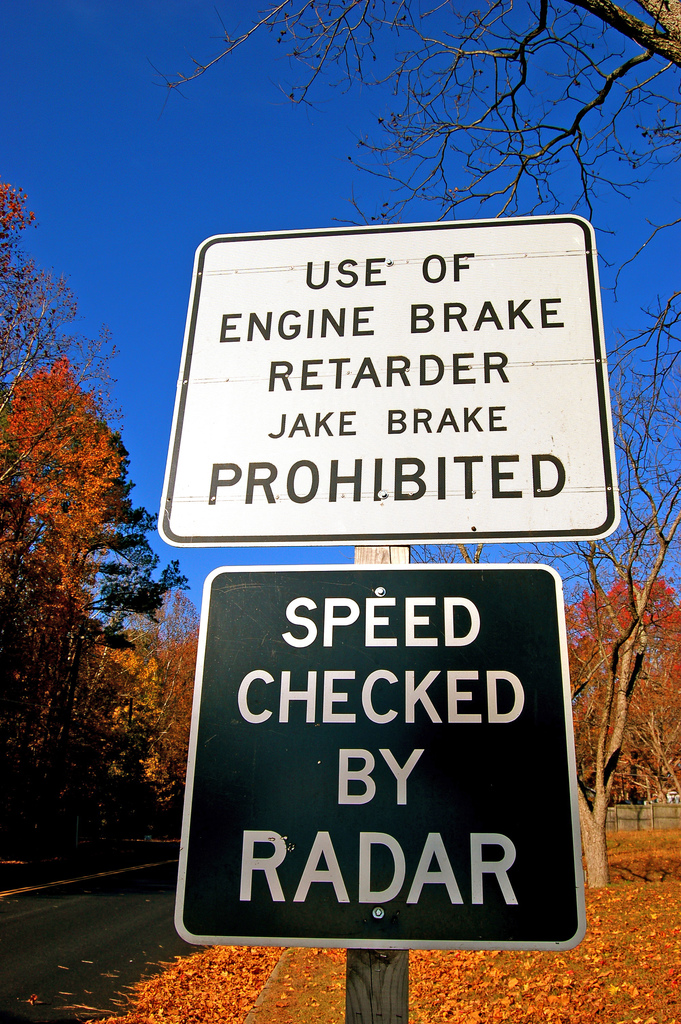
This.
In fact, for the manual car I drove from 2017 to last fall, the Owner’s Manual said to use downshifting to help braking.
I replaced it with a new car having an automatic CVT. Interestingly, when the cruise control is engaged and we start down a long steep hill, the brakes activate for a couple seconds, but then the transmission ratio adjusts to do engine braking. That is, the tachometer starts increasing while speedometer holds steady. In this case, the strategy is entirely up to the car manufacturer, and they are choosing engine braking.
Huh. Finally some useful result from having a tachometer. And here I thought it was pointless.
My '66 MGB has discs in front, and drums in back. I think it was a month or so ago that someone cut in front of me at an intersection. Touted at the time as a great safety advantage (‘Safety Fast!’), they are nowhere near as good as modern brakes. (No, I didn’t hit the guy.) So I do downshift when coming to a stop; except from second to first, because for some reason there is no synchromesh between those gears. (I could double-clutch, but I would have to rev higher than I like to.)
When I learnt to drive in the late 50s, my father owned a Hillman Minx. This was a pretty basic car with a three-speed column gear change. We regularly went to a place where I had to drive up a fairly steep road to a “T” junction at a busy main road. There was no synchromesh between 2nd and 1st gear, so double-declutching was a skill I acquired early on.
Many years later, I was driving an old banger from London to the Midlands when the clutch cable broke. I was able to change gear by matching revs and tried hard to avoid stopping at traffic lights, etc. If I had to stop, I put it in first and bunny-hopped until the engine fired up.
My apologies for too well disguised humor.
I feel like there’s some apples/oranges here - gearboxes are made of hardened metal with copious lubrication; they don’t wear quickly under use. Brakes are explicitly designed to wear.
You’ll wear out multiple sets of brake shoes if you only ever use brakes to slow down; if you downshift (in practical reality this will usually mean using engine plus brakes), will you even wear out one gearbox within the expected lifetime of the vehicle?
Also to consider, for very long downhill stretches, using only the brakes could cause them to overheat and fail, and the outcome of this could be more expensive than both brakes and gearboxes.
Tangential question: I hate it when I’m behind someone who is cruising with their brake lights on. How am I to know if they’re going to suddenly slow down? I’m guessing that they’re using their brake pedal as a footrest for their left foot. How much more quickly do brakes wear out when someone consistently rides them?
Kind of depends. If they are only lightly on the pedal, they could be in that part of the travel where the lights are on but the pads have not yet engaged. In this case they can drive around pissing people off virtually forever.
But if they’re actually putting in a little braking effort, they could ruin things in only a low few thousand miles. It’s the heat. They can warp the rotors, glaze the pads so they work badly, maybe even overheat/boil the brake fluid if it’s badly maintained and has moisture content.
I never did break the habit of downshifting with a manual. Twenty some years in the military didn’t help, and I owned several Jeeps. Never had to replace a clutch or anything major on any of them.
Yes, both my '60s Beetles were like this. But my 2017 Subaru had synchros on all 6 forward gears, and on reverse as well.
Yeah, I had a '65 Ford pickup that had an undiagnosed broken engine mount. This resulted in the cotter pin that held the clutch rod in place being worn through, and then the rod would fall in the road. I could get around to where I could stop by rev matching and shifting without the clutch. Then I had to walk back and run out in the road and grab the rod, then climb under the truck and put it back and put another cotter pin in the rod it attached to. Eventually we figured out that the broken mount was the cause and replaced it.
And of course, I learned the wrong lesson from that experience. I got to where I could shift without the clutch at will. I did it for a few years in my Escort GT. It didn’t seem to harm it, but it would sound nasty if you didn’t get it right. I sold the car with 300K on the odometer, still with the original clutch and transmission. The Ranger pickup we had around the same time had a transmission that was not so stout. It broke an output shaft while we were tooling down the freeway one day. It’s pretty much impossible for that to have been caused by me reflexively shifting without the clutch occasionally in it, and very likely to have been the result of drag strip starts by both my brother in-law and myself. Either way, I stopped beating on the dog ears of my transmissions around that time and started using the clutch like a sane person would.
But yeah, shifting with rev matching causes negligible clutch wear. If you rev match well enough, you don’t even need the clutch.
Yeah! My first RX-7 had an issue for a while where the clutch slave was failing, to the point where it eventually just let go completely. I drove for a couple weeks, including a 500 mile drive to visit my parents, all without a clutch. I’d just use the starter to get rolling away from a stop.
As long as we’re telling stories.
I had a 92 Buick Century where a solenoid on the locking torque converter failed, so the torque converter would stay locked, causing the engine to stall when I stopped. It was intermittent and rarely happened, so I hadn’t investigated what was causing the problem.
Until one day in stop and go ski traffic on I-70 in the mountains. It stalled going uphill when traffic came to a sudden stop. I had to do a series of higher and higher rev neutral drops until I got enough of a burnout to keep the engine from stalling before the car got moving.
To keep it on topic, that was a 3-speed manual, and 2nd would redline at 70MPH or something, so I’d routinely shift from 3rd to 2nd to keep the speed under control when going downhill at 65MPH. With five passengers and skis on the roof the car climbed that hill in 2nd at 65, so I figured it could go down it in 2nd at 65. The transmission itself never gave me any problems.
We called it “slip shifting.” I learned how to do it when I learned how to drive a semi-rig. Trust me, you do not want to use the clutch on those machines unless it is absolutely necessary.
Why is that? Can you elaborate?
Sure thing. Think of a passenger car with a stick tranny. You’ve got a clutch, but there’s not a lot of room in it—you might be able to use it just by flexing your ankle. Or you may have to use your knee, but not much. Pressing the clutch down would be measured in inches. Driving a car with a stick, and using the clutch is easy.
Every semi I drove had a lot of room in the clutch. I’d guess it would be measured in feet. If I put my foot on the clutch, my knee would be in my chest, and when I got the clutch all the way down, I’d be on tiptoe. Necessary, but not something you want to do up through a 15-speed gearbox. I did use the clutch to get the truck going from a dead stop, but I could slip-shift my way up through the gears after that.
With all that being said, I admit that I learned all this about 30 to 35 years ago, and I’m sure that in the years since, technology has made the driver’s job a lot easier with regard to the clutch. I think some trucks now have automatic transmissions. But back then, they didn’t; so if you could find a way around using the clutch, such as slip-shifting, you used it.
