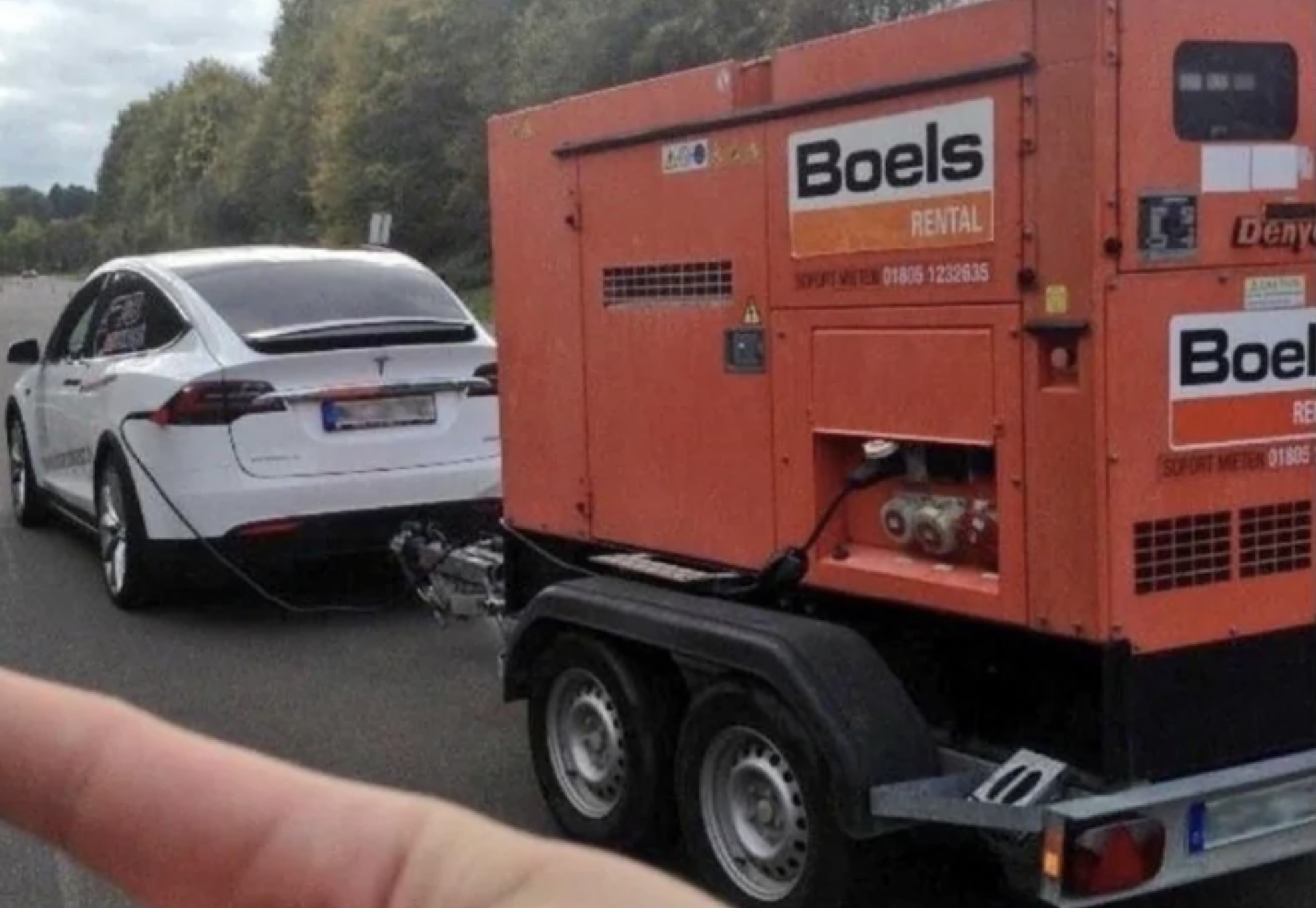
It happens! The electricity units are always confusing to me too.
And wasn’t trying to nitpick you, just pointing out that the DC faster chargers are much faster than level 2 home chargers. The difference is less apparent when you (accidentally) compare 48 A to 350 kW; in reality it’s more like 11 kW vs 350 kW, bigly faster!
Right. What takes me four hours at home takes me twenty minutes at a supercharger. There’s some folk wisdom that primarily using the fast chargers is detrimental to battery health but since most people don’t do that there isn’t a lot of real world data. Anecdotally it may not be that bad but there are very few data points.
I don’t think that particular part is in dispute… most EVs use similar battery chemistry as smartphones and laptops, where we do have a lot of data. Frequent fast-charging does degrade the cell chemistry over time. Any sort of charging/discharging damages the chemistry, but fast-charging is worse.
With any of these devices, the sweet spot is still charging slowly, from 20%-80%, within a temperate temperature range. That said, many new EV warranties still provide for a minimum capacity after X years, fast charging or not, so it may not be a huge deal in the real world. You might get a few % more if you treat your battery very gently over the years, but EVs lose their value so fast that they’re less likely to be kept around very long anyway.
Oh, that video mentions this interesting study of 13,000 Teslas over 8 years, where they found that fast charging basically doesn’t matter: EV Study Reveals Impacts of Fast Charging
Recurrent looked at fast charging in 13,000 Teslas on the road in the US, expecting to see that vehicles that mostly fast charge have statistically lower range and more degradation than vehicles that fast charge infrequently.
We thought we’d see something like this:
This is what scientists expected to see
Instead, to our surprise, our analysis of more than 160,000 data points found that there was no statistically significant difference in range degradation between fast charging more than 70% of the time and fast charging less than 30% of the time. At least not yet.
In the chart below, the blue curve shows the observed range one standard deviation above and one standard deviation below the mean for cars that fast charge less than 30% of the time. The orange curve shows the same but for cars that fast charge at least 70% of the time. The fast charging is not having the negative effect we expected.
So while it matters on an engineering level, real-world, battery management systems will try to prevent you (the driver) from unknowingly damaging your battery too much.
My understanding is that it varies by manufacturer but for most you really are not able to fully charge, your “100%” is in actuality an 80% charge, and the car shuts down before you actually drain the battery enough to kill it.
Ironically enough I have more of an interest in how fast I can recharge for our PHEV than for our BEV.
The BEV can get any full day’s worth of local driving done and recharge overnight. If I have an early work day to and from in the PHEV and then want to drive a few hours later say 20 miles away for something social … I’d love it if the PHEV could get back fully charged in time to keep me from using any gas. I hate using gas … other than on the long road trips.
Yeah, I was surprised to see that PHEVs usually have paltry electric ranges (usually 20-40 mi on electric-only). If they made one with like 100-150 mi range, many drivers would never need to use gas. It’d be a lot better for the battery, too.
In fact I wish they just made EVs with a built-in gas generator, instead of an combustion propulsion motor, that would allow you to pump gas and then charge the battery as you drove
They’re good enough for typical commutes now, but long road trips can still be hard in some parts of the country where there are hundreds of miles between fast-chargers. There might be some L1/L2 chargers at random places in between, but those are frequently out of order (thank god for Plugshare) and too slow even when they’re working.
We had to rent a gas car for such a trip, because there wasn’t any way to get to our destination otherwise without having to do an overnight L2 charge, subtracting a day from our vacation each way.
Once 400+ mi range EVs become more available and affordable, that should be less of an issue. Apparently the Chinese are quite a bit ahead of us (and everyone else), and 300+ mi range is quite normal there already. It’s really too bad we’re locked in a trade war with them… their BEVs would completely outcompete every make we have here, including the Teslas and Rivians.
Huh, when i drive a PHEV, i never worried about range. It claimed 20 electric miles, but i don’t think we ever for more than 16 downhill. I charged it frequently (like, in parking lots) but i just expected I’d burn some gas. And the range was like 600 miles with a full tank. And i knew that i started every morning with enough charge to easily get to a gas station, so i just never worried. And the amount of gas i used was really cheap, i rarely filled up even once a month.
When i sold that car, i did some calculations and realized that about half of all the miles we drove on it were EV, even though we’d used it for a lot of mostly-has road trips as well as routinely burning some gas. And despite it’s tiny EV range.
I started worrying a lot more when i returned to gas-only.
In 5-10 years it’s going to be a complete blood bath for US carmakers. Instead of using their current protected status to develop advanced EVs, the US carmakers are abandoning EVs. Eventually something is going to happen, like BYD buying Nissan, or Stellantis selling rebadged and US assembled Xpeng cars. By then they will be 300-500 mile range, and recharging 10-80% in 15 minutes (if adequate kW can be supplied), starting at $30k.
Or the rest of the world will have that, and we’ll be dealing with 12 year old ICE designs, because the now domestic-only GM can’t afford to develop anything new.
At least the de-fragmenting of the charging network is helping existing EV drivers. As more cars can access both the Tesla Supercharger network and other CCS based networks the places with gaps in charging will shrink, even without adding new infrastructure.
It already feels like that even today… just from browsing YouTube, Asia and Europe already have access to a much larger selection of sensible cars (especially BEVs), vs the needlessly expensive luxury SUVs and trucks we have here that are really just penises on wheels.
What we have feels like the sort of stupid protectionism that helps maybe a few tens of thousands of automotive workers, their CEOs, and of course their short-term investors, at the expense of the several hundred million buyers and drivers. It’s not even just us vs the Chinese… compared to today’s Japanese and Korean models, the US cars already feel like overpriced, unreliable junk. As a taxpayer, it’s aggravating that we bailed GM out only for them to keep making the same stupid mistakes. Gah.
Add in the big one: fossil fuel companies. I think automakers are just along for the ride, and the real target is keeping oil companies printing money for as long as possible. This is reflected in the anti-renewable actions also being taken.
I hope this hijack is acceptable, as the original question in the thread has been answered and resolved (as soon as the delivery arrives).
Let me be absolutely clear - I have ZERO range anxiety. I just love not having to go the gas station, and prefer to use as little gas as possible. Reality is that the only times I’ve had to put gas in current PVEV (a Prius Prime) is during the road trips (Chicago to NJ once and to Detroit once). Most of my daily driving needs are covered in the range I get from a full charge. Today happens to be one of the days that might see me using a bit of gas: short work day, car plugged in now, then going out for an early New Years Eve dinner - between the 20% still in there and the charge it gets in the couple of hours I should het away without any gas - but might not.
The last car, a CMax Energi PHEV, had less range and needed to use gas more frequently, especially in winter.
It also is completely fine for the Prius Prime’s battery. Once it gets low enough to be running in hybrid mode the battery functions as a hybrid battery, keeping to its sweet spot.
Lastly, cars that use the an ICE to recharge the battery rather than to provide propulsion do exist. They get labeled EREVs. The Volt was mostly that way. The market for that set up is especially growing in China, with ranges that you advise!
Are EREVs lower-maintenance than PHEVs, then? One worry I’ve had about PHEVs was having to maintain two separate systems, electric and ICE. Do EREVs significantly simplify that setup, in terms of maintenance burden?
I cannot imagine so. The electric motor maintenance is basically zero. Both need the regular oil change. I would expect an ICE is an ICE for maintenance purposes. Both rarely used for most drivers’ needs. I guess theoretically transmission issues in one and not the other?
No worries, this is IMHO, and the original question has, in fact, been resolved. (I mean, even if the thing doesn’t arrive, i know what my options are.)
Hey, that’s what we had! Ours was a lemon, but other than that, we loved it.
I wonder if a lot of it was driven by the fuel standards, which favored larger cars. But for whatever reason, there are very few smaller cars for sale in the US. Many companies make smaller vehicles, but just don’t market them here.
I should have specified, it’s a completely irrational anxiety. I used very little gas. It probably started out as a game, but I got OCD about it. Plus, my Volt didn’t drive as nice when using gas. Our Prime was smooth and it was barely noticable.
Bought it over the Volt because at that time needed the ability to seat three in the back and the Leaf of the time had only 84 miles range officially, much less in real world, and some daily trips would not have been possible even if most of time it would have been enough. 2014. The CMax Enegi though was built as a hybrid with bigger battery shoved in the back while keeping it front wheel drive. So back weighted and horrible in snow and on ice. And the electric range was never enough to not need gas by the end of the day. That said it is still on the road being used by my daughter. Now just functioning as a hybrid as she has no place to plug in, and its full charge range is under ten miles now anyway, less in winter.
.webp)