Forms of iron, glass and lime can all occur naturally.
Lots of animals have copper-based blood instead of iron-based.
Forms of iron, glass and lime can all occur naturally.
Lots of animals have copper-based blood instead of iron-based.
@md-2000 - I know it’s a fascinating subject, but you keep holding to human / earth based experiences, which are not what we should assume. You say they need a wide body of tinkerers to fix things, but that’s another human assumption, they may NOT have a cultural attitude of ‘good enough for now’ but keep refining on their own.
You worry about information transmission, and passing down information, but you’re assuming said aliens have a finite lifespan, and aren’t capable of transmitting information by any means other than (plant based) books, all of which are again, issue for HUMANS, but not for aliens. For all we know, if they have finite lifespans, they could absorb information by ingestion like the fables about planarian.
If the OP had been restricted to humans and/or Earth - then the answer would be over in the first post - no. We’d be dead, as Earth civilization doesn’t have any survival based capacity w/out plants serving as the predominant oxygen fixers / energy collectors of solar energy. But assuming aliens would be anything like us in terms of tech, needs, society, culture or history is, frankly arrogant and verging on assuming a divine plan.
What works is what happened to work at the time, if everything re-started from the same original point, we’d have different results.
but the counterpoint is - if you can make up anything, then … anything is possible.
I guess the point is to fall back on the standard Science fiction trope. If you suggest A then does B follow?
For example - our experience is that death and reproduction has expedited the process of evolution. A slightly different version replaces each previous generation; with sex (mingling of genes) the successful ones tend to prevail eventually.
If we suggest that the organisms live forever, then what drives evolution? (How did they become complex?) Do they fix themselves? If so, how do they know what the fix is? Do they split and the better ones survive? (Another fun story idea, about a slowly dying off branch of that life tree that split off millennia ago and cannot compete… until the earthling aliens arrive…) Do they do an exchange like bacteria where they absorb some of a fellow bacterial DNA sequence? Instead of sex can they steal useful DNA from those they defeat? Do subservient versions offer DNA as a tribute?
The requirement is not that things be done as humans managed to do things; the requirement in SF (which mirrors real life) is that the explanations be consistent and logical. Otherwise, it is just recto-extractive.
The point is - everything biology does comes with a cost. Our big brains use over 1/4 of the nutrition our body needs. Cheetahs are fast, birds are flighty because they reduce the investment in anything except the attributes that contribute to that - smaller brains… Warm-blooded sea mammals need a very thick insulation layer to survive in colder climates. Peacocks (but not hens) are colourful because that signals good genes and successful hunting, but costs energy. Cows can eat grass that has little nutritional value, thanks to their complex digestive system and help of bacteria, but spend much of their wake time grazing to get enough quantity feed that need. Humans evolved to become hunters and learned to cook - our hunting gave us access to a huge amount of protein to feed our big brains and cooking made it easier to digest, while our fellow apes eat random plants and spend most of their waking hours chewing to get sufficient nutrients out of that.
So if you come up with something an alien does - why? And how is that an advantage? And what does it cost? And how do they fit into their world’s ecology (even if in broad terms)? Where do they get their food?
Yes. That is per the OP - the only thing you can’t have is plants. Although how you would define plants in an alien sense is also problematic. You’re not arguing me, you’re arguing the hypothetical of the OP.
Otherwise we’re in this perpetual loop, you insist that it must work in the same senses of Earth, and I keep saying ‘no, I don’t.’ To quote -
But those are again, assumptions based on how things worked HERE. And for that matter, it’s very higher end animal specific - what about various phages and other organisms that can directly inherit genetic material from others? And you are assuming a singular species, when you could have colony creatures, commensal , etc. As you put it, the whole ‘scifi’ list of possibilities and tropes.
If you want to talk more about how things would be different on Earth, it’s a great point to spin off it’s own thread though. 
I think more we’re arguing both the same thing.
I don’t say it doesn’t work unless it’s like earth, I just say that whatever premise you come up with, has to make sense.
I.e. if they are oxygen-breathing creatures, the oxygen has to come from somewhere. Explain where?
Whatever metabolism they have, they have to obtain their “food” from somewhere. Explain what gives the creatures the energy to carry on life, and where do they get that?
If they don’t die, what means do they use to expand their numbers, adapt to their environment, get ahold of advantageous DNA, etc.
If they use DNA as communication, what means do they use to pass information from creature to creature? How do they put together new data, and how does another creature understand that “GATTACAGATTACA” means “your sunglasses are on your head”?
(Have they evolved a “language”? Does every creature speak the same dialect of DNA? Who makes up new words? etc. etc. Can they understand what ancient DNA tells them, or has the language changed over the eons? ten thousand questions, above and beyond “they use DNA to communicate”. )
I am NOT saying it’s impossible. I’m just saying the devil is in the details, and when you provide details, what are the implications for that form of life? How you flesh out these details will tell you whether this ecological arrangement is feasible. it’s an exercise where you can have great fun fleshing out the details.
I’ll just not that spirulina is a nutritious food that is not a plant and which does not eat plant matter.
What I think we need at this point is the OP - @cjackson - to come back to the thread and give us some rules for the discussion.
How do you want to define ‘plant’ - is it any organism that directly converts sunlight to (chemical) energy [all photosynthesis based organisms in other words ], or just organisms that use chlorophyll as an example.
What level of civilization are we looking at? Because you can have culture and civilization at the stone age, which doesn’t require much investment in industrial development (lots of technique in flint knapping and the like, and plenty of other derived knowledge in practical agriculture and the like). Are we talking bronze / iron / industrial or something equivalent to our own?
Probably want to set some ground rules on how ‘alien’ you want your aliens to be, to cut out some of the ‘sci-fi’ arguments that @md-2000 is rightly concerned about.
Looking forward to more fun!
Yeah, it’s pretty pointless to define plant in terms of Earth taxonomy, since the scenario is supposedly happening on an alien world.
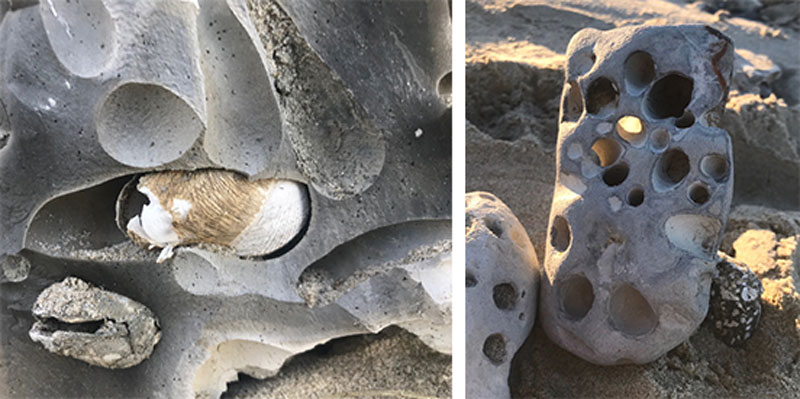
I present the piddock; a rock-boring mollusc.