I definitely remember when it became a household word in the summer of 1993, when a perfect storm of factors led to an outbreak in the Four Corners region. It wasn’t a new disease, and when I went to that region in February and March of 1994 to do clinicals, quite a few people asked me if I really wanted to go there. The answer was YES and it was a great experience. We know now that Sin Nombre Disease (the disease without a name), so dubbed to avoid stigmatizing that region, is now a summertime disease, but that hadn’t been clarified yet at the time.
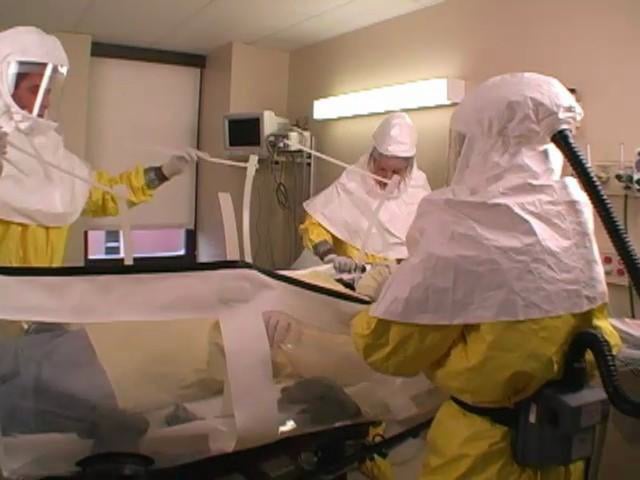
I had been looking for a video I had seen on YouTube about the isolation unit at Nebraska Medical Center, where some American people are going to be quarantined, and finally found it. 25 minutes in length.
I remember reading a long article about hantavirus – I think in Discover – back in the '90s, after the Four Corners outbreak.
It’s a scary disease, but as I understand it, it’s generally not easily spread from one person to another (and even then, only one strain of it can do that). On the other hand, viruses mutate.
You wouldn’t believe how many people told me about that “Discover” story, and I did eventually read it.
One thing I remember is that the Navajo medicine men long knew that the deer mouse harbored a deadly infectious disease, and ordered that any belongings known to have encountered them be destroyed by burning.
When I first heard of a cruise ship with a hantavirus outbreak, I wondered if there was a rat infestation onboard. And then I wondered; are all of the interior walls solid steel, meaning the rats could not easily get around or are they studs and drywall?
Now it appears that someone was infected while ashore for a bird watching excursion. Still person to person transmission is unusual.
I mean there’s a difference between a deadly disease you can catch by standing next to someone in the supermarket line and catch by sharing a cruise cabin, but still there’s a pretty good chance there’s transmissible hantavirus patients wandering round various countries unquarantined.
I’m careful about the topic of hantavirus because the last time I mentioned it, I got in trouble with a moderator. But - to add to what was posted above, how easy is it for a not-so-transmissible virus to evolve to make itself highly transmissible? I’m assuming there must be a reason things like Ebola and hanta typically stay as hard-to-transmit bugs, and not become like measles.
Yeah that’s a good question. Though the strain in this case is not a new strain it’s been known about for 30 years…
Andes virus was first discovered in Argentina in 1995,[6] and is named after the Andes mountain range. Cases were first reported in Chile that same year.[11]
The most common way that hantaviruses evolve is through mutations of individual nucleotides being inserted, deleted, or substituted. Because Andes virus has a segmented genome, it is possible for recombination and reassortment of segments to occur, whereby segments from different lineages mix in a single host cell and produce hybrid progeny
Though of course if this does become widespread in the wider world because of these patients then you have a bigger reservoir of the virus to mutate.
I once worked in a virology lab where the director had done some work on Hanta. It is an RNA virus, and like others it has to have a DNA copy made to act as a template for more viral RNA copies. That back-translation process is error prone, introducing changes that can lead to evolution of the virus. Some of those changes led to animal-human transmissibility, and as with Andes, human-human transmission. Making deliberate changes to increase transmissibility is a Big Deal in virology, and is generally prohibited, despite the valuable information that could come from such an experiment.
Also this. WTF! I first read this as the cruise line doctor but this is a doctor from the French equivalent of the CDC! (If it was the actual American CDC under the current administration I wouldn’t be surprised but their French counterparts don’t have that excuse )
It was slightly ironic to see the World Health Organization take the lead on the response to the hantavirus outbreak, even for the American passengers, given that the US government formally withdrew from that group earlier this year.
Yeah I’m sure none of the current administrations anti-science pro-disease policies are going to have any adverse affects on this or any future disease outbreak
This article, headlined “French woman was told by doctors hantavirus symptoms were just anxiety”, was removed on 12 May 2026 after the Guardian was notified of a fundamental misunderstanding of remarks from Javier Padilla Bernáldez
This popped up in my “suggested” feed last night. It’s very unlikely that it would happen this way, nor will this happen with the Ebola outbreak that’s going on in the Congo/South Sudan/Uganda region. That’s hitting home for me because I know a woman who, along with her husband, sold everything they owned late last year and have relocated to northern Uganda with their 4 minor children (they have 2 adult kids, both married, and one child from each category was adopted out of foster care) to do full-time mission and humanitarian work. I sure hope they remain safe.
Yeah by calculation (having a PhD from the school of “I used to watch a lot of zombie movies”, and so totally qualified to comment ) is that if there were going to be secondary infections outside the cruise ship they would have happened by now.
If course sooner or later there will be another pandemic and we’ll be in the safe hands of Trump’s lackeys and RFK. So everything will be fine
This probably won’t teach anybody here anything they don’t already know or could easily find out if they wished, but I was amused to see this in my feed. “Random,” my butt.
If you’ve never watched Dr. Glaucomflecken before, he’s a treat. And the comments on each video are usually interesting too. He’s very seen in the medical profession.
 )
)
 ) is that if there were going to be secondary infections outside the cruise ship they would have happened by now.

