But, Shodan had a hunch. That’s better than evidence.
At least we now get to see why people shouldn’t be shot based on hunches. Cops have even worse hunches than Shodan here.
But, Shodan had a hunch. That’s better than evidence.
At least we now get to see why people shouldn’t be shot based on hunches. Cops have even worse hunches than Shodan here.
I understand that the prevailing wisdom is that when suspected criminals are shot by cops, regardless of the circumstances, they bear the blame. I disagree with that prevailing wisdom. That doesn’t mean that I think this case would be a slam dunk or anything close, necessarily, but I think it’s entirely reasonable to suspect that this might be a “bad” shooting, in that the cops may not have had good reason to shoot Clark. Our society is broken when this is so damn common, and there’s very, very rarely any serious consequences for shootings that it’s reasonable to believe might have been “bad”.
Maybe cops don’t have to shoot people as often as they do.
I am not necessarily saying that this outcome was inevitable or that it couldn’t have been handled differently. Just like I frequently question high speed automobile chases for the fact that they endanger public safety, I question whether or not it is absolutely necessary for officers to close in on a suspect and subdue him when it is not 100% clear that it’s essential for public safety. OTOH, I could see officers being criticized in other cases if they simply drop their pursuit and then a home invasion occurs later that evening or sometime later in the week.
At minimum, it seemed that the police department’s interest in Clark was reasonable. Clark was given opportunities to demonstrate that he was not someone that officers should be concerned about, and yet he continued to run through the neighborhood in the darkness of night. And when officers did finally reach him, he made one final and fateful decision to run into his grandmother’s backyard, causing even more uncertainty. Maybe I’m wrong but I would imagine that most of us reading this thread would have made different decisions than Stephon Clark did. Had he made different decisions, he might still be alive.
Nevertheless, I would agree that the goal should be to bring suspects to justice alive. Above all else, this should result in calls for widespread improvements in training, not just in Sacramento but everywhere. Training is the issue, and it’s something that should constantly be evaluated and reevaluated. And local police organizations should be strongly encouraged to follow the lead of federal agencies so that there’s a common standard, not thousands of variants thereof.
Stephon Clark was shot eight times, mostly in his back, according to autopsy requested by his family
Stephon Clark, the unarmed 22-year-old killed by Sacramento police officers earlier this month, was shot eight times, with most of the bullets hitting him in the back, according to an independent autopsy requested by his family’s attorneys.
Bullets struck Clark in the neck, back and thigh, breaking bones and piercing his lung, said Bennet Omalu, a forensic pathologist. The bullets combined to make Clark “bleed massively,” Omalu said.
“His death wasn’t instantaneous,” Omalu, who is best known for his role in highlighting concussive damage to football players, said at a news conference Friday. Instead, Omalu said, “Death took about three to 10 minutes.”
www.sacbee.com/latest-news/article207439864.html
Stephon Clark was shot six times in the back and eight times total by Sacramento police officers, according to a private autopsy released Friday morning by his family’s legal team, a finding that may roil emotions in a city already on edge about the shooting of the unarmed black man.
The autopsy found that there were no bullet entries from the front. Instead, the review concluded that Clark was facing a house with his left side to officers when they opened fire and hit him first in the left side under the arm. The force of that round spun him around with his back to officers, and six rounds penetrated his back moving in a forward trajectory, the Clark family legal team said.
The last shot struck his left thigh area as Clark was falling or had fallen, the autopsy found.
Clark family attorney Benjamin Crump said the autopsy "affirms that Stephon was not a threat to police and was slain in another senseless police killing under increasingly questionable circumstances."
He spun around in a threatening manner-they thought he was going to “kung fu” them to death.
This is a good article in the Washington Post
They said they synced up the helicopter and body cam footage and audio. Hell, it looks like most of the shots were when he was already lying down.
Could someone get me a list of all handguns that resemble a white IPhone?
I lie to the cops every time I get pulled over,
“How are you doing today?”
“Great! How about you?”
Obviously my day’s not great, I just got pulled over. And beyond the scope of our interaction, I don’t really care about your day either.
Shodan, do you think it’s reasonable to suspect that the police account is not factually accurate, now that we’ve learned Clark was shot in the back?
By and large, society sees young black men like Clark as disposable. It doesn’t matter to society at large if they are killed by cops – they’re thugs and criminals. If cops kill them and lie about it, who cares? Most of society thinks it’s better off with them dead.
Those are the ones who are supposed to die. So it’s okay when they’re killed, no matter how it happens. It’s all part of the plan.
Until society and culture rejects this, institutions certainly aren’t going to change their policies and practices, including being mostly fine with cops lying about a shooting, as long as they shoot the right people.
Once a single shot is fired, the victim is likely to get angry and may wish to retaliate … or at least cops might fear such retaliation, which is the standard. Therefore once the first shot is fired, then, whatever the victim’s response or even whether there was any initial suspicion, the cops have the right and duty to continue firing until the victim is certainly “no longer a threat.”
Thus, any bullets that entered Stephon Clark from the back are irrelevant. As long as at least one bullet was aimed at his front, it’s a good kill
Do cops carry spare magazines for their Glocks? Given the miss rates we read in some of these articles, I don’t think a single magazine would be enough to guarantee a hit, let alone a kill.
None of the hits can be shown to have been from the front. The piece I read opined that some of the hits might have happened after he was on the ground.
Re: Stephon Clark, for your viewing displeasure,
Autopsy Disputes Police Account of Fatal Sacramento Shooting, CBS SF Bay Area.
CMC fnord!
So… he was just standing there ? Or did he try to run through the wall ?
In case this isn’t in any of the other Stephon Clark links, the infrared camera footage from the helicopter.
CMC fnord!
If he’s in a dark area, then it may be difficult to determine whether an object in someone’s hand is an iphone or a firearm. Officers have to make split-second decisions. I’m not at all saying Stephon Clark deserved to die, but he could have done more to convince officers who were chasing him that he didn’t represent a threat. Search my posts on this topic and you’ll see I’m not an apologist for police culture and officer misconduct, but this is one instance where I might actually sympathize with the arresting officers in this case, which is not to say that the outcome was unavoidable or that they didn’t make mistakes. But whatever errors in judgment they made were also compounded by errors in judgment on Clark’s part as well. As much as we like to trash police misconduct around here, I think it’s disingenuous not to acknowledge the behavior of the suspect.
^^ In that video linked by crowmanyclouds it is stated that in the body camera audio the police are heard identifying themselves only when the other cops have already arrived about two minutes after the shooting.
So maybe Clark was worried about those unidentified, dark clad guys who were chasing him perhaps armed with something and was trying to call police. If he was vandalizing cars he might’ve thought the car owners were coming to beat him up.
A chase is the one time you really, really have to tell it if you’re a cop - otherwise it should be assumed that you’re not and act accordingly.
 Did you miss that Clark was a black man? Even if his attackers were non-cop whites there to lynch, he had a duty to say “Yes, sirs” and let the real Americans have their way.
This video with some narration from a local TV affiliate seems to summarize the situation fairly well (at least from what I can tell):
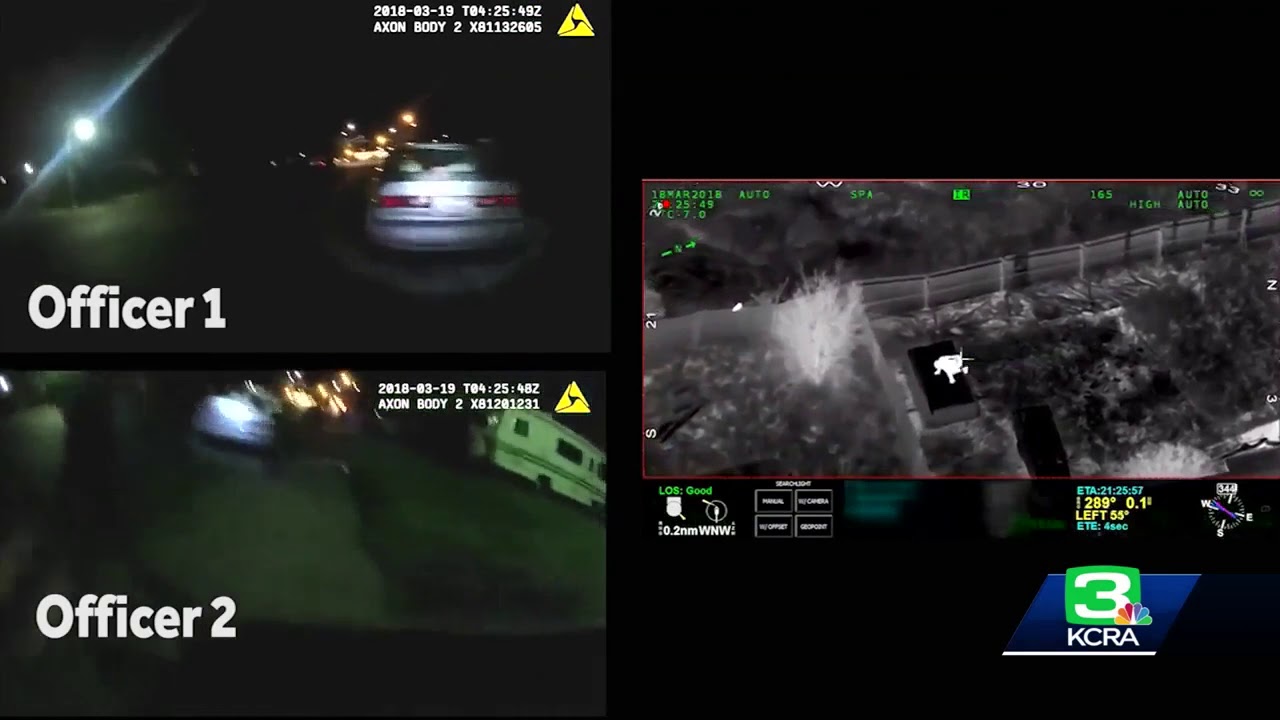
The officers arrive at one property and appear to approach the situation with some caution. They arrive at the property and knock on the front door to speak with the owner and ask her permission to go into her backyard to make sure the suspect isn’t still lurking around. Keep in mind, they’ve acted with reasonable suspicion in responding to a resident’s complaint about suspicious activity. In this case, it appears they’re acting out of concern for the resident’s safety and ask her permission to go into her backyard - so in other words, they’re not just running around the neighborhood with firearms drawn.
The find nobody on her property and go back out to the street to continue moving about the neighborhood where, with assistance from the overhead police helicopter, which has been observing Clark’s movements for a considerable period of time, encounter Clark. It so happens that Clark was already in proximity to his grandmother’s house, but he appears to be on another property at the time when he realizes he’s being followed – why else would he jump over a fence? And did he not notice the police helicopter flying overhead? Helicopters tend to be loud.
Based on what has been mentioned in the news media and the narrative provided by activists, Clark’s family, and his attorneys, one could be forgiven for assuming that police were pursuing one suspect and negligently and maliciously shot Clark as he was sitting in his grandmother’s property, minding his own business, talking on the phone with his girlfriend. That’s not the case at all. What seems more likely (although it can’t be yet proven), is that he was roaming through the neighborhood, breaking car windows, possibly looking for something to steal, and refusing to comply with police commands. I think it’s going to be hard to prosecute these officers individually for their actions.
However, I completely agree that regardless of their guilt or innocence, the circumstances don’t necessarily absolve the Sacramento Police. I agree that there is implicit bias against young black men and that officers often operate on the assumption that black men are dangerous. There obviously needs to be more done in every department across the country and there needs to be a collective effort nationally to reduce prejudice in policing. But at the end of the day, this is a larger social and political problem that has to be address in many different ways. Black men need education and economic opportunities they don’t now have. In so many ways and from a very early age, our society reinforces the notion that black males are “dangerous”.
Another factor is guns. It is the ease and availability of guns that contribute to the climate of fear. I respectfully disagree with the notion that officers acted unreasonably in believing Clark might have possessed a weapon in this case, particularly given his behavior and the prevailing darkness that shrouded his movements. Perhaps if we had far fewer firearms floating around and ending up in the wrong hands, police wouldn’t shoot first and ask questions later.
In the end, though, we have to raise the standard of police conduct and the use of force. We can’t allow officers to use “I was afraid” as an excuse. The primary aim should be “protect and serve” not just “go home alive.”
They also appear to have lied in their account, since the autopsy results contradict it. There should be serious consequences for all the officers involved if this is true.