I’m impressed with the combination locks small size.
Medieval door locks that I’ve seen were quite large and required large skeleton keys.
Link https://phys.org/news/2026-11-ct-scans-reveal-letter-code.html
I’m impressed with the combination locks small size.
Medieval door locks that I’ve seen were quite large and required large skeleton keys.
Link https://phys.org/news/2026-11-ct-scans-reveal-letter-code.html
Does ANCE mean anything, or is it just four random letters?
They couldn’t just try it manually…? It would’ve taken, what, all of half an hour to go through all the combinations?
Was it a matter of it being an antique lock that couldn’t survive more than a few attempts without damage?
I was surprised they had to go to that kind of technology to get the lock open. It seems similar to modern bicycle locks like these:

They might be better now, but I remember back in the 80’s those kinds of locks were relatively easy to crack. By gently pulling it open while turning the dial, you could feel a slight difference when the dial was in the correct spot. Doing the dials one at a time would yield the right combo and the lock would open. Looking at this lock, it seems like that technique should work. I wonder if they asked any locksmiths or lock hackers to try and open it first?
I suspect they didn’t want to risk it falling apart, or getting damaged, so knowing the combination made opening it easier on the lock itself.
Another article stated he had tried to open it:
It seems like it shouldn’t have been this difficult to crack that kind of lock. Perhaps cracking open locks isn’t his forte and he didn’t know what options he had to get the lock open.
“I tried to unlock it for about 20 years, I tried moving the dials, finding the right combinations, and I failed,” he said.
I know who I’m not inviting to the next escape room 
Also, I wonder if this counts as prior art to all the word locks out there:
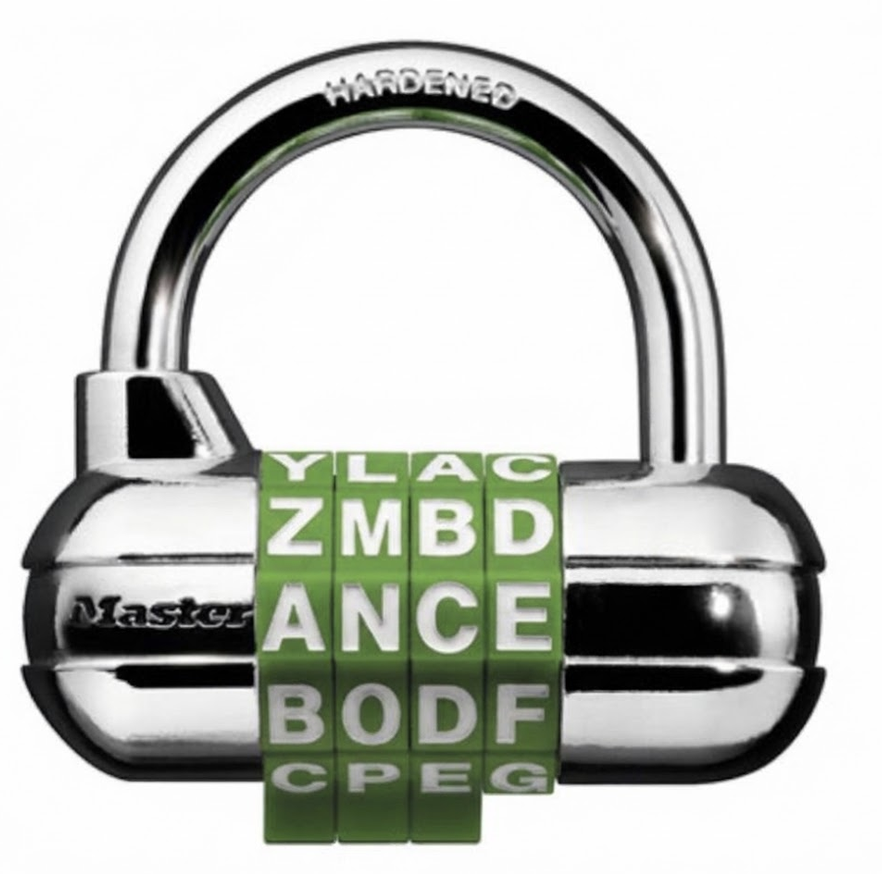
I’ve looked at several articles hoping the ct scan image was published.
It would be interesting to see the handmade interior parts.
Maybe someone could make a copy of the lock?
The Daily Mail article has a few photos: A 400-year-old secret unlocked: CT scans crack the four-letter code on a brass lock recovered from a shipwreck off the coast of Wales in 1583 | Daily Mail Online (open the gallery)
And the video shows it a little bit at 2:55: https://youtu.be/mpi8Ma_GwvM?si=Tp8cTLYxM09xXWTo&t=175 and a few more minutes at 3:45 (this is the best view)
I’ll take a look. Thanks
The video at 3:45 offers the best internal views
Claude made a representative interactive 3D model from the photos and CT imagery we could find: Claude Artifact
You can play around with the mechanism there and zoom/cutaway as you like.
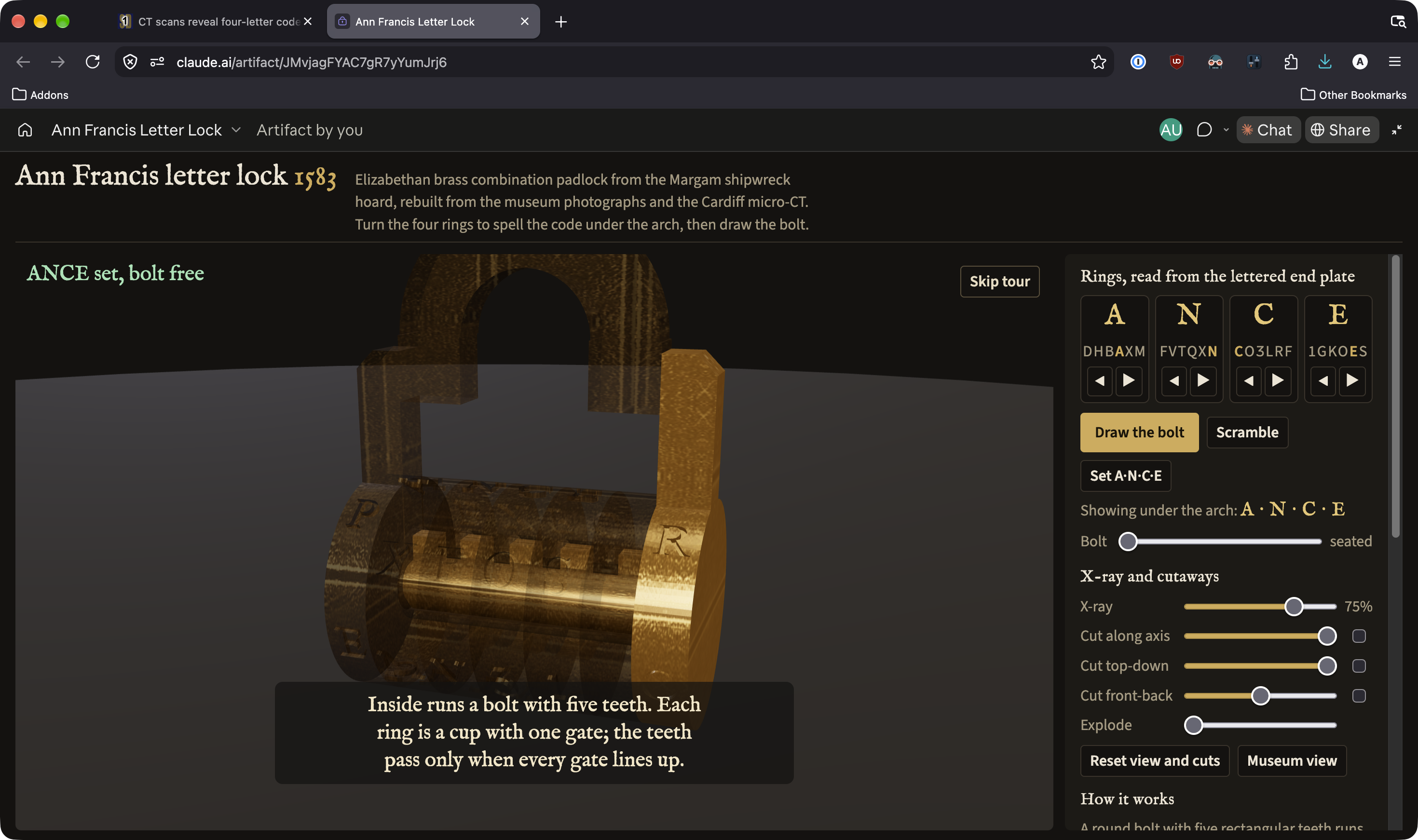
It is a reconstruction based on available photos and similar period locks, not an exact replica, because we don’t have the actual scans.
If you can find the actual CT scans (if the researchers are willing to share them), we can probably make a pretty close 3D printed replica of it.
It doesn’t mean anything in English, Latin, or Welsh. It’s a northern English / Scots form of “once,” but I suspect if anything it’s a nickname: Annis is a name, albeit rare (from Agnes), as is Nancy (from Anne). I can see “Ance” being a form of, or close to, once of those names, or a word ending in -ance (“endurance” is good for a lock)… or just random letters.
There are two “locked” letters before and after ANCE, btw.
So the whole word would probably be something more like
_ A N C E _
The left blank could be one of PEƷDA. The right could be one of ROGCB
But they don’t move and might just be a decoy: Code cracked for Margam shipwreck padlock solving 400-year-old mystery
“Also, confusingly, there are other letters on the ends which don’t move, which are unrelated, and it’s like they were to mislead any potential burglar,” he added.
So it could be DANCER, with only the -ance- moving.
Yep, that’s one of the internet’s speculations so far, but the geometry doesn’t seem to work. The spinning dials are 6 letters and the endcaps are 5, and their orientations don’t line up that way:
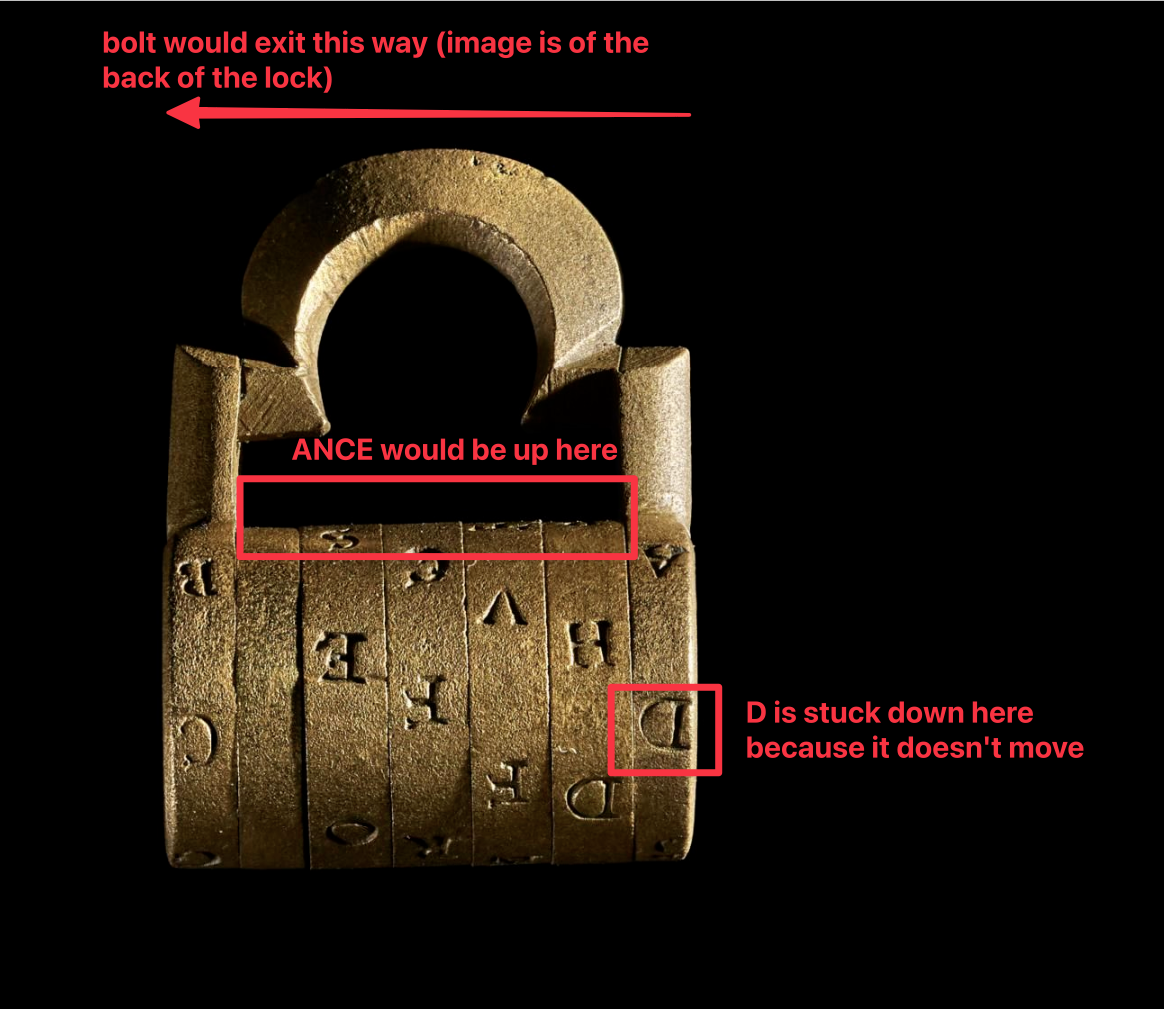
It’s clearer if you play around with the Claude sim above, which is measured on the real museum photos and CT scans.
Still, it might’ve been a useful mnemonic for the lock owner. We may never know unless we find a way to CT scan Elizabethan Wordle.
If you’re just guessing, we’re looking at a 4 dial lock with 6 digits per dial, the number of possibilities is 6x6x6x6=1296. That’s an awful lot of attempts to try on a 400 year old lock, without even knowing for sure that the mechanism works correctly. Trying to crack the code involves putting pressure on the moving parts and feeling when things bind, which seems very ill advised for such an old piece.
I do have some experience with this, my son found a 3 digit padlock (1,000 combinations) and I spent the necessary time to increment one digit at a time until I cracked it. It helps that I found the right combo after ~ 12 attempts.
I guess there was also no particular urgency, since… well, first of all, whatever the thing was meant to lock is obviously not attached anymore
And also, many other such locks have been found and either unlocked or forced open/shut:
Numerous examples of sixteenth century combination locks have been recovered through the Portable Antiquities Scheme. A complete example from the Suffolk coast (PAS unique ID: SF8892) no longer rotates and the lock is now closed reading OXEN under the clasp. As the lock is closed another word was presumably required to open it, an obvious (perhaps too obvious) alternative possible from the available letters is OPEN, other options were OVEN and ROBIN. An example from the British Museum collection (M&ME 1992, 0410.1) opens with the word MARCI.
I’m wondering why they assume that the code word is read at the “top” of the lock, near the shackle. If ANCE is lined up there, there are presumably 5 other places around the lock where a different word appears. Actually, reading the word underneath the shackle, when there is some other clasp passing through the shackle, seems like the most awkward place of all six of them to try to read a word.
Yep. Putting your point together with @Cheesesteak 's …
There are 1296 permutations of the dials. But the entire matching combo of ANCE also must be properly aligned with the frame for the lock to be opened.
In a modern lock there are index marks to make clear where the combo must be aligned with, and also detents to reliably index the various wheels into one of (usually) the same number of positions (in this case 6) which then lines everything up within the required tolerances to open.
If the indexes and / or detents are absent or well-worn on our antique, then each of the 1296 combos would have to be carefully rotated through all 360 degrees while maintaining their collective alignment also while the lock body is under gentle tension to ensure that a single test combo had actually been fully tried before moving on to the next.
A long and painstaking job for sure.