Curse You Red Baron! Memoirs of WWI Flying Ace Eddie Rickenbacker

Just stumbled across this site which has the complete text of Rickenbacker’s memiors about his service in WWI. It ought to be pretty interesting reading, however, since Rickenbacker was basically one of the guys who originally created the image of the dashing young fighter pilot who lived fast both on and off the ground. He was also supposed to be a top-notch mechanic and race car driver.

Mods, I wasn’t sure of where to put this, so feel free to move it as need be.

I couldn’t figure out why the name was so familiar to me until I just Googled his name. He was indeed a race car driver near the turn of the lsat century and as an owner of the Indianapolis Motor Speedway. I must have heard the name from my dad, a race enthusiast, as a kid. In his time, he was indeed an American Hero.

Very nice. I once read a kid’s book about him, and found it fascinating despite being in my early 20s. I’ll definitely check this out.

I received Rickenbacker’s autobiography as a 9 year old kid. I eagerly lapped up the adventures of Rickenbacker.

Not only did he own the Indianapolis speedway, he actually raced in it - but never won it. The closest he came was in 1914, when he placed 10th.

He started supporting his family at age 12 when his father was killed in an industrial accident. His first job was in a glass blowing factory, later in a automobile repair garage, and ended up quitting school in the 8th grade.

He was a very successful early automobile salesman, later leading him to be a successful auto racer.

He convinced a superior officer in WWI to lie about his age so he could attend flight school. He ended WWI as American Ace of Aces - the flyer with the most confirmed enemy downed aircraft.

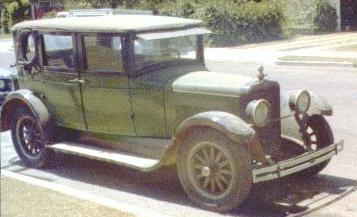
When he came home from the war in France, he was determined to build his own car. He put together a group of investors, friends, and engineers, and built the Rickenbacker automobile, shown is a 1925 Brougham. A 1925 Rickenbacker, driven by Captain Eddie, paced the 1925 Indianapolis 500. The company went bankrupt in 1927, leaving Rickenbacker $250,000 in debt.

He quickly raised enough cash to pay off that debt and raise another $700,000 to buy the Indianapolis Speedway.

He sold the speedway to Tony Hulme in 1941 and went to work for Eastern Air Lines. But when war broke out he once again took a commission in the armed forces to serve the United States. Used principally as an aviation advisor and inspiratinal speaker, he was called upon to deliver a private message to Gen. MacArthur. While flying from Hawaii to Canton Island, the plane picked up an unexpected tailwind, causing the plane to overshoot the island by many miles. The plane’s radio gear failed, and Rickenbacker and 7 others were forced to ditch the plane in the ocean, and take to the sea on life rafts. One died during the ensuing 24 days, but the rafts were located and Rickenbacker had cheated death once again. He fianally delivered his message to MacArthur a month late.

AAfter the war, he went back to work for his pre-war employer, and was named president of Eastern Airlines. Eastern was the first air carrier to operate at a profit, therby not requiring the government assistance other carriers relied on.

He flew on a pre-flight demonstration of the Boeing 707, the first successful passenger jet, and was honored by being asked to fly it for a few minutes.

One thing about Eddie Rickenbacker, he never obtained a pilot or driver’s license. On the occasions he was asked to show one, he would show his gold-plated American Legion lifetime membership card. He said it always worked.

Magnificent life. One of my few regrets is that I never wrote him like I wanted to. He died in 1973 at the age of 83.

I strongly recommend his autobiography. Very few slow points, utterly absorbing reading.

I was reading somewhere ( Smithsonian Magazine, I think) that Rickenbacher ( or another big WW1 ace) suffered a head injury that in our times would have grounded him for the rest of his military/flight career. He showed all the classic signs of head trauma from a crash. Something about severe mood swings, hyper focusing on something and a few other things.

I think it was Richenbacher…

It was really interesting.
anyways, carry on.

I got interested in Eddie from reading an article in Reader’s Digest (of all things!) about his 24 days in that raft. A fascinating man! He was in a plane crash, and when trying to extricate himself, cut his face so badly on wreckage that his eye popped out!

Thanks for the link!

There is also a very readable account of this incident available (at least as a second-hand book) called We Thought We Heard the Angels Sing, by James C. Whittaker. It is currently out of print, and apparantly never really went very far - but I reccomend it, as well as the autobiography.

I read his autobiography while I was in junior high. I agree very readable. Also, a note about it - it was a self-published book, and was donated to school libraries across the country. A very interesting man.

I’ve got a copy of that somewhere in my library! A memorable account of sharing a few oranges, eating raw seagull, and of what happens if you drink seawater to slate your thirst (poor Alex).

Captain Eddie’s name at birth was Edward Rickenbacher.

He changed it during his service in WWI because of anti-German sentiments. He also gave himself a middle name at that time, Vernon.

Truly, the man was a model of fearlessness:

All little boys growing up in the 1920’s and 30’s knew about Eddie Rickenbacker and the Hat In The Ring pursuit squadron.

That and G-8 And His Battle Aces along with other such pulp fiction made everybody want to be an aviator.

His squadron included others who later became notable such as James Norman Hall who wrote the Bounty Trilogy, Mutiny On The Bounty, Men Against The Sea, Pitcairn Island with Charles Nordhoff.

Shortly thereafter, a relative of Rickenbacker started making Rickenbacker guitars, which were popular with some very questionable people.

That would be von Richthofen, actually. Wrong side.