They came from “east of Jerusalem”. That covers a lot of territory. The only hint regarding Persia is the use of the term “magi”. But note that a lot of people used magi/magus in that region around that time. One mentioned in Acts is Simon Magus who was apparently a Samaritan, i.e., from the Judea area. Another person called a “magus” in Acts is Elymas who was Jewish. Josephus wrote about a Cypriot magus named Atomos.
There is nothing in the New Testament to suggest the Magi visited anywhere near the solstice.
Again, this thread demonstrates a problem so many people have of distinguishing what is actually in the Bible vs. the folklore that later accumulated.
(BTW: The singular term “star” (astēr) is used in Matthew. No plural.)
Actually, to break that down, there’s nothing in the New Testament to suggest what time of year Jesus was born, and even if he was born near the Southern Solstice, it doesn’t matter, because there’s also nothing in there that says that the visit by the Magi came when he was still a newborn.
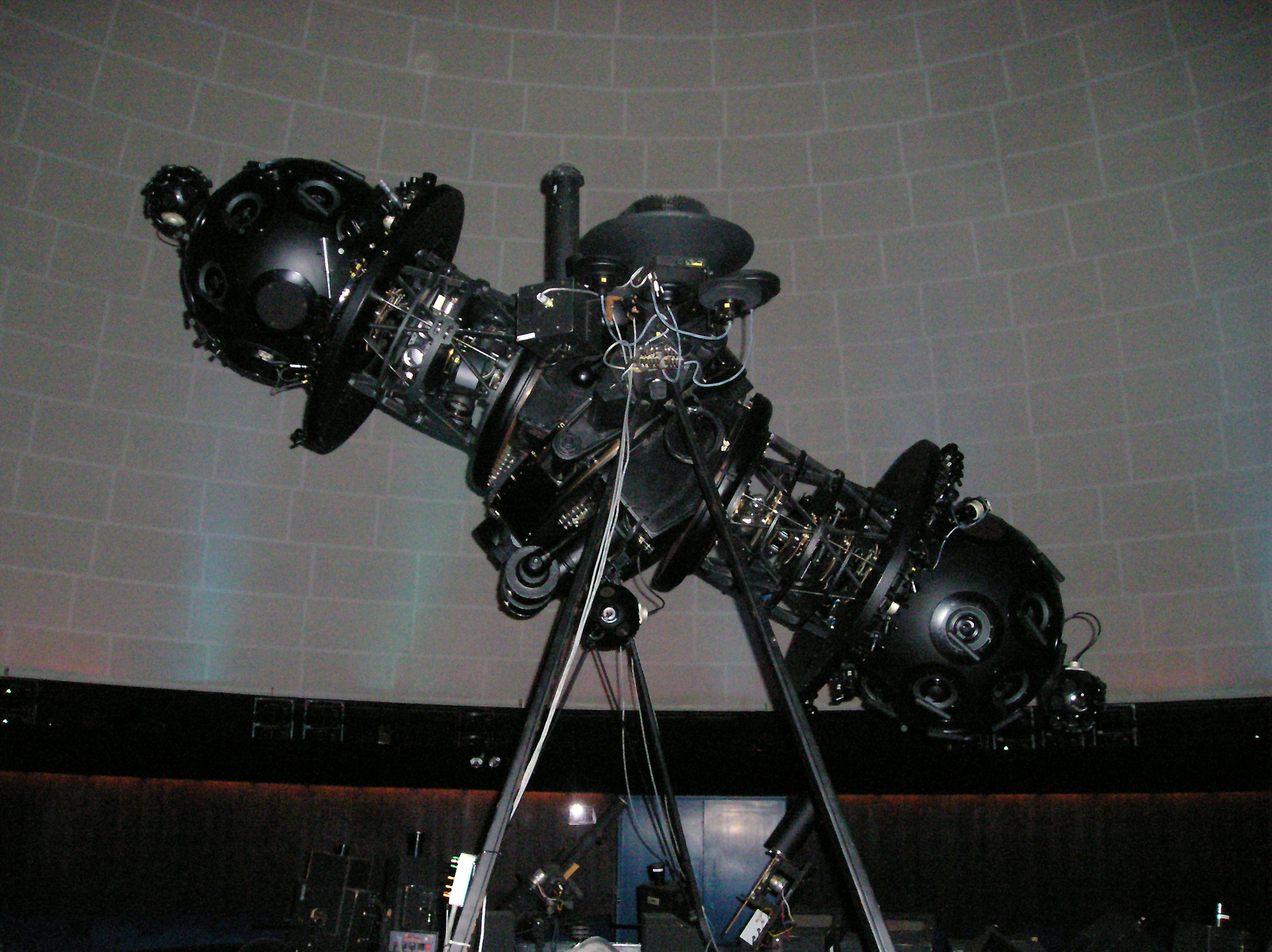
What really impressed me at that time-travelling star show (this was many years ago), was the not-digital, massively huge mechanical star projector (photo) with the umpteen-unknown-thousands of moving parts. It tracks the movement of all the stars, planets and other heavenly lights completely mechanically like physical clockwork. They physically run the whole machine forward or backward in time. The whole thing seems to rotate around various axes in twelve or more dimensions and whole bunches of sub-components all have their own movements and axes of rotation, etc. How do they even build something like that?
BTW – OP, come back to this thread and tell us what you saw!
Did you get out on the Solstice Night? Was the sky clear? Did you see any stars lined up? Did you follow them? Did you encounter any Magi on the road? Did you find the Holy Boy Child? What gifts did you bring? Did you come across any shepherds in the fields? Was the cold winter night really so deep? So many questions!
I fell asleep after watching Benny hill so the mystery of whether there is astronomical phenomena that gave birth to the three wise men myth will have to wait until next year apparently.
But that makes no sense, because the entire story of Jesus doesn’t specify a time of year, and even if the writers did know (or think they knew) when Jesus was born, the time they (thought they) knew probably wasn’t at the Solstice.
I think if you pick any arbitrary point on the horizon, you can probably find three stars that align with that point. But the main reason this theory doesn’t make sense is, as mentioned, the earliest versions of the story and the one in the Bible don’t mention that there were three Magi. If the whole story is an astronomical metaphor for these mythical three stars, it’s hard to see how that part could be missing from the original story.
Yes, it was eventually decided to celebrate Jesus’ birth on December 25 (though even then, I don’t know if the folks who decided that actually believed it was any more accurate than the Queen’s Birthday is in the UK). Eventually. As in, long, long after the story of Jesus was written. And even if December 25 was chosen to factor in pagan beliefs, it’d be a completely different set of pagans than whichever ones were relevant at the time the story of Jesus was written.
Your argument is like claiming that Henry Ford never actually existed, and the Ford Motor Company was actually named after the 38th President of the United States. Showing that there was a real President of the United States in 1904 doesn’t help your case at all.
When Julius Caesar instituted his canlendar, the winter solstice was on the 25th (or 24th, it moves a bit from year to year, and sometimes that takes it to the previous/next day). But his calendar was off on the length of the year and the solstice drifted away from that date over the centuries. It was finally corrected by Pope Gregory XIII in the 16th century, at which time they dropped 10 days to get it back to what it once was. But they didn’t get it all the way back to Caesar’s day, but rather to the early 4th century when the date of Easter was set. That was much more important than the date of Christmas. So it’s still four days off of what it was originally.
Stars can behave strangely to humans. Rise in the west; move north or south; stand still. Seasons and years are just as funny. But a census?
So if Yusef and Maryam left home in Natzrat (which place was unrecorded then) to Bet Leḥem, it wasn’t due to a census. If a historical Yeshua actually existed, he was born in spring; we can combine Xmas and Easter. If Magi showed up some time later, they either didn’t arrive from the east or didn’t follow rising stars.
Wouldn’t sky-watchers besides a few Magi have seen the astral signs? Wouldn’t a mass of astrologers have descended on Judea?
I just checked. Today is 23 December 2019 Gregorian, 10 December 2019 Julian. Xmas will be 13 days late.
We are talking about 2000 years ago. Only a couple days’ difference. (I mean, if you extrapolate the Gregorian calendar.)
This is where you have lost me. You are claiming that around Caesar’s reform, let’s say 45 B.C., the date of the winter solstice (in the Julian calendar) was December 25, but I think (admittedly based on only a rough calculation, but I don’t think I was 2 days off) it was December 23. Can you show your work?
By the 4th century, we are talking around December 20, and March 20 for the vernal equinox.
I’m not sure they did any significant calculation. I think they just knew from records that the vernal equinox (which is what they were actually interested in) was ten days later in 325 than what it was going to be in 1583. So they skipped forward ten days to get it back to that day. That, according to the Gregorian rules of how leap years are dropped, actually put the calendar back to the 3rd century, not the 4th. The one-day difference might just have been because of the difference in where 325 (or perhaps 324) and 1583 were in the 4-year leapyear cycle.
However somewhere I heard that they did do calculations but used a slightly wrong length of the day and thus got it wrong. Maybe that’s right, I don’t know.
I doubt if “8th degree of Capricorn” is all that exact from a modern measurement point of view, so perhaps the actual solstice was on the 24th or even the 23rd by that time.
Well, the OP asked about sunrise on the winter solstice (Dec. 23 on the date in question), not sunrise on some date somebody calculated was more or less near the solstice. Either way, the sun will not have moved THAT far in the sky in the meantime. Anyway, it looks like a regular starry night to me, but feel free to load up the planetarium software of your choice and use your imagination.
The software I use compensates for the procession of the equinoxes, but I didn’t allow for the three or four days change in the calendar. That would be a trivial consideration, however.
Much more important is determining which year Jesus was born in- has anybody got a clue?
While the year range for the birth is kinda wide, it isn’t anywhere close to being broad enough to cause a problem in determining what stars (per the OP) were in the sky before sunrise (for example) on a given time in the solar (per the OP) calendar.
This assumes that Yeshua bir Miryam “actually” existed in our observable reality in a timeline that somehow accords with censuses and slaughters unrecorded elsewhere. IOW pick whatever date you want. And I recently read (sorry, can’t find the cite) an analysis of the Magi’s “star” as being an astrological aspect, not an astronomical event. Pick an astrology system and chart your aspects, no problem!