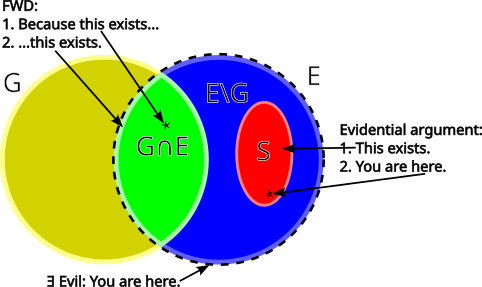
But the problem is that you are claiming to know something, namely, that the probability of the evidence (seeing evil, seeing orange) given the truth of your hypothesis (tri-omni God, orange-hating John) is smaller than the probability of seeing that evidence given the falsity of the hypothesis. This is mathematically equivalent to saying that ‘observing the evidence should lower my belief in the hypothesis’. The problem is, you don’t know that. So you’re implicitly asserting knowledge you don’t have.
I’ll give a short demonstration of this for the curious:
Summary
Let H be the hypothesis, E the evidence, and \neg H denote the falsity of the hypothesis. Bayes rule tells us how to adjust the belief in H upon encountering the evidence E:
P(H|E) = \frac{P(E|H}{P(E)}\cdot P(H)
Now the question is, when is P(H|E)<P(H), i.e when does the evidence allow us to judge the hypothesis less likely? This leads to:
\frac{P(H|E)}{P(H)} = \frac{P(E|H)}{P(E)}<1,
which directly leads to P(E|H)<P(E). So it has to be the case that the truth of the hypothesis lowers the probability of the evidence being observed. That’s already something that isn’t obviously true, but we can make this more intuitive.
By the law of total probability, we have that
P(E) = P(E|H)\cdot P(H) + P(E|\neg H)\cdot P(\neg H).
For this to be larger than P(E|H), it suffices that
P(E|H) < P(E|\neg H),
because then, any addition of P(E|\neg H) weighted with some positive P(\neg H) will make the result bigger than P(E|H).
Consequently, only if P(E|H) < P(E|\neg H) is it rational to lower belief in the hypothesis upon observing the evidence.
If that were true, that is if the expected value of orange were exactly zero, then in fact any observation of orange would directly make the hypothesis that John abhors orange logically false, because this entails that the probability of seeing orange given that John abhors orange is exactly zero. If there is any positive probability of seeing an orange item on John even though he abhors orange, then the expected amount of orange seen on him is likewise greater than zero.
In this as well as in the case of the PoE, we know that there is a positive expectation of seeing the respective kind of evidence because we know the intersection of cases where the hypothesis is true with cases where we see the given evidence is non-empty.
I’m being perfectly consistent: we have no reason to believe any amount of evil to be inconsistent with the existence of God, as long as we have no information on the amount of evil to expect in a world with a tri-omni God (except that it is non-zero). The arguments that certain instances of evil are gratuitous give us exactly this information, and to the degree that they are inductively convincing, reduce the probability of the truth of the hypothesis (i.e. God’s existence). It yields exactly the information that is needed: something we are less likely to observe given the hypothesis of a tri-omni God than we would be given its falsity.