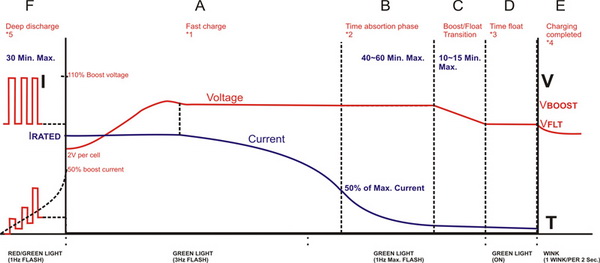
Most lead-acid chargers don’t try to charge the battery at maximum current, so it’s generally not an issue worth worrying about. Your battery will last a lot longer if you don’t charge it so quickly.
If you are pushing the limits though, yes, you need to reduce the charge rate. If you don’t, you’ll damage the battery (mostly plate corrosion and electrolyte loss due to H2 and O2 gassing, and possibly some evaporative losses from overheating) and shorten its life even further.
Depending on how the battery aged, it’s also fairly common to end up with some cells having less capacity than others. Pushing the charging limits on those weaker cells can cause them to overcharge and be damaged further, which kinda feeds back on itself. The cells get even weaker, and get even more damaged by overcharge, which makes them even weaker and even more susceptible to overcharge damage, and soon the weak cells end up dying completely, and that’s the end of your battery.
Keep the charge rate well below the limits and the weaker cells don’t suffer so much abuse and don’t fail so quickly.
A good charge controller will watch the voltage and current curves as the battery charges, and switch to float charging after the current drops to a preset value (usually .1C). This will compensate for any loss of capacity.
I hate to sound dumb, but charging rates are typically given in current (or, if you like, charge per time, as in 1 Amp = 1 Coulomb per second). Battery capacity is in charge (or, if you like, 1 Amp-Hour = 1 Coulomb/Sec * 3600 Sec/Hr = 3600 Coulomb). So, how can you set a rate equal to a capacity? What does that mean?
Does it mean that if a battery has 45 Amp-Hour capacity, you should just ignore the hour part and charge it with a charger rated no larger than 4.5 Amps? Or, as batteries are usually marketed with “Cold Cranking Amps”, if you have a 300 CCA battery, you can use a 30 Amp charger? That seems awfully high.
Typically what this means is that if you have say a 45 amp-hour battery (to use your example) and you want to charge it at 10 percent capacity, the charge rate will be 4.5 amps for 10 hours for a total charge of 45 amp-hours. The actual charging algorithm is typically a bit more complex than that in a modern charger, and a lot of the charging energy gets converted to waste heat instead of recharging the battery, but that’s the basic idea of it.
This will often be abbreviated as C/10. A charge rate of C/20 would be 2.25 amps (45/20) for 20 hours, again for a total of 2.25 x 20 or 45 amp-hours.
The maximum charge rate you can safely apply depends on a lot of things. Part of it is the chemistry of the battery. Part of it is the geometry of the plates. It takes time for the charge to fully migrate from the surface of the plate to the plate’s interior, so thinner plates can be charged faster than thicker plates. For the same amount of lead, thinner plates will give you a greater maximum current, and thicker plates will have less maximum current but a longer capacity.
For a car battery, you want relatively thin plates so that you have more cranking amps. For a deep cycle marine battery, you want much thicker plates. For the same amount of lead, you can charge the car battery faster because the plates have more surface area but are thinner.
Yes, as a lead acid battery ages it becomes more resistive (gets hotter when charged), and the charging area gets smaller (more concentrated).
“10%” isn’t a magic number: it’s just 10% because that’s a nice round number. It’s not the number “for a new cell” -it’s not that exact.: It’s a number for “any cell”, including old batteries.
Note: most lead-acid battery manufacturers don’t know very much at all about battery chemistry, charging, or discharging. What they know about is making batteries (for profit). That is an entirely different branch of engineering/science. When they say “10%”, they know about as much about it as you do: somebody told them that 10% was the right number for that kind of battery.
You can detect this with a smart enough battery charger. (one integrated into the battery module itself, like in most modern devices)
As the battery gets more resistive, the voltage required from the charger to maintain a current of 10% will increase. That could tell your software algorithm to backoff and set a lower threshold for constant current.