I recently purchased a Crossland Coffee CC1 espresso maker and a Baratza Vario grinder and am just trying to dial them in. So far, it’s going reasonably well–I’ve got a nice crema going, though I’m certain there’s much more optimization to be done. Currently trying to find the best grind point.
Anybody got their own tricks of the trade? What settings have the most “sensitivity”, so to speak–that is, what should I get right first before trying to fine-tune the rest?
The espresso maker has PID temperature control and nigh-infinite control over the various parameters. The defaults work well but I wonder what I should be looking at first for optimization.
Of course I like lattes as well as espresso. The milk foaming isn’t working as well as I’d expect, though–I have the feeling it’s because I’m using whole milk. I think the foaming action comes from the milk protein and the extra fat is probably interfering. What milks have you found work best?
If nothing else, feel free to brag about your home setups. Curious what everybody else has. The Vario in particular is a fantastic grinder. Not cheap, nor does it feel like it–that sucker is dense. I like… heavy things.
I’ve had good results heating up a small amount of 2% milk in the microwave for 7 minutes at a heat setting of 2: if the temperature is low enough, the milk doesn’t curdle. You can get that started first and then start the grinding and foaming. Wait, that doesn’t sound right. Anyway.
Remember how soft serve ice cream feels lighter and tastes different than solid ice cream? It’s because it’s mixed in with the air. Much the same is likely happening with foam.
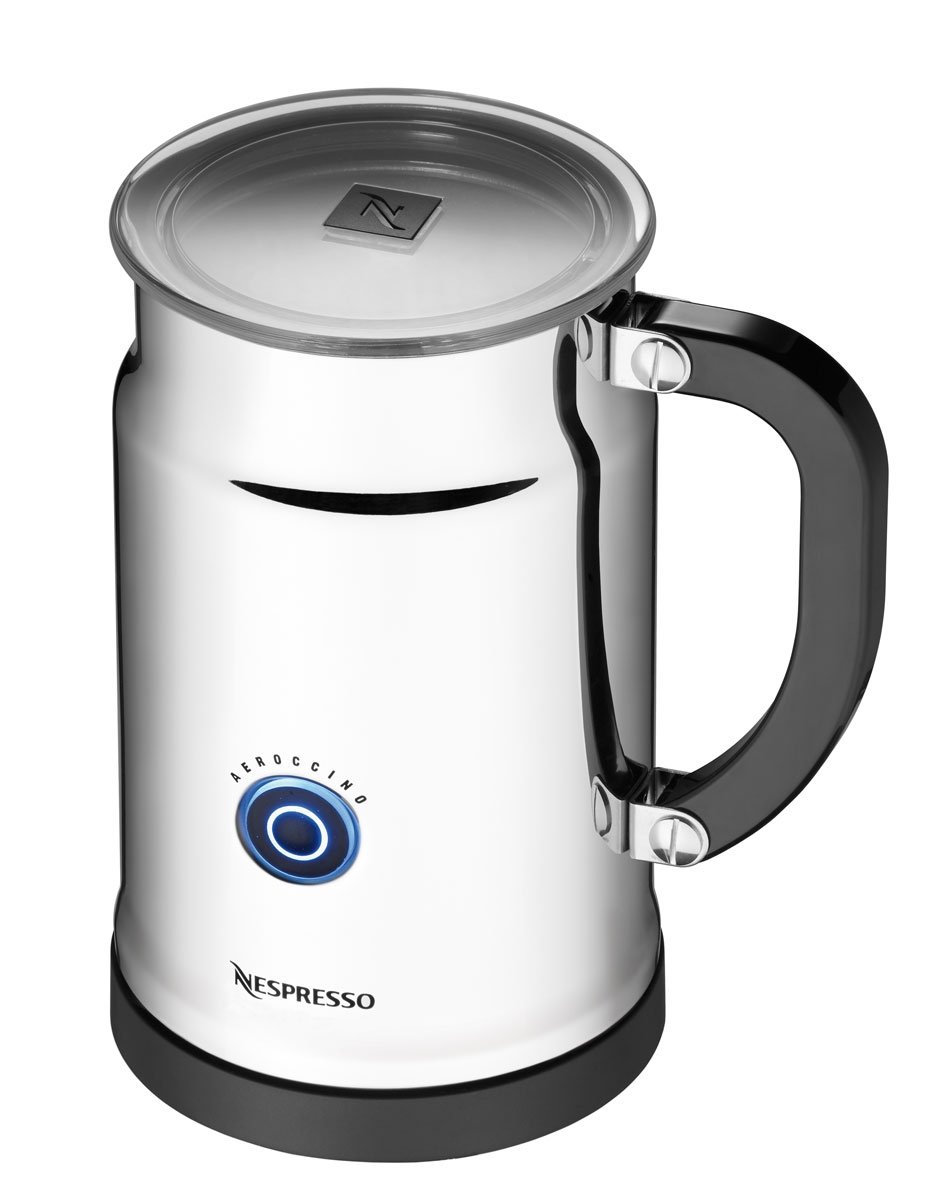
The foaming tube requires more skill than I’m willing to learn given my alternative. I pour a small amount of 0% milk into something like this https://images-na.ssl-images-amazon.com/images/I/61w6bCsJY5L._SL1200_.jpg If you tilt it about 45 degrees, the milk at the top (where there’s more air) will take a turn at the bottom (where there’s less air) and vice versa. If you don’t do that, what can happen is that milk at the top will be too highly oxygenated (bubbles are too large) and stay at the top and milk at the bottom hardly has any bubbles and will stay at the bottom. By tilting it, it reliably gives me very fine foam.
The espresso itself: Instructions usually mention letting the espresso drip about 20 seconds. Try 10 seconds for a ristretto. You may either like the stronger and qualitatively different taste or not. If not, you can still use it as a base for lattes, cappuccinos etc. I’ll often use 2 ristrettos instead of 1 espresso in cappuccino.
Thanks for the tips–I’ll definitely try the microwave trick. I did get some 2% milk and it works better than the whole, though the foam still collapses more than I’d like. It almost immediately mixes with the coffee and dissolves the foam.
I wasn’t aware of standalone frothers. I’ve basically found the same thing as you, though–getting the tilt right is key. The bubbles are either way too big or small. Maybe I should try 0%.
My machine is currently set to 25 s, but I’ll look into the lower settings. It’s very configurable.
It makes a surprising amount of difference.
To preclude miscommunication, when I mentioned 2% milk, I was talking about the milk you’ll pour the espresso into, not the milk used for the foam. Using different milks means you can get the best foam using 0% milk while still using whole milk for the body if that’s what you prefer.
Instead of using a shorter brewing time, I get my ristrettos by grinding finer, and brewing for the same 22-26 seconds I use for espressos. Usually end up with better crema that way. At least that’s my experience with my Rancilio Silvia with a PID, set for 218 F.
I’d recommend you fiddle with the temperature. I’ve tried my machine out from 215 to 225 before settling on 218.
Finding the right grind settings took me a while, too. Finally I decided to adhere to the advice “grind finder, tamp lighter” and made some huge jumps in quality. I got myself a Rancilio Rocky with its 50 settings and that gives me the variability I need. I find I sometimes am better off adjusting the grind if the humidity has been high for a while. Usually by making it a single notch coarser.
I also got a spring-loaded tamper that lets me know when I get close to 30 lbs of pressure. That helps let me know my own strength!
That’s really hot, isn’t it? I haven’t experimented at all with temperature–200 seems to be the standard–but I’ll play with this.
Only 50 settings? Mine has 230 (yes, it’s kinda ridiculous). I’ve converged on a pretty good grind/tamp pairing, but haven’t really pushed the limits of fine grinding. Crema production seems to take a few seconds to start–I wonder if a very fine grind will help with that.
Been thinking about making my own variable tamping system with electronic force gauge. Silly, but I like this kinda thing…
My PID measures the temperature on the top of the boiler; that doesn’t reflect brewing temperature. Somewhere in that 10 degree range is the sweet spot for the brewing. Or so it says in the technical manuals.
Finer grind, gentler tamp, and my crema is awesome about 83.4% of the time now!!
I hear that, for sure. I contemplated doing all my tamping on a small kitchen scale that could go up to 40 lbs. but decided that’d make the counter too cluttered.
Well, the Mrs. decided that bit.
Anyway, there are so damn many subtle variables; room temperature variations, humidity, recent change in humidity, age of the beans, ambient ozone levels during thunderstorms, recency of our last water softener recharge cycle, etc. etc.
 (yes, it’s kinda ridiculous). I’ve converged on a pretty good grind/tamp pairing, but haven’t really pushed the limits of fine grinding. Crema production seems to take a few seconds to start–I wonder if a very fine grind will help with that.