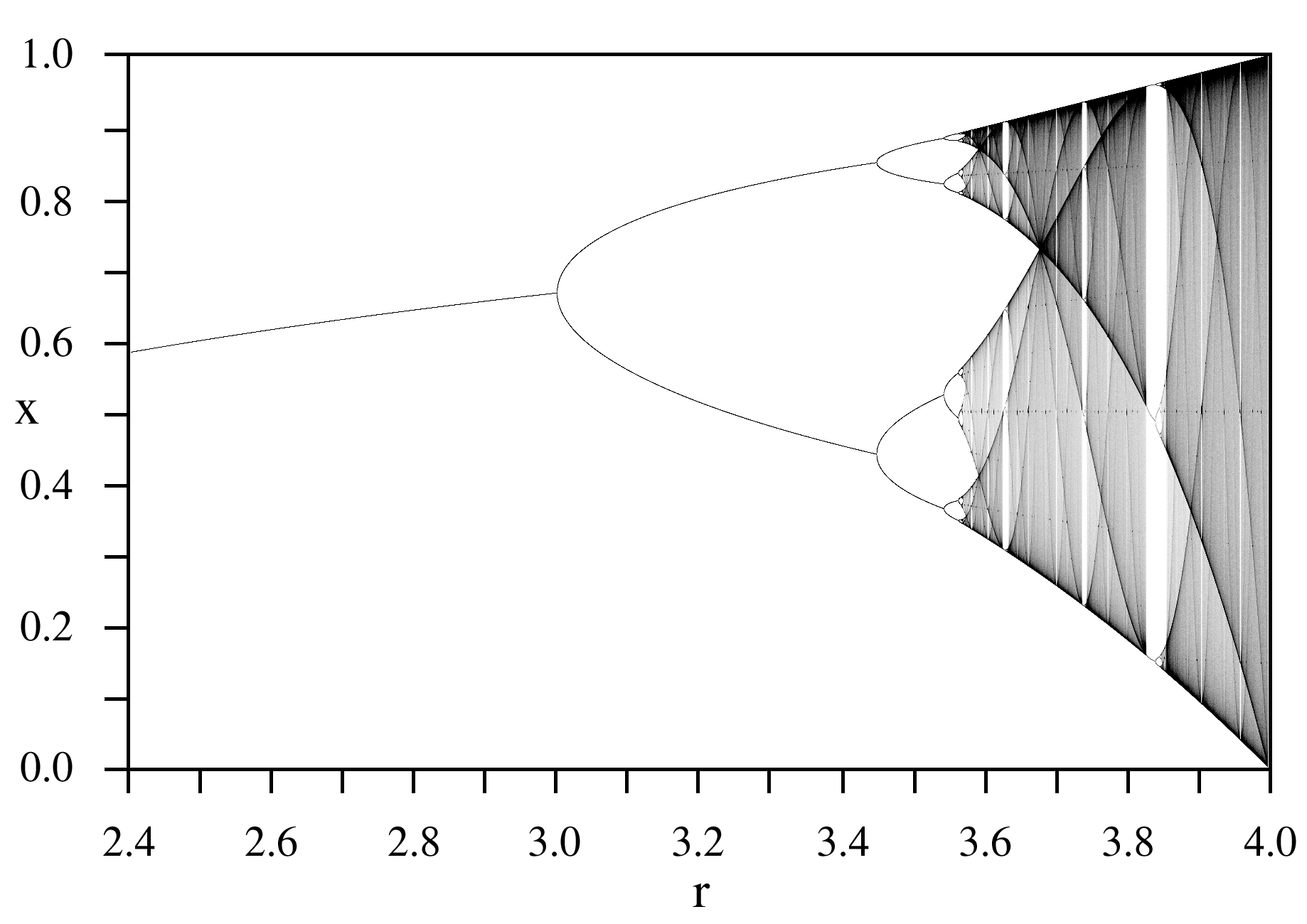
Both of the Feigenbaum constants (delta and alpha) relate to the bifurcation approach to chaos: that is, they talk about the left part of the logistic-map image you linked to (r<3.57 or so). This image is a graph of the locations of stable orbit points (on the vertical axis) versus a parameter r. That is, choose the logistic parameter r and some arbitrary initial condition x0; apply the logistic map for long enough that it settles into a stable orbit; and plot the positions (r,x1),…,(r,xn) for the points (x1,…,xn) in the stable orbit. Then increment r and continue. (For a very simple algorithm you might, e.g., just apply the map a hundred times to let the transients die out, and then plot the next hundred points.)
In the period-doubling (bifurcation) approach to chaos you initially see a single stable point (i.e., f(x)=x); then as the parameter is varied you get a period-two orbit (f(x1)=x2, f(x2)=x1), a period-4 orbit, and so on. Eventually (r>~3.57 in the logistic map) you lose all periodicity and get a fully chaotic map; the Feigenbaum constants don’t talk about that.
In the logistic-map image, for r<3 there is a single stable point of the map (which is the single point in the vertical slice at a given r<3). At r>3 the formerly-stable point becomes unstable, and there is now a stable period-two orbit (the two points in a slice for 3<r<~3.45). At r~3.45 this period-two orbit becomes unstable, and there’s now a stable orbit of period 4, until r~3.54; and so on. The limit of the ratio between these “onsets of instability” is delta; so the first term in the sequence whose limit is delta is roughly (3.45-3.0)/(3.54-3.45).
The other constant, alpha, relates the height of one of these forks to the height of one of its “children”. The first fork has “tines” (the points where the period-two orbit becomes unstable) at r~3.45, x~0.45 and x~0.85, so its height is 0.85-0.45~0.4. Its wider child has tines at r~3.54, x~0.37 and x~0.53. So we have a ratio (0.85-0.45)/(0.53-0.37), as the first element in the sequence whose limit is alpha.
For the white regions at r>~3.57 (“islands of stability”) you can see the same bifurcations occurring; these are regions where there’s a brief return to finite-length periodic orbits before the chaos returns. You can compute delta and alpha for just these regions, and the universality of the constants implies that they should be the same.