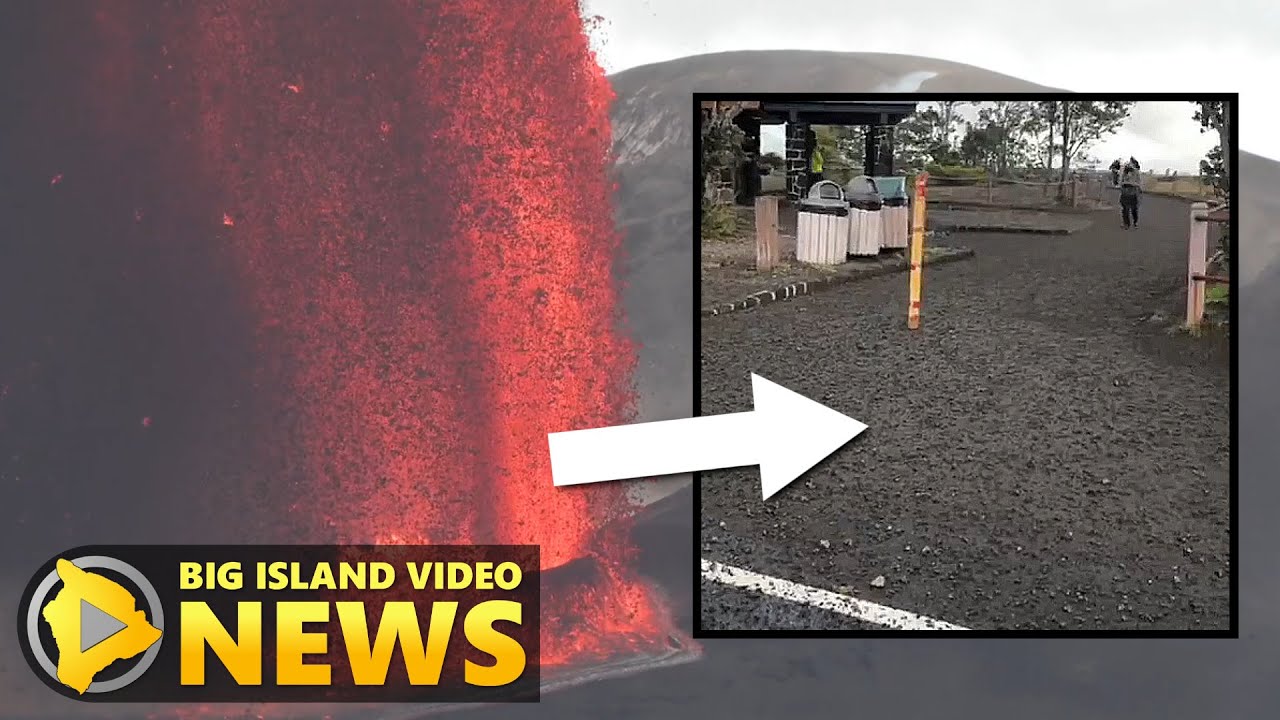
The solution is obvious. Since current eruptions are very roughly at 6-week intervals, you need to plan a 2-month stay on the Big Island. At that rate you’re sure (hah, famous last words) to see one for real.
A 7-foot Marlin? You’re talking some serious work there. Hat’s off to you. I pulled in a ~5’ billfish off the coast of Ecuador decades ago. I won, but the effort damned near killed me too. Big fish are strong.
Here’s a semi-related island story: sometimes you can see the plume from the eruption if you go to a viewing spot along a road that’s just a 2-minute drive from our house. It can be quite striking when the sky is blue and yet there is this singular, vertical cloud on the horizon.
Alas, not today. There were some low clouds that obscured anything we might have seen from the volcano.
However, there was a pomelo on the side of the road. That’s not uncommon - fruit just appears on the ground here, because it fell off a tree or a truck. While I’ve been out running I’ve picked up passion fruit, strawberry guava, oranges, avocados … a few days ago I ran by three nice-looking durian but it was impractical to pick up even one with my bare hands (they’re big and thorny), so I left them be.
So we grabbed the pomelo and took it home for breakfast. Quite tasty!
The report has come out. It died at 18:04 HT. As of now = 0730 ET = 0230 HT that finale will be visible on the stream for about another 4 hours.
I just watched it on V3. It had been fountaining higher than the surrounding rim but not with great volume. Then the volume dropped a bit and the height increased. Then over literally 30 seconds it went from top of fountain well over the rim to nothing. Reminded me of the big finale of a fireworks show, but for a small one. One last oomph, then abrupt silence, darkness, and slowly clearing smoke.
The tiltmeters are calibrated in microradians. Which are ~= 1/20,000th of a degree. The slope has shifted about 4 microradians ~= 1/5,000th of one degree over the last few days. And seems to shift about 1/500th of a degree peak-to-trough over an eruptive episode.
The GPS sensors show the ground there rising and falling a few tens centimeters = a few inches over the last few years.
The motions are very real, but very subtle on a human scale.
Okay, it just started! My niece and her husband were planning to wander around Hilo this morning then drive to Volcano. Calling them now to tell them to get moving. I hope they are already on their way over!
Wow, that’s the tallest I’ve seen since this thread started. I think the v2 cam is zoomed all the way back as far as it can go and the fountain is still going out of frame.
Okay I take that back about V2 cam’s ability to zoom out. It’s zoomed way out now much further back than when I posted. That’s still an impressively tall plume.
I just got an alert from our civil defense saying that Hawaii Volcanoes National Park is closed due to ash fall. I hope my niece and her husband got in and out of the park to see the fountaining! (If not, at least they’ll have an above-average story of being thwarted from seeing the eruption.)
And now 1840HT = 2340 ET, the fountaining is down to small. Small is still a hundred meters high, but compared to the start, this is piddling.
I wonder how much that means the remining show will be short-lived versus it will be long-lasting but not tall. Which is really a question about how the volume of magma on the move is connected to its pressure. Clearly we already blew off a LOT of the very high pressure that was available 7+ hours ago when this thing got going like crazy. But what now: low and slow, or one and done?