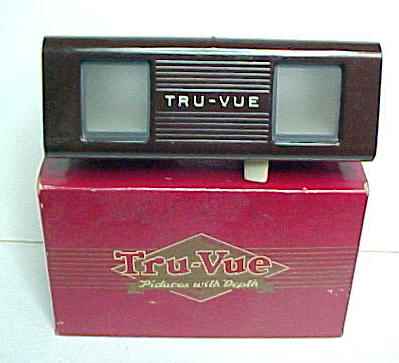
Who else grew up with a True-Vue 3-D slide viewer?
I believe it came out before its more famous cousin the GAF ViewMaster. Unlike the more famous version, which had round disks containing images that would rotate one slot at a time when you pulled the trigger, the True-Vue had its slides in a rectangular cardboard strip, with the left and right images, umm, right there left and right. To advance it, you’d just reach out your index fingers and slide the sucker down until the next 3-D image would slide into place in the binocular viewer.
I remember two series’ of (lessons? slide shows? whatever they called 'em…) associated with the model I’m talking about: “Know Your America Program” and “Around The World Program”. (I think they were put out by National Geographic).
What brought this to mind was watching a DVD of Wonderfalls. The introductory graphic was done to mimic a GAF Viewmaster (with new scenes rotating into place) and I commented on that and then started thinking “Now what was the one we had? Because we didn’t have ViewMaster…”
Hmm, IMHO or MPSIMS? Well, can’t get much more mundane and pointless than this…
Who else grew up with a True-Vue 3-D slide viewer?
I believe it came out before its more famous cousin the GAF ViewMaster. Unlike the more famous version, which had round disks containing images that would rotate one slot at a time when you pulled the trigger, the True-Vue had its slides in a rectangular cardboard strip, with the left and right images, umm, right there left and right. To advance it, you’d just reach out your index or middle fingers and manually slide the sucker down until the next 3-D image would slide into place in the binocular viewer.
I remember two series’ of (lessons? slide shows? whatever they called 'em…) associated with the model I’m talking about: “Know Your America Program” and “Around The World Program”. (I think they were put out by National Geographic).
What brought this to mind was watching a DVD of Wonderfalls. The introductory graphic was done to mimic a GAF Viewmaster (with new scenes rotating into place) and I commented on that and then started thinking “Now what was the one we had? Because we didn’t have ViewMaster…”
Hmm, IMHO or MPSIMS? Well, can’t get much more mundane and pointless than this…
I was born in the late 1940s, and I had both a ViewMaster and a True-Vue when I was a youngster. I have fond memories of both. Thanks for reminding me! There is an interesting history of True-Vue here.
I had a View-Master as a child. I remember watching reels of cartoon characters like Yogi Bear and Huckleberry Hound, as well as many reels of Niagara Falls, Yellowstone, London, space launches, and so on. It was fun!
I had both, too, but it was obvious that the True-Vue system was poorer in design. My viewer took a 35mm sprocketed film roll on a stiffer base than ordinary film, and the only roll I had was a sepia-toned one of the Pasadena Rose Parade. I think you used a lever to move to the next scene, but there was no blanking of the image while you did that, and if you moved the lever half-way you saw two images that did not match (the left of one, the right of another). The strip had to be hand-threaded but was surprisingly durable considering it didn’t have any cassette or protection. ViewMaster seemed like a much better idea, especially since all of those were in color and had a text caption for each image.
As this page mentions, View-Master’s marketing company (Sawyer’s) bought out Tru-Vue in 1951. I was born in 1959, too late for Tru-Vue, but right on time for View-Master. Not only do I recall reels purchased during my (and my siblings’) childhood years, but some older titles my Aunt Sharon (born in 1948) passed down to us. Her collection included such movie stars as Debra Paget and Broderick Crawford (see reel #741 on this page). I recall receiving the Seven Wonders of the Ancient World as a gift from “Santa” one Christmas, and enjoying the accompanying booklet as well as the pictures.
My cousin Laura also had a View-Master, but her tastes ran more to the cartoon reels. I remember one in which Bugs Bunny is trying to repair Elmer Fudd’s TV, and Fudd says something like “If it’s not fixed in time for me to see Maverick, I won’t pay!” Nice little bit of Warner Brothers cross-promotion circa 1960…
Funny, but as a kid in the mid 70s I swore I had a ViewMaster, but given the description it appears I had a True-Vue (even though that name doesn’t ring a bell), since mine took the discs and had the lever to advance images. I did love it though – seeing pictures in real 3D was freakishly cool to my young and impressionable self. Hell, I still think it’s cool. It was a lot closer to feel like being there than ordinary photographs were.
Mind you, I was also impressed with those lenticular stickers you got in Cracker Jack boxes and such – either the motion ones or the static 3D-looking ones.
Unfortunately, although I still have my childhood View Master & all the discs, I don’t have the other device I described. I assume it was the Tru Vu line, but my model had filmstrips, no cardboard, and they loaded horizontally (since both left & right images were on the same film, it would have had to be loaded horizontally if there were many images). I seem to remember a lever to advance the film, once it was inserted in the slot. Maybe there were other models that used cardboard carriers? Or perhaps mine accepted both kinds?