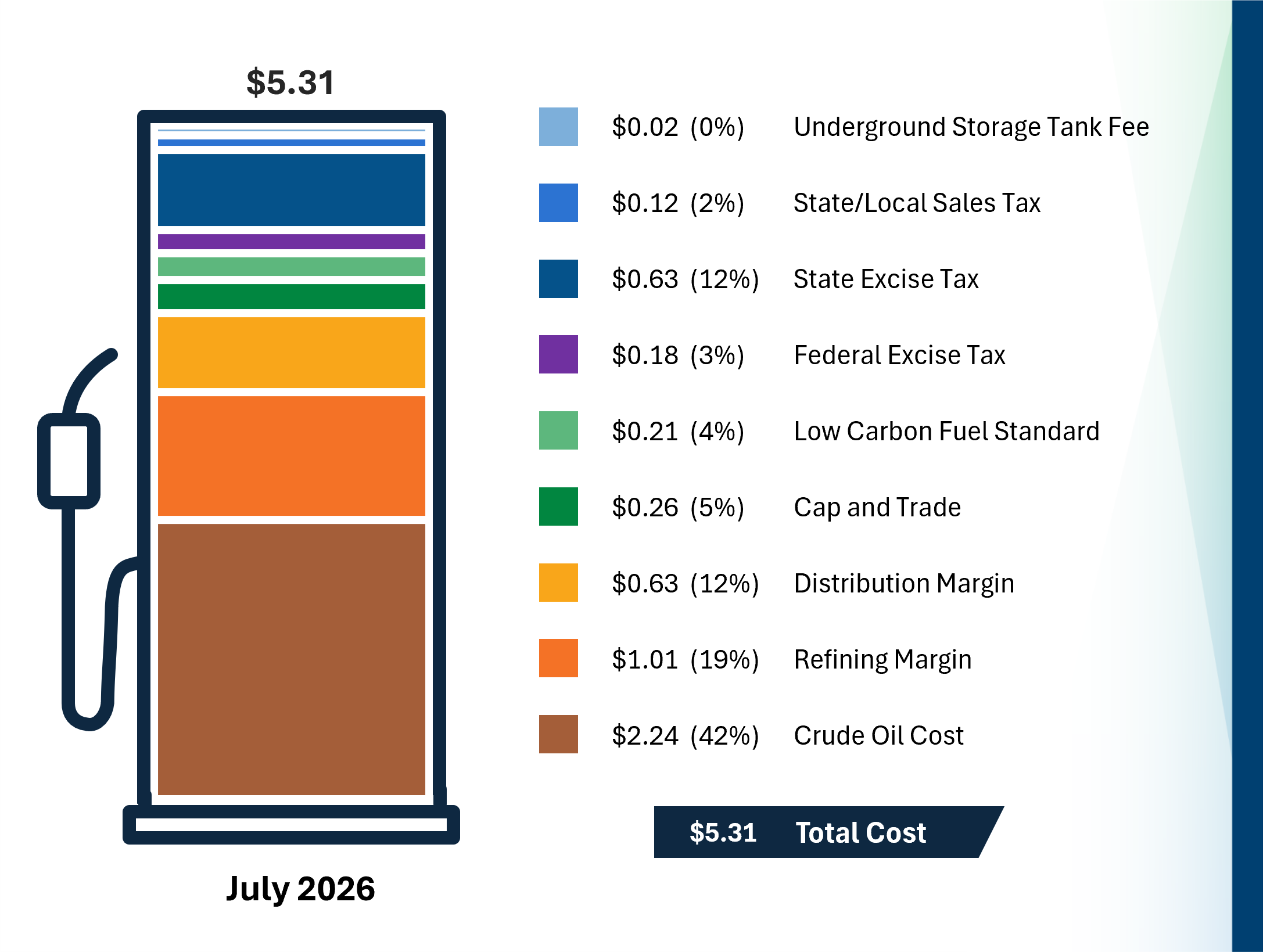
California has large cities in valleys surrounded by high mountain ranges. It has a long dry season with no rain. One of many things we do to reduce smog is to mandate a special formula for gasoline. Not every refinery makes it. Itis reasonable that it would be somewhat more expensive.
It seems to be about $2 / gallon more than the rest of the country. Is the added expense really that much? Is there some price gouging going on? The difference does not seem like it would change that much as the price of crude oil goes up.
At least a big chunk of it. The state tax on gasoline in California is 73.6 cents/gallon, which is the highest in the U.S. (I don’t know if there are county/municipal taxes, or to what extent general sales taxes also impact the overall price.)
This cite, from the California Energy Commission, shows that, as of July of this year, when the average price of a gallon of gas in the state was $5.31, $1.42 of that was various taxes and environmental fees.
Yup; we don’t have the various environmental and emissions fees that California bakes into their gas prices.
FWIW, in Cook County, where 40% of the state’s residents live (including me), gas is more like $4.99 in suburban Cook, and around $5.19 or more in Chicago proper.
It’s the same here in Ontario, where federal and provincial taxes traditionally account for much of the cost of gas. Thanks to sane governance in Ottawa, the reviled carbon tax on gasoline has been eliminated and the federal excise tax on gas for individual use is temporarily suspended.
Here’s a map of existing U.S. oil pipelines. Note that California is pretty much on its own. Separate oil terminals, separate refineries, separate formulation and additives, separate distribution, separate wholesalers, the whole works. Illinois, by contrast, is networked into the rest of the U.S. oil supply.
I think our unique requirements have a lot to do with it. I remember a few years ago refineries would go down for unscheduled maintenance (which seemed to rotate across companies) and prices would spike. We can’t get any from outside.
On the upside, I remember when I first moved here, and when I visited my parents in LA 50 years ago, the local news would always have an air quality report, mostly bad. No more, except when there are fires. At the edge of Joshua Tree National Park there was a pair of pictures, one showing LA from the '30s or something, nice and clear, and one showing it in the '60s where the smog blocked the view. When I was there in the early 2000s you could see LA again.
A lot of taxes. Nevada gets California refinery gas and it’s more expensive than e.g. Texas. But significantly cheaper than many parts of CA, and gas in Clark and Washoe counties is significantly more expensive than in other NV counties.
Yep, this is what i came here to post. This is probably the single biggest factor in why gas prices on the West Coast are so much higher. Many of the other factors are just a consequence of the lack of pipelines. I would rate the reasons as follows in roughly the order of importance.
Lack of pipelines connecting the oceans of oil being produced in the rest of the US.
Jones Act(All ships going from one US port to another US port must be ships built in USA, own by USA companies, crewed by USA, and captained by USA.) Because the US ship building business died decades ago, it is literally cheaper to ship oil from Saudi Arabia than it is from Texas. (Or anything else, for that matter. We should have repealed the Jones Act decades ago. We might be the only coastal nation on Earth where it is cheaper to move things by ground than by sea.)
Because of #1 and #2 it isn’t economical to have excess refining capacity on the West Coast, so any time a refinery goes down for maintenance, costs spike. Refineries cost billions. They aren’t going to build for a self-contained market like the West Coast that has limited ability to ship it elsewhere if they have excess capacity when they can just do it in Texas and use it’s piping system.
Regulatory and permitting hurdles for new refinery investment. No one wants to spend billions building a refinery if we are moving away from oil in the next couple of decades. That and the regulatory red tape of California is legendary.
State and local taxes on gas are much higher on average on the West Coast.
California’s specialized blend is harder to make and takes more technology, and few refineries can do it. All of these increase the cost. (Better for the environment, though)
California and Alaskan oil production has been on a steady downward trajectory for a long time now. Because of #4 above, companies don’t want to invest money in a market that is slowly going away to increase that capacity.
Environmental compliance costs. Cap and trade programs and other environmental requirements are good for us overall, but they obviously are going to have an effect on costs.