In what universe? 860k sq miles to Australia’s 2.9 MILLION?
Yes, Australia is a continent. It’s also an island (a body of land completely surrounded by water).
In what universe? 860k sq miles to Australia’s 2.9 MILLION?
Yes, Australia is a continent. It’s also an island (a body of land completely surrounded by water).
So are you going to tell us the North America landmass is also an island–or if you disagree about the Panama Canal as a separator–then the combined North American/South American landmass is also an island?
It’s still not as big as Eurafricasia. 
Australia has always been able to be circumnavigated year-round. No need to invent icebreakers or dig canals.
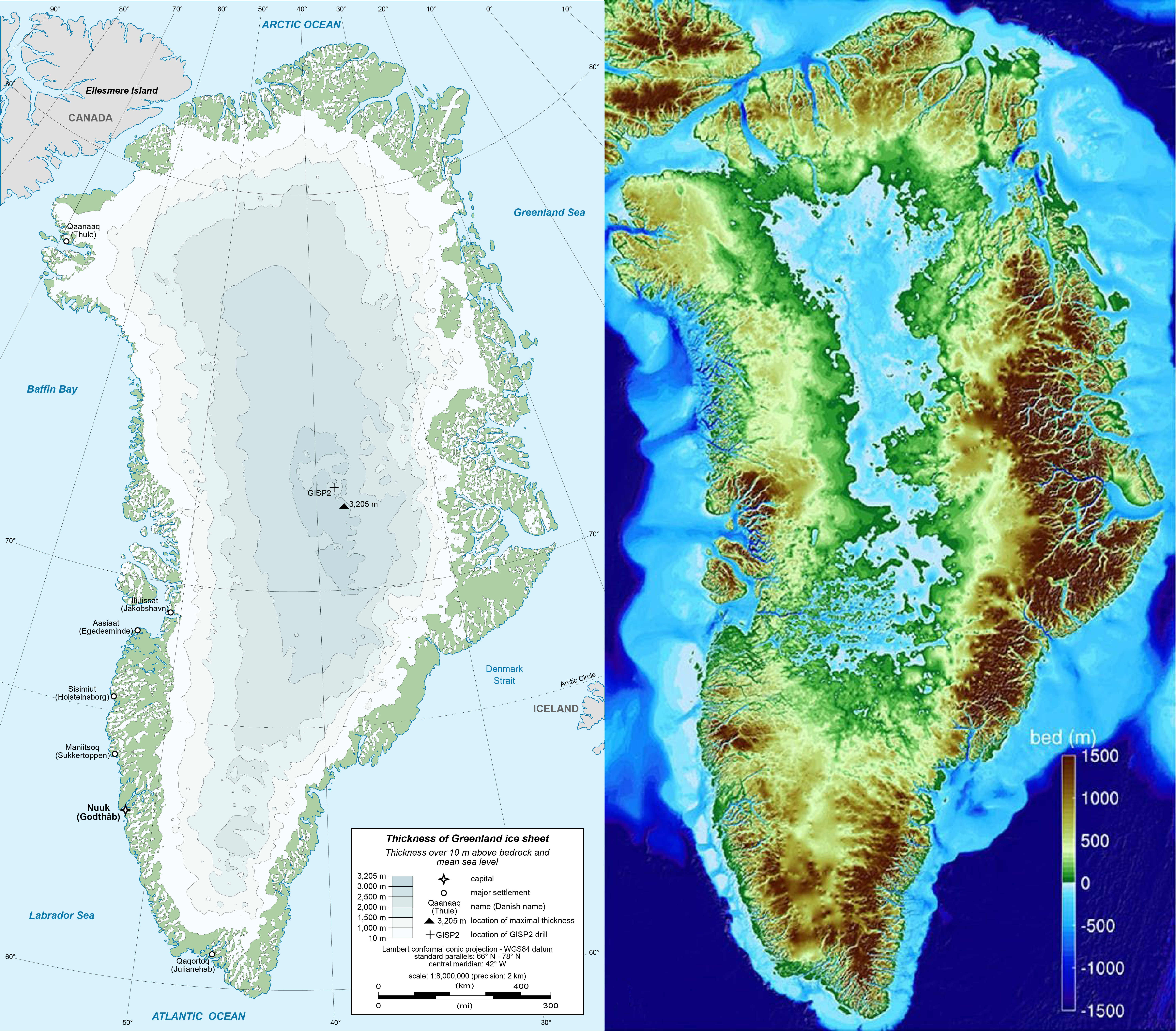
Even discounting Australia, Greenland ist disputed. Under the ice shield, it may be split into several smaller islands surrounding a large bay.
Just like Antarctica. It’s also nowhere near as big as it looks on the commonly used Mercator projection. IIRC the name “Greenland” was a fiction invented to encourage settlement. Greenland isn’t very green; it’s mostly white, the colour of ice and snow!
Maybe another difference, other than size, is the number of countries that reside on that land?
As a local, when I was a kid it was one of those fun facts we all “knew” that we lived on the world’s largest island and smallest continent.
But since recent events bringing Greenland to the fore, I’ve seen Greenland described as the largest island several times so I looked it up.
Quite simply there seems to be no definitive criteria. But the modern consensus seems to be that anything that is a continent is by definition not an island, and Australia is a continent because amongst other things it has its own tectonic plate and it’s big and has (or had) its own distinct indigenous peoples and wildlife.
Yeah, i guess i thought Greenland was the largest island and Australia was the smallest continent and you can’t be both. And the distinction is somewhat arbitrary. 
Decent reference material and discussion here: List of islands by area - Wikipedia.
Assuming arguendo that that image of a Greenland composed of several large islands and innumerable small ones is 100% accurate, then the largest island within the Greenland archipelago still has a decent claim to being the largest island.
For round numbers single-island Greenland has an area of ~822K sq mi. The next runner up is West Papua & New Guinea at ~303K sq mi. So ~37% as large. If the biggest hunk of a multi-island Greenland is >37% of the whole, it’s still in first place.
The next runner up after that is Borneo at 289K sq mi. if the biggest Greenland hunk is larger than 289/822 = 35% of the whole then it’s in 2nd place.
After that the islands rapidly get a bunch smaller. For sure the biggest hunk of that putative Greenland archipelago is in the top 10. And in fact multiple Greenland hunks would probably be in that revised top 10.
All of this discussion needs to be modulo what height is sea level, and how do different sea levels move the coasts of every continent and island. If the Greenland ice cap was to melt with no other changes in Earth’s ice cover, sea level goes up ~24 feet. All low lying islands will disappear and any land with extensive coastal plains will shrink materially.
Of course in the real world, the Greenland ice cap won’t melt without other ice caps and glaciers changing somehow and therefore sea level rising even more.
Conversely, as long as the Greenland icecap remains intact enough, then practically speaking the “land” area of Greenland fully includes the ice cover that binds the archipelago into a what looks on the surface like a single landmass.
Well, the Encyclopedia Britannica describes it as the world’s largest island:
National Geographic does not consider Australia an island, because it is a continent:
My recollection growing up is that in the 80s I have memories of being taught Australia is the world’s largest island or somesuch, but in high school in the early 90s, we were told a continent can’t be an island (especially as all continents are surrounded by water). Similarly, Antarctica is not an island, as considered by geographers.
So, colloquially, sure, Australia might be an island. Technically, in the field of people who care about these distinctions, no, it’s not an island, as it is a continent.
So you’re saying sleazy real estate developer puffery has a long history? 
Good post. I will just add that if Greenland’s ice cap melted away, isostatic rebound would change the shape and composition of it’s islands into potentially one, bowl-shaped landmass. Of course, the process would take hundreds, if not thousands of years - it’s still ongoing in northern Canada from the last ice age.
There are multiple components to isostatic rebound - a slow component which does take millennia to fully unfold, and the quick one which happens very fast. Greenland in fact is rising quicker than the oceans are rising, due to the recent removal of a lot of its ice. If this can be linearly extrapolated to the entire ice sheet (and I don’t know if it can or not), then very soon upon removal of the ice sheet, a lot of the “islands” would link up, since that would mean rising meters instead of millimeters due to a thousandfold increase in the ice mass that was removed, and a lot of the straits between the future islands are pretty shallow.
This also, fortunately for us current humans, means that there isn’t a danger of a runaway sea intrusion, where rising ocean levels mean more ice loss which mean more sea level rise, etc. (There are other feedbacks that could come into play of course.)
AIUI, Erik the Red named both it and Iceland (the latter to discourage settlement so he and his friends could glom onto it).
That’d be a criterion of doubtful usefulness. There are fairly large islands on which only one country sits (e.g. Borneo, Madagascar, Honshu, Great Britain) and fairly small islands divided among several countries (Hans, Märket, St Martin, Usedom).
And as for Australia, I’ve also been taught that it’s a continent rather than an island. My guess is that its status as a continent comes from the old myths about Terra Australis, the vast southern continent which Europeans assumed for centuries existed south of Africa and Asia. Australia is much smaller than that hypothetical continent, but since it was discovered in the course of the search for the latter, it inherited both its name and its status.
In the book Worldwar, aliens arriving on Earth describe it as having two continents: a giant one that includes most land and has some broken bits in the south, and long squiggly one that stretches north to south.
“Afroeurasia” is a better name than “Eurafricasia” IMHO.
0 and 1?
According to FIFA, Australia is part of Asia, and that’s good enough for me!