I wrote a .bat file last week. I can’t say I use them a lot, but when the situation calls for it, they’re mighty handy.
They are being used by some portable spyware scanners to elude blockiing by the target spyware.
I have some on a USB key for when I want to boot straight to DOS (mostly to play really old games, or to un-fuck windows stuff that the OS won’t let you touch while it’s running).
Again, LaTeX is a plain text file with text markup. If your tape wasn’t crap, you could edit and render your file to DVI/PDF/EPS/HPGL/whatever just as easily now as then. And you could probably use scalable fonts and a bunch of new goodness to make it look really smooth.
IMHO: ASCII never goes out of style 
Si
I use .bat files most days…
If I have a load of file copying / moving or such - do it in a .bat file and run the file on startup script on every PC - easy - would not be without them.
I was shocked a while back reading about what happened to the original tapes of the Apollo 11 moonwalk.
Extinct is not a good term here because in the wild, if there are no more of a species left, that species can never come back (ignore cloning). If every BAT file ceased to exist tomorrow, I could still create one. Media format, excepting hardware, is similar. When was the last time you could even purchase hard sectored floppies for your HeathKit or DEC Rainbow? Now read this from 2009. But then again, the original (8-bit) CP/M worked with Intel 8080 or Zilog Z80 chips. If those are both out of use and unavailable, then I guess you could say that in a way CP/M is extinct.
But you asked about file types. Since a file type can be created ex nihilo, a better term may be defunct and I can think of quite a few from the good ol’ DOS days like Wordstar, Lotus, Dbase or even eariler such as Visicalc. The point being that they may be defunct (not in use) but they are not extinct as I could creat a Lotus 123 or Wordperfect file if I needed to.
I suppose if the format of the data were lost and the data were encoded on some obsolete media the specifications of which were unknown, then the data might truly be unrecoverable.
That is a singularly narrow set of circumstances, and probably doesn’t exist now in 2012.
But what about 3012? We can read cuneiform tablets from about 5000 years ago, but I doubt if any of these scattered caches will be available for decoding even 50 years from now. Some archival methods are more sturdy than others. Which is the best to ensure that critical data is not lost?
Is acid-free paper and ink stored in nitrogen filled capsules deep in a cave our best bet?
In other words, this is a more extensive topic than was originally presented.
Should we split out a new thread for this?
Oh and .bat files are useful to catch .bugs, of course.
I have Word 4.0 documents which current versions of Word for Windows are incapable of correctly converting forward.
I have a box of 5.25 floppies from my C=64. I also happen to have a 5.25 disk drive from some long-ago Winbox build (it’s actually a combo 3.5/5.25 from when both were out). Is it theoretically possible that I could both get the drive up and running under Win 7 and run an emulator to read the disks, run software and read files?
Not impossible, but the trick will be finding a box that can run Win7 that has the motherboard connectors for a 5.25 disk drive.
Would it be possible to get some sort of USB adaptor? Seems like they make those for every possible configuration of old hardware you may have.
This is a concern in long term storage. A few years ago in Europe, a bunch of government and tech entities got together to study how to store data long term and also be able to read it in 50 years. http://mobile.techworld.com/news/storage/7637/old-file-formats-battle-extinction-threat/
For a normal person, the media is probably more important. If you put a lot of important data on Zip drives 15 years ago, you may be out of luck trying to recover it today, and surely will be screwed if you wait another 20 years. It may not be impossible, but cost might be a factor.
I haven’t had to look specifically, but I’m pretty sure even my most recent build (just a couple years) had a floppy connector. Every board that I looked at seemed to have one. Again, though, I wasn’t looking specifically, just something that’s there.
(linkto the layout of the P6t; item 15 is the floppy controller.)
Or will that connector only work with 3.5 drives? But weren’t 3.5 and 5.25 working in the same machines for years? Don’t remember a connection change that forced abandonment of the 5.25 cabling.
They are also useful if you want to automate and you are very good at programming.
I created some just last week - it was the right tool for the job at the time.
Connectors for 5.25" drives are frakking huge and look really weird compared to modern connectors. Actually, that image reminds me that if your motherboard has a floppy disk connector, all you need is the right cable. Funny what you forget.
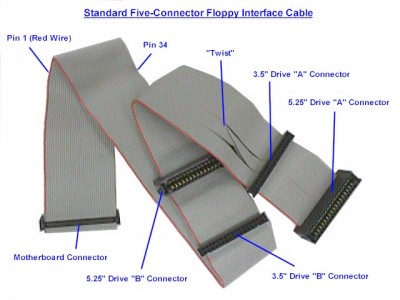
I’m no good at programming, but if all you need to automate is copying files around and renaming them, I don’t see why you’d ever need anything else.
JPG is a really bad example to pick, since it is one of the most common file formats out there. In fact, it’s one of the ones I would pick as safe for an archive use.
But let’s look at my old publishing project from circa 2000. I still have the files backed up. But I do not have a version of either Photoshop or Quark XPress that will run on my current computer. So restoring those files means either spending $1,000+ on new software or finding a very old computer to run it. In 20 years, I’m not sure what the options will be. So the files are not extinct, exactly… on the other hand, they are still effectively lost to me.
(Fortunately, I do have plenty of the source files in .doc, .tif, .pdf, etc. and I do have the final print files in .pdf. I could republish in an instant, but making updates has a huge hurdle to cross.)
Many, many years ago there was a one-page article in the American Heritage Magazine of Science and Technology bemoaning the fact that a lot of early computer records were no longer accessible because the formats had changed, and no one had adequately documented the formats. The data still existed on reel-to-reel tapes and the like, but nobody could decode the ones and zeroes into meaningful information. This article was written , IIRC, in the early 1980s, so it was talking about data from the 1950s and 1960s. I don’t know if the situation has changed for that early stuff.