You could say that one mountain is 3dB taller than another.
It’s all about abstracting away the actual unit of measurement, and talking solely about relative values. Either between two measurements or one measurement and an implicit or explicit base value.
The fact the most common use of dB is for sound w an implicit base value really pollutes everyone’s understanding.
Since the OP has been answered, I’ll get this off my chest re examples of how loud something is.
One of the most common examples is comparing sound/decibels to a jet engine. This is an awful example. 99% of people have never heard a jet engine the way the example is intending, but most people have heard a very muffled jet engine (sitting inside an airplane). So I can instantly recall the sound of a jet engine in my head for the example, but I think it’s completely inaccurate. It’s not that loud at all.
Is this right, or am I way off? Or is that the right level and it’s not that different outside the plane.
You could also develop a dB scale based on a reference height for a mountain. It can be anything, but everyone has to agree to use it. You could say, for example, 5000 ft is the reference height, and thus 5000 ft = 0 dB, 10,000 ft = 3 dB, etc.
But… I think it’s bad form to use “dB” when signifying absolute values. One or more extra characters should be added to let the reader know that there is an agreed-upon reference value. As mentioned previously, dBm is used in electronics for absolute power levels, where the m signifies the reference power level is 1 mW. For this example, perhaps a 10,000 ft. mountain would have a height of 3 dBf (where f signifies a reference height of 5000 ft) or even 3 dB₅₀₀₀.
For those learning about dB scales, I agree it can be confusing. A few things that might help:
dB scales were invented for convenience. They’re not necessary. Everything in science, math, and engineering can still be done without using dB scales.
A dB scale is simply a lossless function / mapping of numbers. It is usually done when the range of values is very, very large, like many orders of magnitide. We take that huge range of numbers and “compress” them down to a range of only -100 to 100, or -200 to 200, or whatever. Similar to what the Richter scale is for earthquakes.
Once the “compression” is done, you learn that some of the rules are really convenient, e.g. doubling the magnitude (regardless of what it is) is an increase of 3 dB, 10X the magnitude is a 10 dB increase, 100X the magnitude is a 20 dB increase, etc.
My take is that “jet engine SPL” is standing outside near a late 1950s 707 at takeoff thrust. IOW a sound nobody under age 50 could ever have heard, and precious few older than that.
IOW, not instantly damaging, painful but tolerable briefly, and you’d need to shout to be heard by somebody standing next to you.
I am over 50 and I have heard that noise and yeah…it was borderline painful. I would not say jets are “quiet” today but they are sooo much more quiet (read: less loud) than they once were.
I have never stood near a jet engine outside whole it was running, no, but I have seen enough movies with such a thing and been inside enough planes to understand that it basically means “Very loud, would have to shout to be heard, should be using ear protection and would be painful for more than brief moment.” Which is really all most people need to understand so IMO the comparison makes total sense.
There are various ways we can use dB scale(s), as others have commented. For audio/sound purposes, we often use a term like “dBA.” The “A” does not stand for “audio,” it indicates that we are measuring sound pressure levels using the DIN A weighting scale. DIN A places more emphasis on frequencies towards the center part of the human hearing spectrum and less towards high and low frequencies. Public address and fire alarm systems basically always use dBA as the standard measurement of sound level for notifying occupants. You would NOT use this for home audio systems because you don’t want the weighting…you want a flat frequency response measurement from 20 Hz to 20,000 Hz.
I mention this because engineers will see “dBA” and immediately think “measured sound pressure level weighted for best intelligibility in human hearing.” If they see “dBm,” they think “power measured relative to one milliwatt.”
I have no idea what abbreviation we would use when measuring mountains.
This is what I don’t understand… (the “why” of using decibels)
But… why did we need a separate unit for that? We routinely do that already:
In common use, we say things like a “ton” or “ounces”, or milligrams and kilograms
In science & engineering, you can express things in scientific notation, or as a log of something else
For example, for sound, why not use micropascals, millipascals, pascals, etc.?
e.g.
Common Reference / Example
dB SPL
Equivalent Pressure
Jet engine / Threshold of pain
140 dB
200 pascals
Loud concert / Threshold of discomfort
120 dB
20 pascals
Jackhammer / Motorcycle
100 dB
2 pascals
Standard calibration reference
~94 dB
1 pascal
Heavy city traffic
80 dB
200 millipascals
Normal conversation (at 1m)
60 dB
20 millipascals
Quiet library
40 dB
2 millipascals
Rustling leaves / Quiet room
20 dB
200 micropascals
Threshold of human hearing
0 dB
20 micropascals
Like, among all the units that commonly span orders of magnitude, why is sound in particular typically expressed as a ratio instead of an absolute value with an SI prefix?
Am I unusual in finding SI + pascals more intuitive than dB, then? Like the difference between 200 pascals and 2 millipascals feels much, much bigger than the difference between 140 and 40… no?
Logarithmic graphs are pretty common, no, regardless of the unit?
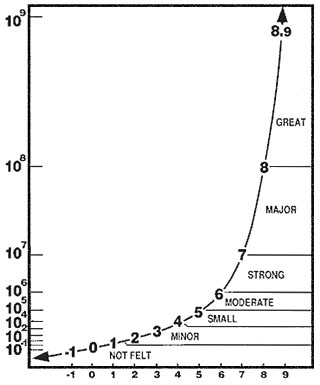
like for earthquakes:
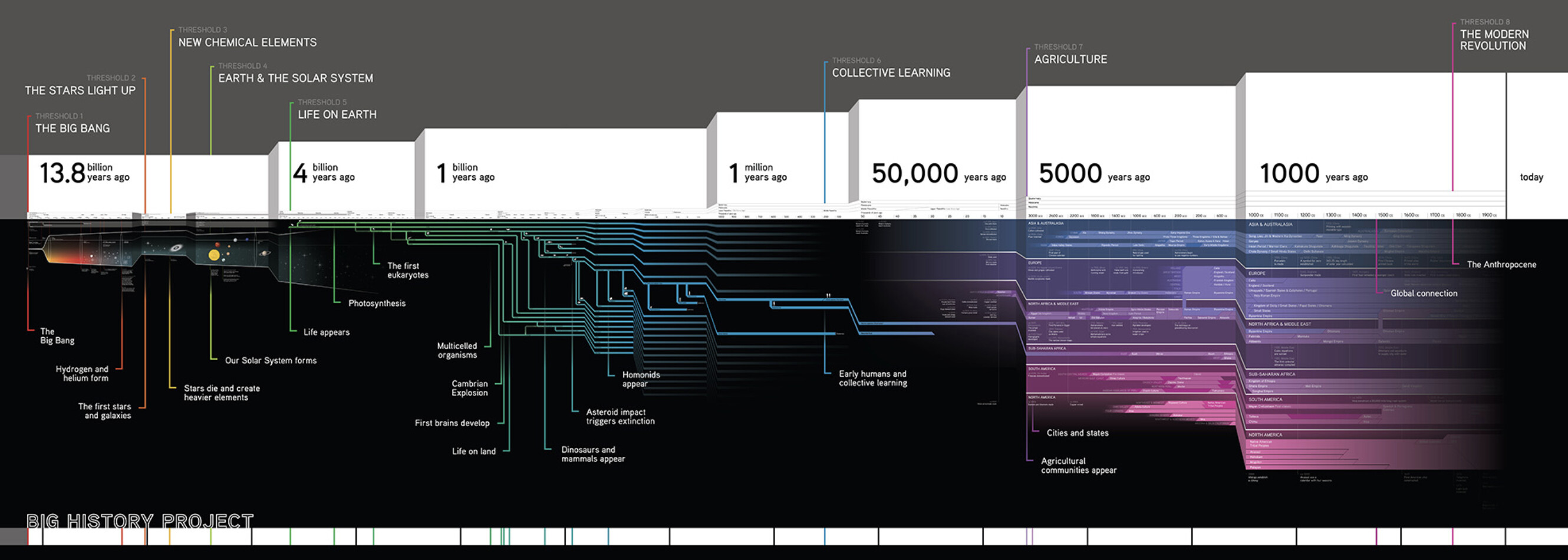
or years:
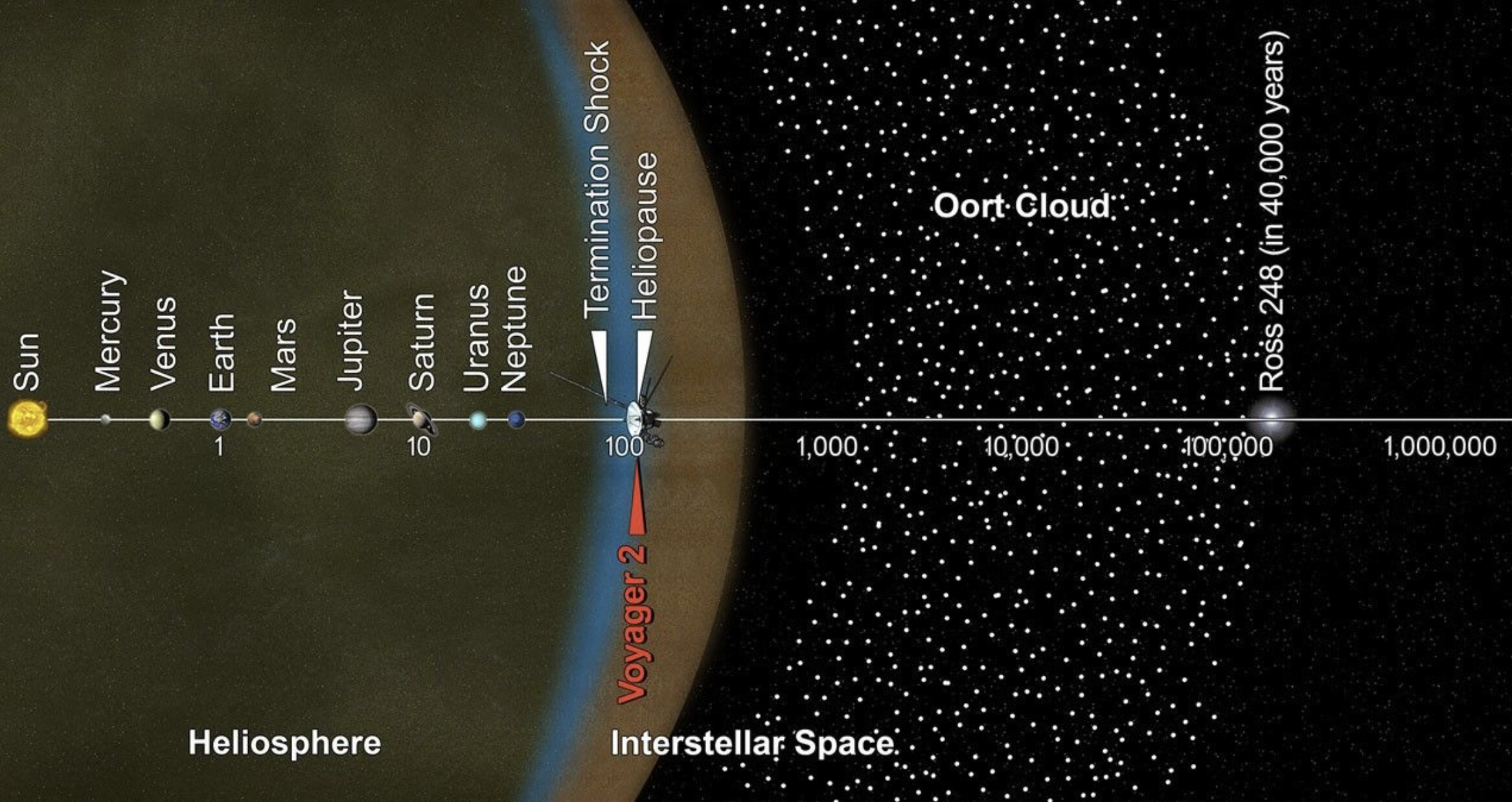
or distances:
But the base unit for those things still aren’t ratios like they are for sound?
I guess what I’m asking isn’t so much “when are logarithmic scales convenient”, but why sound is measured as a ratio (to the reference value) when most other orders-of-magnitude units simply use SI + an absolute value?
Part of the reason is that human hearing is nonlinear. It’s difficult to quantify precisely what “sounds like” means, but a logarithmic scale is at least a reasonable approximation. Roughly speaking, you can tell the difference between the loudness of two sounds that differ by about one decibel. You can’t make a statement that simple about sounds as measured by SI units.
Echoing others: For sound specifically, a logarithmic scale is sensible given that our perception of loudness is roughly logarithmic. And, nicely, every increase of one bel (10 dB) makes a sound seem about twice as loud. Many years back I lightly hobbied with acoustics, and a friend and I would play each other sound snippets at two secretly chosen volumes and test if we could accurately say what the dB change was. And this sense of “change” (e.g., 2 dB? 12 db?) is largely the same regardless of the absolute level, within reason.
It’s a small step to make this sensibly logarithmic relative scale absolute by placing a reference zero on the chart.
In audio engineering and mixing, you usually don’t care at all about the actual SI pressure (pascals or whatever) in some eventual air for some eventual listener in some eventual environment. If I want to lower the perceived loudness of this channel relative to that channel, the relative amplitude or power – discussed in dB – is all I need to talk about. And the log scale also conveniently means that changes in power and amplitude relate simply by a factor of two instead of by squaring of some absolute level.)
The last several posts have done a very good job explaining the advantages of the logarithmic scale, especially due to our nonlinear sense of hearing.
Going back to audio amplifiers, it was once common for consumers to think, “If I buy a 100-watt amplifier to replace my 50-watt amplifier, it will sound twice as loud!” As we’ve seen from this thread, the most that the consumer could expect to get would be sound that is 3 dB louder. (Increasing by 3 dB requires doubling the power, and it takes at least 10 dB to sound twice as loud to a human.) 3 dB is hardly worth mentioning if someone really wants to turn up the volume.
Anyway, using a dB scale to measure sound levels is much more convenient and practical than working with power (watts) or pressure (pascals).
I don’t see a problem with negative temperatures, since they simply mean “less than some established baseline for zero”. But apparently old man Daniel Fahrenheit wasn’t too fond of them, so he set the baseline at the freezing point of brine – he used a mixture of water, ice, and salt. So negative temperatures would at least be rare in typical weather forecasts.
This prevents negative Fahrenheit temperatures in most regions of the world, but those of us in northern climes still see them once in a while. I find 0°F to be a useful baseline because “zero or less” on the Fahrenheit scale exactly represents the chances that I will be leaving the house in such ungodly weather!
In my line of engineering work, we use dB everywhere as a simple way of accounting for multiplicative factors. Instead of multiplying the linear factors, you add the dB terms. The end results is often a ratio (like the signal-to-noise ratio) so that it’s easy to associate the value of 1 to 0 dB.
Furthermore, using dB makes it easy to estimate values, because of some easy to remember conversions:
linear
1
2
4
5
8
10
dB
0
3
6
7
9
10
It’s like keeping a very simple slide rule in your head. I force junior engineers to work out estimates in their head using dB until they develop a good intuition of what values are reasonable. Use the computer to get a precise answer, but the human engineer had better know what it should be within a few dB.
Maybe so, but Celsius is the real problem when it comes to USAian perceptions. 0°C sounds awfully cold to those unaccustomed to Celsius, but to us hardy Canucks it’s merely the temperature at which pure water freezes, and thus is basically shirtsleeve weather!
The numeric meaning of decibel (or bel) is overlooked in many of the answers. If we set aside questions of human perception; and just treat bel (or decibel) as simply the ratio between two measures of power, then:
10 decibels (i.e. 1 bel) denotes a power ratio of 10:1. So 20 decibels (i.e. 2 bels) denotes a power ratio of 100:1. Thus a 100-decibel source transmits energy at 100x the rate of an 80-decibel source.
In signal processing, “energy” is a sum of squares; and SNR (“signal-to-noise ratio”) is often measured in decibels.