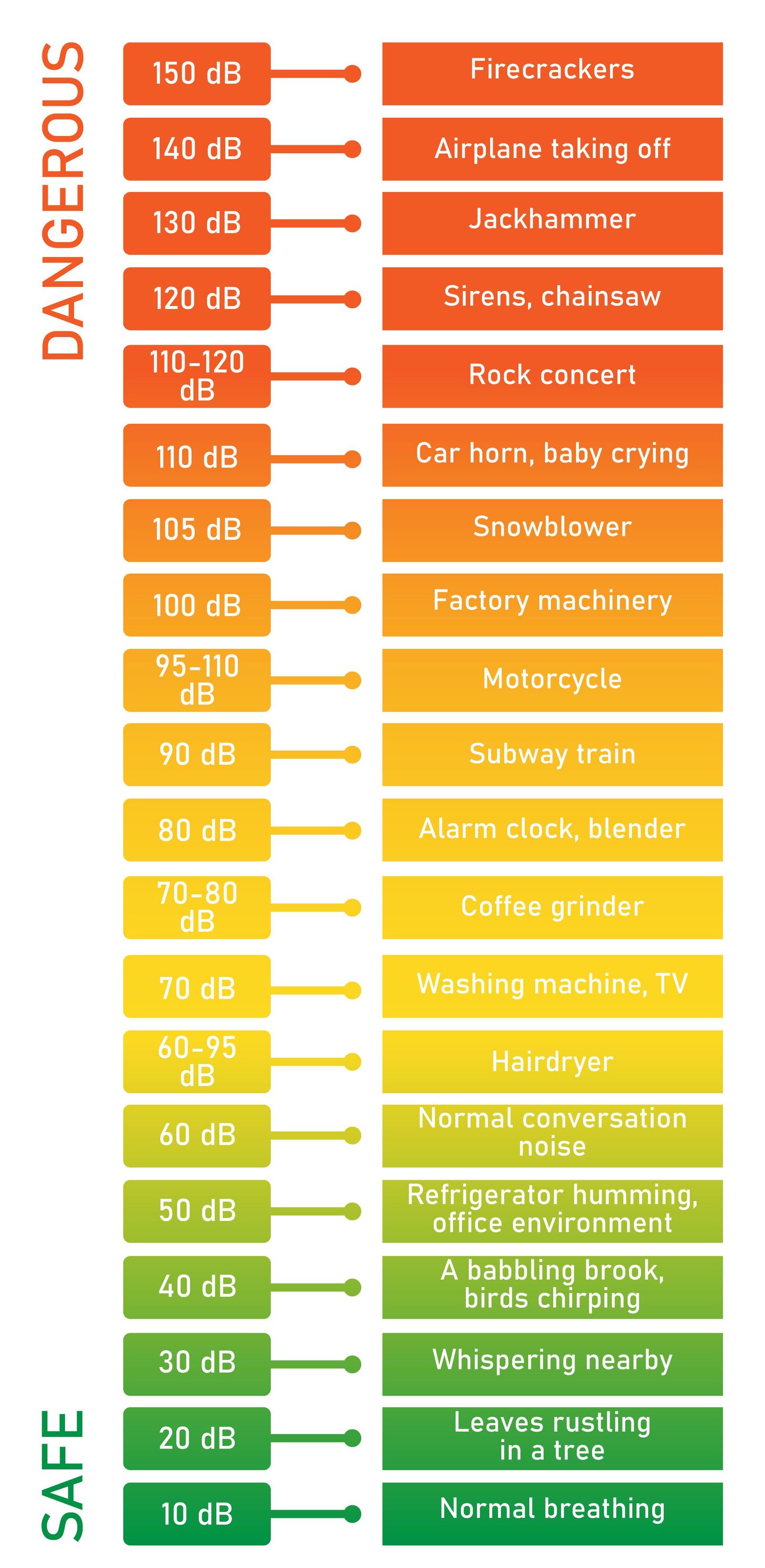
Decibels can be applied to anything. In the electrical world, decibels (dB) are used for power.
Let’s apply decibels to the power of an engine. But we first need to define a “baseline” power. It can be anything. Let’s make it 10 horsepower (10 HP).
Here is the horsepower to dB mapping for the power outputs of six engines:
10 HP → 0 dB
20 HP → 3 dB
100 HP → 10 dB
1,000 HP → 20 dB
2,000 HP → 23 dB
10,000 HP → 30 dB
Here are things to be noticed:
The mapping greatly compresses the numbers; for a range from 10 HP to 10,000 HP, the decibel range is 0 dB to 30 dB. And it’s a nonlinear mapping.
If you double the power output of an engine, e.g. 15 HP to 30 HP or from 44 HP to 88 HP, then the power has increased by 3 dB. (Actually, 3.0103 dB. But we usually round to 3 dB.)
If you increase the power output of an engine by a factor of 10, e.g. 15 HP to 150 HP or from 44 HP to 440 HP, then the power has increased by 10 dB.
Here’s the data from 1 HP to 20 HP:
1 HP → -10.00 dB
2 HP → -6.99 dB
3 HP → -5.23 dB
4 HP → -3.98 dB
5 HP → -3.01 dB
6 HP → -2.22 dB
7 HP → -1.55 dB
8 HP → -0.97 dB
9 HP → -0.46 dB
10 HP → 0.00 dB
11 HP → 0.41 dB
12 HP → 0.79 dB
13 HP → 1.14 dB
14 HP → 1.46 dB
15 HP → 1.76 dB
16 HP → 2.04 dB
17 HP → 2.30 dB
18 HP → 2.55 dB
19 HP → 2.79 dB
20 HP → 3.01 dB
Note that a negative power level in dB simply means the power is less than the baseline power.
The equation for converting horsepower to dB is simple:
engine power in dB = 10 * log (engine power / baseline engine power)
where “engine power” and “baseline engine power” are both in HP.