so 100 to 80 half to 94, half again to 88 , half again to 82 …
so down to less than an eighth.
There are a bunch of attenutation effects, eg a specific distance, any filter, sound proofing, a connection in a cable, a splitter in a cable , that operate as a constant dB drop. So its conventient to be able to simply deduct that dB rather than if it was done with linear units, they would be factors like 1% reduction, you’d have to get the calculator out.. but with dB , just subtract the dB.
Basically most of the calculations in the physics that use dB are simple + or - the dB…
Also the graph fits on one page better than using linear units.
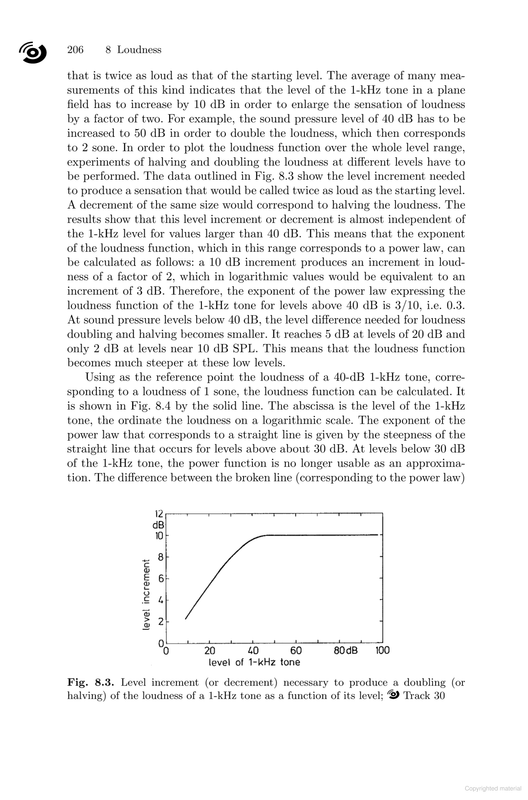
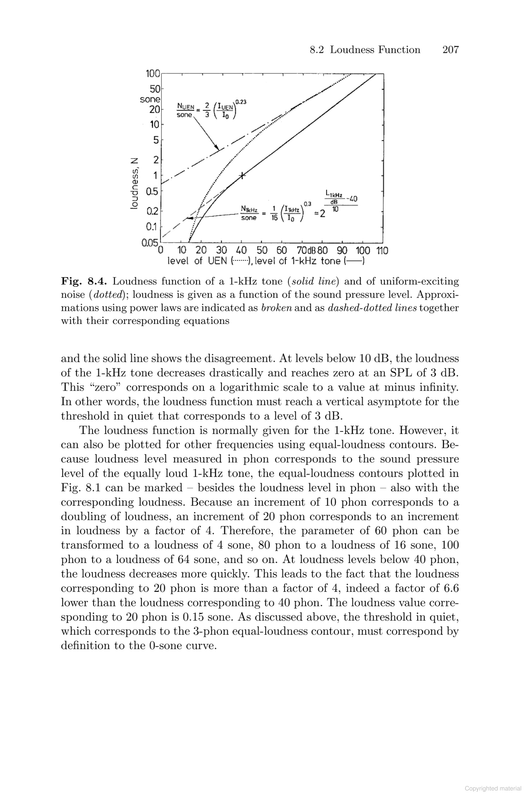
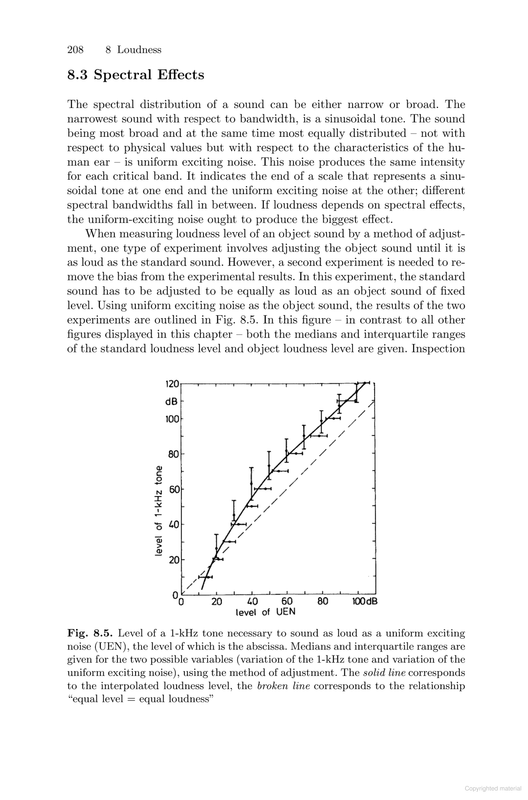
Again, this is simply not true. If you crack open any psychoacoustics textbook, you will find various graphs and formulas for perceived “loudness functions”. And you will see that, for example, for a 1 kHz tone between approximately 40 and 100 dB SPL the level has to change by approximately 10 dB to half or double the loudness, not 6 dB.
Cutting the voltage in half would be a 6 dB drop. Power is the square of voltage so reducing by 6 dB is a quarter of the power. To your ear though, it does not sound like very much. One dB has been described as a barely perceptible difference. Our senses work on a logarithmic scale. We can feel the weight of a coin or of a concrete block.
There is often confusion here. Decibels are about power (almost always).
log_{10}(2) = 0.301 So a power doubling in dB is ten times that, or 3dB.
Power is proportional to pressure (or voltage squared). And - log_{10}(x^2) = 2log_{10}(x)
Which is why when we see the definition of Spl, via pressure (or power measured via voltage), the definition is 20 log_{10}(ratio)
The factor of two is thrown into the mix so often that is becomes part of the landscape. This is because measuring power is harder than measuring voltage or pressure. So it is common to see a (sometimes confusing) mix of definitions. If you see 20 times, you know why.
Sound pressure levels in dB Spl are defined as 20log_{10}({pressure \over 20 \mu Pa} )
Thus the result is always a relative power level from pressures.
Perceived loudness is a whole different problem. The “10dB Spl is a perceived doubling” is a good rule of thumb, but does fail in the extremes.
The point made above about adding rather than multiplying really is a key to why we use them. It isn’t just a weird arcane convention.
If I am an RF engineer, and I have a bunch of devices and a transmission line everything is easy. I might have 100 metres of coax with a loss of -0.1dB/m at the frequency I am using. I have four connectors with an insertion loss of -0.2dB each, and a preamplifier with a gain of 9dB. All I have to do is add them all up to get the final gain/loss of the contraption. -1.8dB. Easy. Working with simple ratios is wretched and error prone. Otherwise: the amplifier has a voltage gain of 2.8, the coax loses 1% power per metre, and the connectors 2% each. How would you want to wrangle things?
I’ve heard of those things the same way I’ve heard of pocket protectors (in nerd-dom lore), but I’ve never seen or gotten to use one in real life… is it like this sort of handheld ratio converter thingy, a kinetic Excel almost?
It’s essentially a ruler where the distance markings are logarithmic, not linear.
If you put two such rulers long edge to long edge, you can multiply, say, 2 x 3 by setting the start ( =1) of the first ruler next to the 2 of the second ruler, then looking at the 3 of the second ruler. Which you will notice is aligned with the 6 of the first ruler. Ta da! 2 x 3 → 6. Because log(2) + log(3) = log(2x3) = log(6). Because you’ve measured a log distance of 2 on one ruler, then a further 3 on the other.
A slide rule simply attaches the two rulers together so they can slide back and forth alongside one another. The old slang term “slip stick” accurately describes how the two sticks = rulers slip back and forth relative to one another without getting separated.
A real slide rule often has more than just one set of rulings on each stick. @Ancient_Nerd’s picture shows 8 or 9 scales; so many they’re hard to count, much less use. That’s so the same device can not only multiply, but square and square root, cube & cube root, do trig functions, etc. Like late era scientific calculators, there can become so many scales / buttons you can’t readily find the basic plus, minus, multiply, & divide features amidst the clutter of everything else.
But the very most basic elementary school version is just two rulers, each with a log scale instead of linear markings.
Slide rules were in common use when HP electronic calculators cost uninflated $$$; today they belong in the “what was once ubiquitous that has completely disappeared” thread.
Slide rules were normally carried in a case, not just loose. Also, on every slide rule that I’ve used, the middle section has enough friction that it won’t slide out just by holding it vertically.
A stop wouldn’t really work, because in different situations you need to slide the middle section either left or right.
The slide rule I have came with a carrying case. Also, you do not want the slide too loose; it should slide completely smoothly but stay in place when you are not moving it.
Semi-ninjaed, but here’s some more history as it was experienced.
As to sliding or falling apart:
The sticks were tongue and groove in cross section where they met. There was usually a leaf spring device somewhere in there that provided some friction between the two sticks. That friction also helps ensure the sticks didn’t slip relative to one another while you were reading out one answer or prepping to do another calc in the chain. Likewise there was a leaf spring inside one or another end of clear plastic cursor so it didn’t slip either. Move easily; yes. Slip; no.
As to chronology:
I started first grade in late 1965. Simplified kiddie slide rules were introduced in AP math around 5th grade along with logarithms, so 1969 for me. Once in HS, the nerdly crowd had slide rules; you could buy cheapies alongside the rest of the school supplies at drugstores, the then-current equivalent of modern Target, etc. Certainly the then equivalent of a modern Staples or Office Depot would have them.
Handheld scientific electronic calculators became available as I was starting HS in late 1972. But cost more than the modern equivalent of $1K. Nerds with rich parents got them as graduation gifts, or maybe when they started taking extra classes at the local junior college before HS graduation. The sale of slide rules to students cratered as the prices of integrated electronics cratered too.
By the time I graduated HS in 76, all the middle-class and up nerds had scientific calculators while slide rules were now snickered at. The non-nerd kids almost all had classic “4-banger” electronic calculators that could add, subtract, multiply, and divide. And some of those even had an accumulator you could add intermediate values into. Woot!
By the time I was halfway through undergrad, say 1978, slide rules were museum pieces.
Yeah. I’m a bit younger than you, so sliderules were just out of fashion when I got to the age at which I’d have been introduced to one. In 7th grade (in 1977) a friend of mine was assigned to do a math report on slide-rules and he was completely flummoxed, so he came to me for help. I quickly diagnosed his problem: while he had an instruction manual for a slide rule, he didn’t have a slide rule - he had a metric-imperial conversion doohicky.
Once he got a real slide rule, I figured out how to use it (with the instructions) and showed him how to use it, and we had a few weeks of fun getting good at it. Later I acquired a few slide rules of my own, from my slightly older cousins and an uncle.