I’m considering the purchase of a lithium battery-powered lawn mower, and I’d like to get some idea of battery lifetime. Assuming I can cut my lawn on one charge, I expect to charge the battery 30 to 35 times a year. I seen numbers like 500 charging cycles, but that seems to be for Lithium ion phone batteries.
Does anyone here have experience using these batteries in lawn mower application?
Lithium-ion batteries in general do not age well. That’s just the way that the battery chemistry works. It doesn’t matter if it’s in a cell phone or a laptop or a lawn mower. Lithium-ion batteries start dying from the moment they are made, and to some degree there’s not much that you can do about it.
Hopefully you’ll have at least double the battery power required to mow your lawn, so that when the battery does lose capacity, you’ll still end up with enough capacity to keep mowing your lawn on one charge. At best, after about 5 years or so, the battery will probably only have about half the capacity it does now. Worst case, you’ll get more like 2 years out of it before the battery is shot.
Heat kills lithium-ion batteries. So mow in the morning or evening so the battery doesn’t get as hot, and don’t store the battery in a hot shed. If the only place for your mower is a hot shed, maybe take the battery out and store it in your basement during the week.
A typical lawn mower battery will give you about half an hour to maybe an hour of mowing on one charge, depending on the size of the battery, the power and size of your mower, and how thick and tall your grass is. Like I said, the battery is going to lose capacity over time no matter what, so the bigger battery you get, the more likely you will be to be able to finish your lawn in one charge as the battery ages.
Sorry for not putting this all in one post, but I didn’t think of this until later.
Another thing that will help with the battery longevity is not to store the battery at full charge. If you mow on Saturday, leave the battery at a low charge all week and charge it up again on Friday night.
Lithium lawn mower batteries get particularly stressed. They are subject to heavy loads, and apparently rapid charging as well. They are also very expensive. However, if you mow once a week, and the batteries only last 500 cycles, that should be 10 years. 5 years if you have to recharge during a mowing session, or 10 years again if they actually last the 1000 cycles that higher quality batteries last.
Gas powered mowers don’t have very great longevity, in my experience they typically start to fall apart around 10-15 years at best. And they cost about $250-$500 to replace, depending on quality.
I’d say if you have a small yard, the lithium mowers are probably fine. Large yards, the issue is you won’t have enough battery capacity to finish in one charge.
Lithium-ion batteries can age well–if they are treated gently. For the most part, this involves what you’ve said, though I would add that you don’t want to store the batteries at too low a state of charge, either.
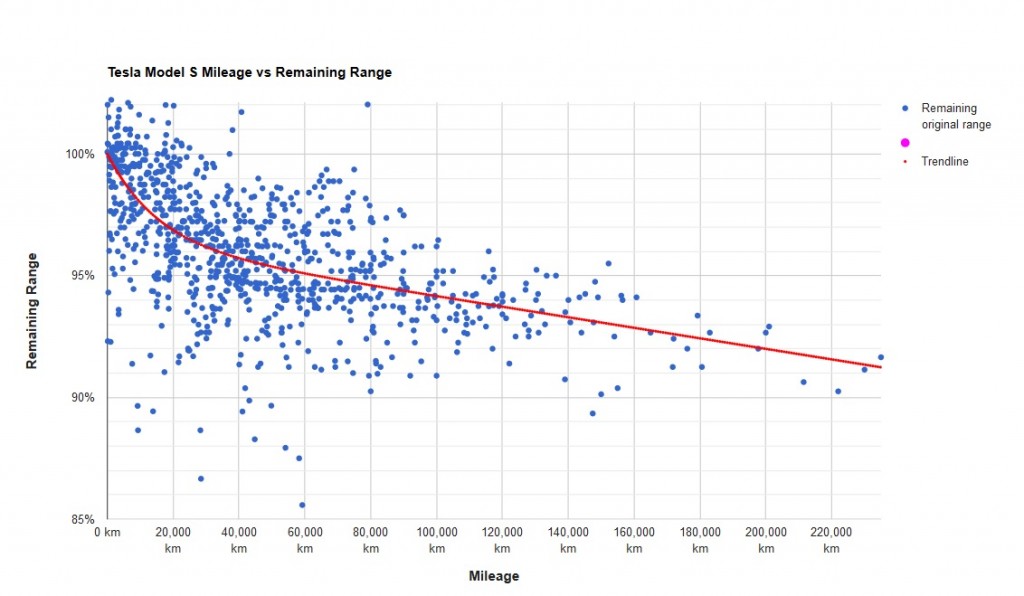
Here is a graph of cell performance of the Tesla Model S. Consider the 200,000 km mark; the cells still have 92% of their capacity remaining. A Tesla uses about 0.2 kW-h of energy per km, so at that distance the pack has been through 40,000 kW-h. If an average pack is 75 kW-h, that’s 533 equivalent full discharges.
The trick of course is that the packs rarely, if ever, went from 100% down to 0%. The charge controller keeps the pack from reaching the endpoints, and only rarely in normal usage does it even come close. For most day-to-day use, it probably stays at the 70-90% mark.
Unfortunately, a lawnmower battery is a very different thing. Its charging electronics aren’t as sophisticated, and the environmental conditions are worse. But as you say, being careful about temperatures and charge status can increase the lifetime greatly.