Well, they can kinda cheat it… the current date is injected into the system prompt when you start a new convo (so you can ask it what “today” is). The system prompt also includes your approximate location, the external tools the LLM has access to, injected memories, etc. From there they can usually figure out the tools to call if they need to, say, do detailed datetime math.
But they still don’t always get it right…
Given a prompt like:
What day is it today? What day was it 3 years ago? What about 365(3) days ago? And if it’s 6pm PST now, in this same location, what was the time 100 years ago? 1000 years ago? 10,000,000 years ago?
A weaker model (Haiku) messed them all up:
Today is Friday, September 25, 2026.
3 years ago was September 25, 2023 (a Thursday).
365×3 = 1095 days ago was June 18, 2023 (a Sunday).
Opus got them all right (verified against a classical datetime calculator):
[It does some web searches to make sure it got Oregon’s DST rules right, and learns about how Earth’s tidal changes over time affects day cycles]
Working out how much shorter the day becomes.
Today is Friday, September 25, 2026.
3 calendar years ago was Monday, September 25, 2023.
365 × 3 = 1,095 days ago was Tuesday, September 26, 2023. It lands one day later than the calendar answer because Feb 29, 2024 falls in that span, so three calendar years were 1,096 days.
The time question. In late September Bend is on daylight time (PDT), so “6pm PST” shows as 7pm on local clocks today. Assuming you mean the moment that is 6pm on the Pacific Standard Time meridian:
Notice the “working out” part (it’s reasoning to itself internally). In this case it doesn’t appear to have called an external datetime tool — I guess the internal reasoning systems have gotten better over time too (though I’m not exactly sure how; they stopped showing the full reasoning transcripts a while ago because the Chinese were scraping them and distilling them into cheaper models).
But you can force it to:
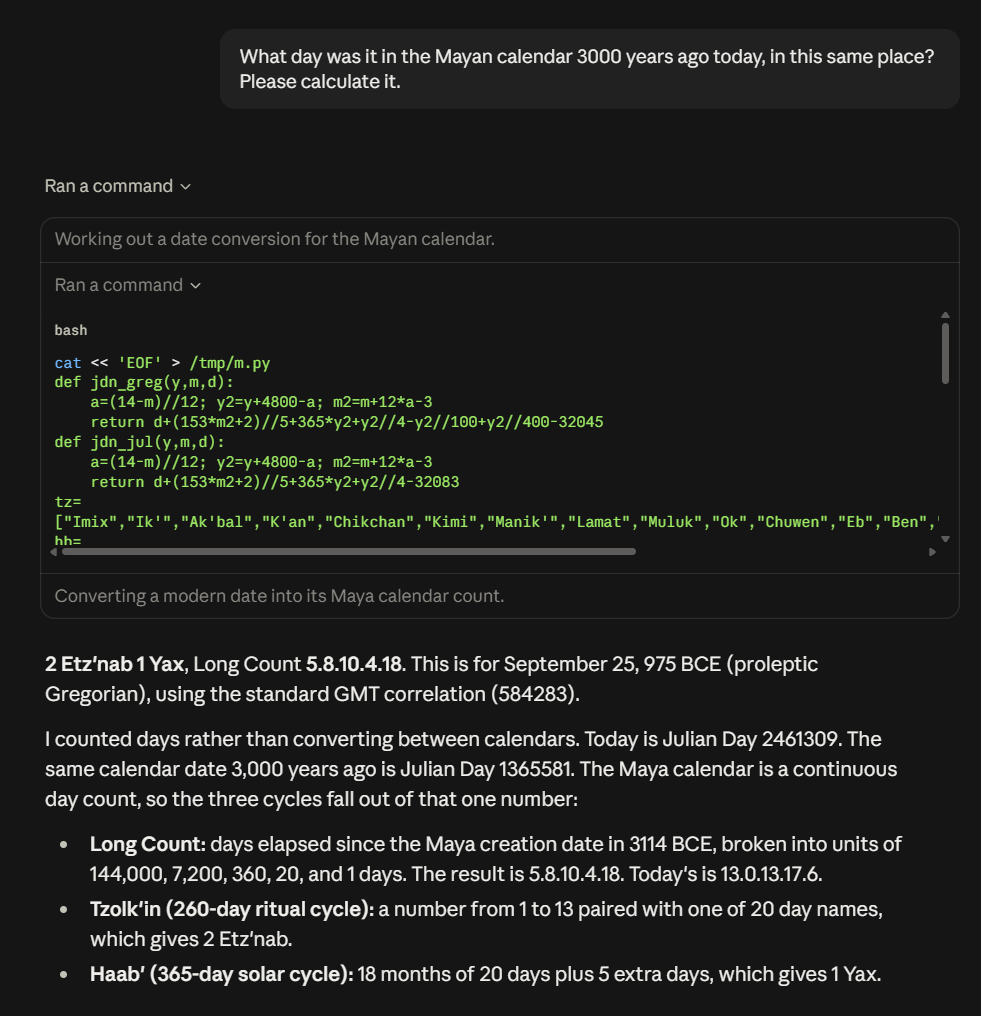
In that case it wrote some code to do the calculation that the LLM cannot do on its own.
(And it gets more interesting if you follow the rest of the conversation. Basically, it knows that the general rules around the conversions, and is able to write code to successfully calculate it. Then it either got lazy in a subsequent turn and guessed a wrong number, or if I’m understanding its reply right, it found an actual bug in the other calculator — I don’t know Mayan dates to say for sure either way  )
)
Also, side note, datetime math is HARD, even for humans, and even for classical computers: Calendar math vs time math (an explainer for some of the scenarios)
In my career as a computer programmer, this is the #1 topic that my peers tend to underestimate the difficulty of… everyone generally thinks it’s easy until they have to work with it. It’s actually quite nightmarish, between things like leap seconds, time zones (including half-hour and 15-min ones!), daylight savings time, etc.