How to make people comply without force

If you define any kind of coercion as force I think useful subtlety is lost, though it’s true in a sense. In particular if there’s a way to punish bad behavior that does not involve physically tackling somebody then and there but say some financial penalty they can’t practically avoid, though allowed to move off from the physical scene of the incident, that’s still ‘force’ in some very broad sense but has less of the downside of people who work out a lot, and let’s face it many aren’t always really looking to avoid physical confrontations they’re sure they can win, aka the cops, wrestling with people. And it’s not necessarily ‘letting it slide’ except in the sense of perhaps the ego of the cops (maybe mouthing off to them is one aspect, but so what, IMO, if that by itself) and/or the vicarious sort of way some people seem to look at the world through the eyes of cops though not cops themselves.

Though I’m not saying that can always be avoided. Sometimes it can’t. Some people are imagining a totally unreasonable (including drunk or high) person posing an actual threat to others, then not many other tools in the kit besides physical force.

jtur88 makes a valid point as far as it goes. Not all battles must be won, and certainly not won this instant. But …

There is a societal interest in having most people comply with most rules most of the time. We can argue whether “most” means 90, 95, or 99%. Different issues have different thresholds. i.e. The socially acceptable rate for speeding on the freeway is apparently 1% compliance and 99% not. The socially acceptable rate for simply running through red lights without slowing down is more like 99.999% compliance and 0.001% not. Which still means many lights are run in a big city every day.
The issue with selecting a hook (great post there Tranquilis) to influence behavior in any given instance of misbehavior is that society as a whole wants to select a hook that doesn’t encourage the behavior next time or in others watching. The US public is in an especially me first selfish mode these days and rampant impolite jerkitude is very much in style. Teaching people that they get a cookie when they misbehave might solve the instant case at the expense of creating 10 more. We’ve all seen spoiled kids caused by parents taking exactly that tack to “picking their battles” as they’re fond of calling it.
Most of us have experienced or heard of other societies where nobody stands in lines. They just all push and shove their way towards the front and whoever gets closest and shouts loudest gets served first. I don’t want to live that way. I suspect most Americans don’t want to live that way. But we will end up there if enough people decide they’re willing to live that way because waiting in lines is beneath them.

The problem is that “enough” is a pretty small number. If every time you line up for something, 10% of the crowd push to the front and the server accommodates them, real soon it’ll be 20 or 40 or 80% doing the same. So the two choices are to hold the number of cheaters to just a couple percent, or have it be nearly 100% soon enough.
An interesting side effect of social media is that bad behavior is more entertaining than is good behavior. One person getting away with their dog pooping in a park teaches only a couple of random witnesses that it’s acceptable to get away with that. A vid of the same event going viral teaches a million people that it’s acceptable to get away with that. Social media is a powerful amplifier for our worst tendencies.

i think you and i are mostly on the same page here. i dont think the airline should be accountable for the harm inflicted by the police. their shame in all of this lies elsewhere. however, i dont believe the on-time rating of the airlines should be of any concern to anyone other than the airlines. its not the police’s job to make sure the plane leaves on time. once they were called (regardless of whether or not they should have been), their only concern should be whether or not to evict the passenger, and, if so, how best to accomplish this. it is conceivable to me that this might not have gone the way it did if the police took their time assessing and processing the situation.
i dont know if time was a factor weighing on the officers, but it seems to me that it likely was.

mc

Ok, I will say it then. Violence is the only universally correct answer. There is a reason that every government everywhere insists that only it’s own agents, whether they be soldiers or police, can use violence lawfully. That reason is because it is super-effective in getting shit done.

Until it stops getting things done - Which it sometimes does. Or sometimes it gets the wrong things done.

Closer, as was expressed somewhere above, is: “The ability use, and implied threat of, violence, which is occsionally brought to reality, is the correct answer.”

Except that even subtly-implied threats of violence are frequently unnecessary, if you can find the right manipulation hook.

United made a mistake by not getting the other passengers behind them. The pilot should have come out in the cabin and explained to the passenger loudly enough to be heard by the other passengers that he had to leave based on legal regulations. The pilot would apologize and explain that he has to do this as part of his job, he has no choice in the matter, and he could lose his job if he takes off without removing this man from the plane. And if the man doesn’t get up he’ll announce to the crowd that they’ll be sitting on the runway for a while and the flight may even be cancelled if they can’t take off soon. If the guy doesn’t leave the crowd will cheer when the cops come and drag him out.

That works if the guy is a serial killer, pedophile, or hedge fund manager.

Doesn’t work so well when it is just a fellow passenger minding their own business.

Sure, there are going to be a few who get a sadistic pleasure out of watching another person get dragged away, but many people (and I like to believe most) do believe in empathizing on the “there but for the grace of god” principle.

The guy did nothing wrong, up until the time that AU ordered off the plane, in a way that was both against their policy and against the law. It very well could have been you being dragged off the plane.

And, it’s an escalation thing that goes both ways.

If we let the doctor get away with what he did, then what we will see is fewer flight crews willing to abuse their paying customers for their own convenience. If we let the airlines get away with what they did, then we will see more flight crews abusing their customers for their convenience.

You’re agreeing with me. I didn’t say inflicting violence was the universal answer, I just said violence in general. Violence can be implied and hinted at. It can even be aimed at someone else. The nazi in Indiana Jones and the Last Crusade didn’t shoot Indiana Jones to make him comply, he shot his father. This is why violence is the swiss army knife of problem solving.

If it stops getting things done, or gets the wrong things done, you are using it incorrectly. I have yet to find a single situation that can’t be resolved by the correct use of violence. It may not be the most effective tool, but it is always effective.

How United fucked up was letting the public see behind the curtain. They should have disembarked the entire plane, citing mechanical problems. Without the video to get people worked up, this case wouldn’t be local news, never mind an international scandal.

I had a cop friend tell me they had a hierarchy. Ask. Tell. Make.

Here is an article from the justice department on use of force continuum.

Persuasion tactics or using leverage (threats of fines or loss of privilege) can work.

And they could have used another tact to do so:
“We have randomly selected the passenger in seat 15C to be rescheduled to a different flight to accommodate additional crew members which need to be on this flight. If the passenger in seat 15C does not depart the plane in the next 30 seconds, we will reschedule ALL of the passengers in row 15 to be on a different flight and to have them exit the plane.
If the passengers of row 15 do not comply in 90 seconds, then we will reschedule all of the passengers in row 16 to be on a different flight and to have them exit the plane.
(and so on)…”

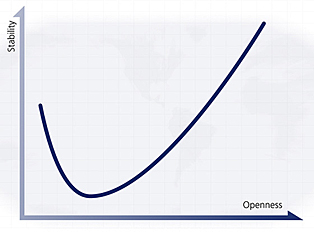
As far as violence, I think it follows a J-curve (X axis is the intensity of violence, Y axis is the level of compliance among the people who are on the receiving end of violence). Meaning, a small amount of violence works, a moderate amount of violence backfires, but overwhelming violence works again.

What happened at United was a moderate amount of violence. Moderate violence just enrages people and pisses them off while failing to intimidate them. But true brutality (torture, killing family members, etc) will make people accept the worst injustices. Lots of cops in America are (IMO) getting in trouble for moderate violence. Since we are a developed liberal democracy, cops and authority figures (thank god) cannot engage in extreme violence like torture, killing family members, etc.

But those same cops overreact to situations that only call for a less intense form of violence, which enrages everyone who is not intimidated by moderate violence.

Punishing the group for an individual’s actions is a favorite tool of tyrants, because it does work effectively on captive populations.

Does not work on populations that will never fly with you again.

Ultimately Crazy Canuck has a point. As Wesley says, standard police tactics run: “Ask. Tell. Make.” Let’s analyse this chain.

Ask works if the authority figure(s) are skilled enough at asking AND the subject is sufficiently receptive AND the subject believes they’re willing to escalate to Tell. If any of those are lacking, the subject is inclined to say “screw you”.

After Ask fails, Tell works if the authority figure(s) are skilled enough at telling AND the subject is sufficiently receptive AND the subject believes they’re willing to escalate to Make. If any of those are lacking, the subject is inclined to say “screw you”.

After Tell fails, Make works if the authority figure(s) are skilled at enough making AND the subject is insufficiently skilled at resisting AND the subject believes they’re willing to escalate to Kill. If any of those are lacking, the subject is inclined to say “screw you”, perhaps injuring some authorities in the process.

After Make fails, Kill works if the authority figure(s) are skilled enough at killing AND the subject is insufficiently skilled at evading/resisting. If any of those are lacking, the subject is inclined to say “screw you”, perhaps injuring or killing some authorities in the process.

All four steps form the hierarchy of negative reinforcement.

The hierarchy of positive reinforcement goes the other way: Since you’re misbehaving, we’ll reward you in exchange for you stopping doing so. Said another way, you’ll auction your compliance to the highest bidder. “We’ll pay you $20 to quit acting up.” “Nope, not enough.” “We’ll pay you $100 to quit acting up.” “Nope, not enough.” Doesn’t matter if it’s cash, goods, pride, or whatever. It’s some currency the miscreant values.

It’s pretty clear where that ends. If the troublemaker is smart he (it’s almost always he) will settle for a smallish payment. If he gets excessively greedy, even authorities who start out in positive mode will decide this guy’s too hard core for them to manage positively. At which point they switch into the negative ladder above.

This flowchart is why the OP’s question’s doesn’t quite work. There are lots of tactics besides violence. But once those fail against a sufficiently hard case, then what? To be sure, there are lots of cases where maybe the authorities *can *elect to walk away. But what if they legitimately shouldn’t?
From a cold, hard perspective, the only alternative to violence as a last result is a wildly disproportionate response (aka, go nuclear.)

A passenger refuses to get off the plane? Cancel the flight, remove the flight crew, have the ground crew offload all the luggage and cut the power to the plane. Then when the passengers get off, put the Louisville crew on and take off.

Woman won’t clean up after her dog? Follow her home, screaming at her, throw the dog poop in her front yard, and picket her house every day.

The problem with disproportionate response is the likelihood of disproportionate reaction. The airline might get its crew to Louisville on time at the cost of an even worse PR nightmare. The neighbors might decide someone who pickets over dog poop is crazy and shun them.

But, hey, you can’t make an omelette without breaking a few eggs.

I really like this response, it aligns with my thoughts on the matter.
And it points out the main problem of letting infractions slide, the me-too snowball starts.

A side effect of that short-term vs. long-term concern is that almost any single incident will be over-enforced vs. what it really “deserves” when viewed in strict isolation.

Every time I receive a traffic citation I’m being over-enforced vs. the dozens of people around me doing the same thing and vs. the other many dozen times I’ve committed the same infraction with no citation.

All enforcement is overreaction when viewed through that lens. It’s only when we consider that the true logical alternative isn’t “don’t ticket me here now” but rather is “don’t ticket anyone anywhere anytime” that we see the problem. Once enforcement goes to zero, miscreantism skyrockets.

So the societally optimal strategy is this: sufficient enforcement to maintain adequate deterrence. While recognizing that each individual act of enforcement is indeed individual over-enforcement.

Equally obviously, that sentence contains qualitative words like “optimal”, “sufficient” and “adequate” where there’s room for reasoned debate, and also unreasonable shouting and chest-poking, over what numeric values we should actually plug in.

That’s called “unlawful restraint” and is a good way for you to become the one who gets arrested.

Or they could simply ask another passenger or keep increasing the incentives until someone gets off.

I think that would only be the case if you physically touched them. Keep in mind, people have fisticuffs over dog poop, and rarely does anyone get arrested in that scenario.

That’s not a bad idea.

No, all you need to do is intentionally prevent them from leaving (i.e. blocking their path, locking a door). You don’t need to physically touch them or confine them. If you touch them, it might also be “assault”.

I don’t have any stats on dog poop and fisticuffs, but that would also be a good way to end up in jail.

Unless more than one seat is needed, Bob agrees to a figure, Carol then agrees to a higher figure…and Bob renegs on his original deal “'Cause she got more than me, so I’m not moving I get the same!”. Now, the airline could just tell Bob to forget about his deal and move on to the next bidder…but it would be silly to think the next bidder will take any less than Carol. BTW, while this is going on your plane has been pushed to the end of the line take-off wise because those other airlines on tight schedules aren’t going to wait for you to get your crap together.