Famous last words! 
Ha, I know! Same for my motorcycles. And guitars. Darn it!
Yes. Fundamentally, it’s all just marketing… but not altogether useless marketing, IMHO. Basically, we went from “road → hybrid → mountain” to a lot of in-between things. I’m from that same generation, and the way I’d describe it is just that gravel bikes are modern, nicer hybrids for people who predominantly ride on roads and casual bike paths, not purpose-built technical MTB trails (with steep curves, climbs, jumps, hops, rock gardens, etc.)
With a mountain bike, you can basically handle any terrain, but it will be pretty inefficient (heavy and slow and tiring) on long, flat roads. It’s like using a quad/ATV instead of your family sedan for grocery trips.
With a road bike, you can go on flat pavement very well and fast, but you will likely slip out on anything with a bit of dust or gravel. Older ones also “suffer” from very minimal tire clearances (you can only fit narrow tires on them) due to the industry’s earlier mistaken believe that narrower = faster (before recent studies more or less disproved that). Wider tires tend to be more comfortable, but older road bikes can’t fit them.
With a hybrid, you can do easier versions of either of those, but maybe not the extremes (like you probably wouldn’t want to do a road race or long century ride, or harder MTB trails, on a hybrid — unless you were an exceptionally skilled rider).
With a gravel bike, it’s basically a fancier hybrid following more or less the same basic design philosophy as a hybrid, but “keeping up” with bike industry trends (that you may or may not care about, only some of which are genuinely beneficial). For example, you’d more likely find genuine upgrades like disc brakes and better derailleurs and shifters on a gravel bike than a hybrid bike (because of marketing, not because of any inherent technical limitation). You might also find secondary, not necessarily helpful things like in-frame cargo space, adjustable hydraulic seatposts that you can toggle from the handlebars, carbon rims/wheels, a slightly different geometry, etc. The overall benefit is just that if you’re willing to spend the money on one, it can give you a little more technical control off-trail, and a little more comfort over longer road rides (vs a budget hybrid). But you can also choose to save hundreds/thousands of dollars and just get a hybrid if your rides are shorter or infrequent or not otherwise not demanding… or you’re just a better rider.
A lot of bike marketing and categories are basically catering to that post-COVID clientele with more money than riding experience, and now there’s a specific bike for whatever specific riding niche you might be in. And if you don’t know which niche you’re in, don’t worry, the industry will happily invent one for you.
It’s like cars. It’s not just sedans vs SUVs anymore, but “compact crossover hatchback wagons” and everything in between.
But the TLDR is still just “go to a proper local bike shop, discuss with them what you want and what your budget is” and they’ll find you something. A gravel bike is just a useful shorthand for “mid-market do-everything bike, but a bit more upscale than your budget hybrids”. A decade ago this niche was filled by “cyclocross” bikes, but cyclocross is an officially sanctioned sport with defined rules (like max tire widths) that gravel bikes don’t have to worry about — you would be more comfortable on a gravel if you’re not racing cyclocross. A decade or two before that, they were just hybrids. And before that and well into today, they are all still just fundamentally two wheels on two triangles.
If you know exactly what you want, you can get direct-to-consumer brands like Canyon and others and save a lot of money, but you lose out on the “help me choose the right bike” that a LBS would get you. Gravel is just a safe default middle ground to start from.
Gravel bikes come in a few different styles. One is a racing gravel bike, used for (you guessed it) racing gravel road races. Another is a bikecamping gravel bike, built not for speed but for comfort, carrying enough gear for camping at a much more relaxed pace. Lots of ways to bolt on racks and stuff.
I have both styles, and I think that @John_DiFool would do well with the first type. I have a Trek Checkpoint ARL5, a few years old. It’s a drop bar bike, aluminum frame, 2x11 gearing, 35mm tubeless tire, and disc brakes. This bike has almost completely taken over all road riding duties for me - my road racing bike is a Litespeed Ultimate, and while it is a bit faster than the Checkpoint, I just don’t go that fast anymore. But the new Checkpoint bikes are fitted with a 1x chainring, which is simple but not as useful on the type of riding John_DiFool is likely to do. So I suggest something like the Trek Domane AL5, which is pretty similar to what my Checkpoint is. Not particularly endorsing Trek, just noting a type of bike that I think would work for him as a starting point to look.
For the backpacking type bike, I have a Kona Sutra LTD. Fun bike, able to ride some pretty serious off road singletrack with 45mm tires, but it’s a slower bike with a 1x chainring (which is perfect for the type of bike it is. Horses for courses).
Neither bike is a real replacement for a dedicated mountain bike, though the Sutra is close.
A ‘gravel bike’ may be a marketing ploy, but rest assured that the bikes themselves are a solid choice and fun to ride.
From “pavement” to “technical trails”, the overall spectrum might go something like this (note that this is NOT an exhaustive list, just a sample of the many different marketing categories out there):
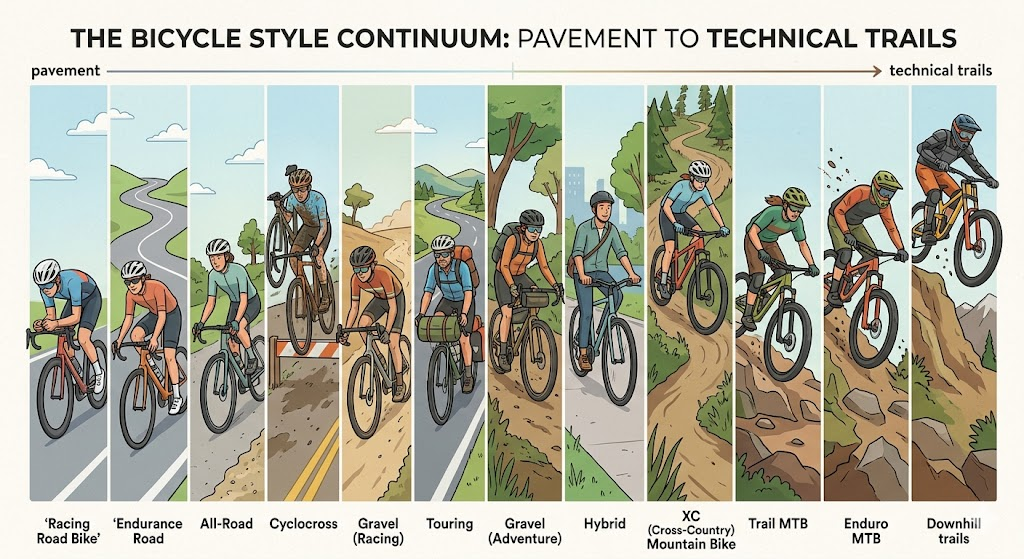
(AI illustration, nevermind the saddle-headed cyclocross rider  )
)
With a note that “hybrid” is still a good more-or-less centerpoint, not only in terms of use case but also geometry. Left of that, they tend to be road geometry, where you’re sitting somewhat more bent over with weight distributed between your butt and your arms. Right of that, you tend to be more upright, with most of your weight on your butts (while you’re sitting, that is — for more technical MTB trails, riders will often stand up on the pedals instead and hydraulically lower their saddles out of the way). The geometry will have other impacts beyond comfort, like agility (cornering ability) vs stability (staying stable on a straight line).
None of these things are absolutes — there are many variants and sub-categories and overlaps, and also people who like to mix-and-match their bike configurations outside of any commonly understood category.
Bikes are like desktop PCs (computers) in that regard… mostly made up of modular components that can be swapped around as necessary, but also commonly sold in specific predefined configurations (“gaming PC”, “workstation”, etc.) to address different market niches.
That 'cross rider is so well prepared, he’s carrying a spare bike!

That’s almost a perfect illustration of a cross race. Only thing missing is the rider puking, but I guess he can do that at the finish line.
This is the real answer here… ride your gravel, but carry your road bike on one shoulder and your MTB on the other! Prepared for any situation, and plus you get Arm Day at the same time.
Thank you, Gemini, for the next great industry revolution.
Yeah, on this note… you actually need tires like that if you want to go snow riding (or you’d just sink in). Think “snowshoes for bikes”.
But there are also some “fatter but not quite for snow” tires for super cushy riding (they just roll over EVERYTHING and absorb every pebble or bump or curb), without the expense and complexity of a frame or fork suspension.
You need a special kind of bike frame or fork to accommodate such wide tires. Most people don’t need a special setup like that, but the folks who ride them love them. (I’m not one of them).
For the rest of us, your average gravel tire should already be wide enough and comfy enough for any situation you’re likely to throw at it outside of very technical MTB trails. (I’d say the same applies to recent road bikes too, which have also started adopting wider tires.)
There’s a bit of a trickle-down effect that happens where “comfort” technologies (as opposed to speed) often start in the MTB world (where they’re not so much meant for comfort, necessarily, but maintaining control over uneven terrain) will eventually bleed into the gravel/cyclocross world. From there, the ones that don’t have a big weight/speed penalty eventually also make it into the road world. That’s why road bikes now often have disc brakes and wider tires, the result of both more recent science and advancements in manufacturing technology allowing lighter parts.
Oh, and on the topic of suspension, that is another real difference between the “giant springs” you typically find on big-box store hybrids and the “real” suspension systems made of tuned hydraulics + dampers you’d find on a proper MTB (or sometimes, gravel).
Their goal isn’t really to make the riding more comfortable (although that can be a side effect), but to keep the bike tires in contact with the ground as much as possible, without the pogo-stick like “marshmallowing” that @Chronos so aptly described.
See this video for an example:
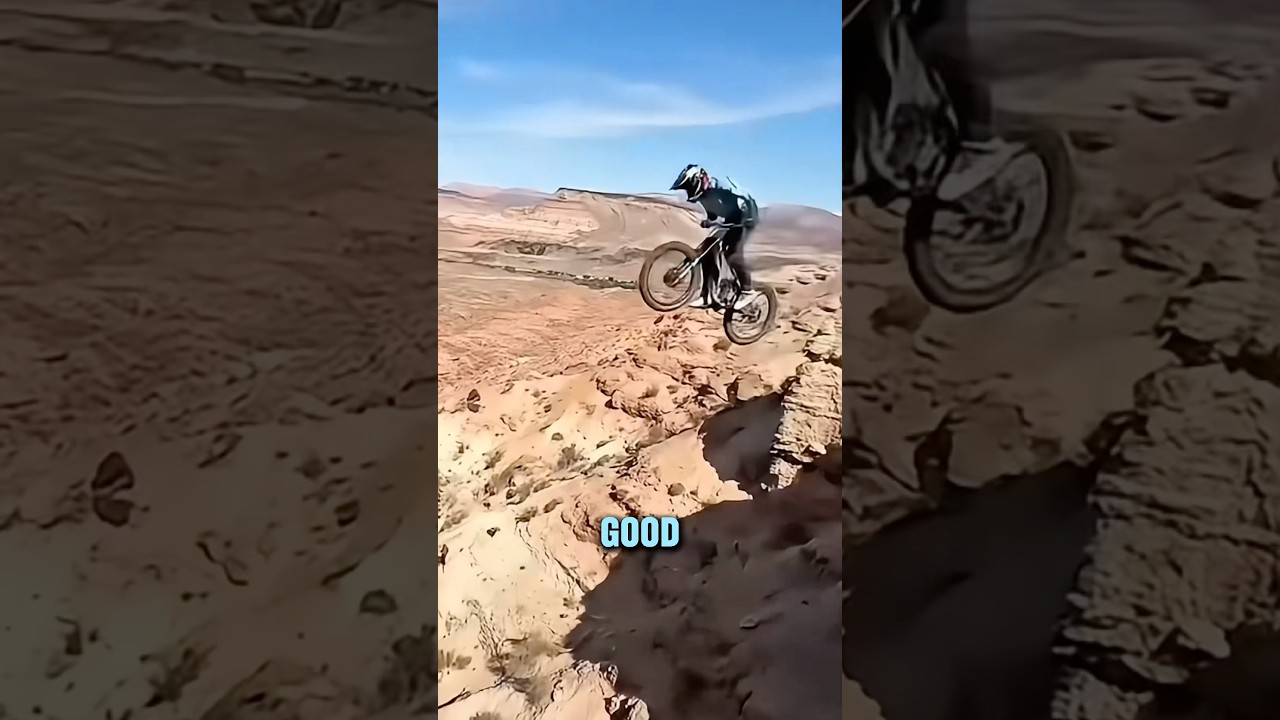
A good suspension doesn’t make you bounce up and down unnecessarily; it makes the bike feel like it’s “stuck” to the trail even if it’s full of potholes or rocks.
A bad suspension system doesn’t really do anything except give you the illusion of comfort while actually just adding a lot of mechanical stress to both the bicycle and your body — THAT is a marketing gimmick and anti-feature to be avoided. Without a good dampener, the spring coil could actually “reverberate” and bounce your wheel off the ground even after it’s already made contact.
For technical MTB, a good suspension is sometimes a matter of life-and-death (as in, you lose enough traction and you could crash and seriously injure yourself). For gravel, it’s similarly about preventing the loss of control and slip-outs. There’s also the side effect that if you’re actually riding on gravel (as in little tiny rocks), it can help smooth out the ride so it doesn’t feel as bumpy — but that’s just a nice beneficial side effect, not really its main purpose (keeping the wheels on the ground and able to provide traction). Wider tires kinda serve the same purpose, absorbing up-and-down motions (but via rubber deformation instead of hydraulic action), so that the bike frame and rider don’t bounce.
But for around town, you really don’t need suspension of any sort. They just add cost and complexity for minimal to no benefit, and a real cost in both weight and dollars. If you absolutely insist on having some sort of suspension, probably a hardtail is the way to go (front shocks only, on the fork, and nothing on the frame/saddle). But you almost certainly don’t need suspension. Even a lot of semi-technical MTB trails can be done without it, or just with a hardtail.
Although, just sinking in is also an option. I ride year-round, and sometimes that does mean riding through deep-ish snow. It’s extra friction, certainly, and that means it slows me down, but you can still get there.
Also note that the road conditions that are unsafe for cars are not the same as the road conditions that are unsafe for bikes (in either direction). The two things I can’t ride on are either fresh snow on top of ice (so I can’t see where the ice is), or the sort of grayish dirty dry snow you find especially at intersections, when it’s too cold to be slushy. That gray stuff will slide right under your tires and land you on your butt, but cars seem to be able to more or less ignore it. On the other hand, I can get great traction in slush that has cars all over the road.
My pure road bike was a Litespeed Tuscany. But, it is a tad small for me at 61 cm (I’m tall) and I’m going to sell (it also has tall gearing and I live in the land of hills/passes). My bike touring bike which has become my pure road bike is a Litespeed Appalachian, which at 63 cm fits me great, and has much better gearing. I stumbled into both of these as fairly inexpensive used bikes and love them, but the Tuscany has to go. I’ll be sad to see it go - it is quite dashing.
One thing to add about the trend to go with wider tires, and hence selection of a bike that can accommodate them - I think recent developments in tire materials and structure have made skinny tires pretty much irrelevant. AIUI fatter tires have stiffer sidewalls than in olden times, making them as efficient as thinner tires. For example, a 38C tire today rolls about as efficiently as a 25C tire, but is a lot more comfortable (when inflated correctly). Many tires today can be safely ridden on low pressures unthinkable 20 years ago - I run my touring bike at around 50 PSI. You don’t have to ride on rock-hard slicks any more.
Then there is the whole discussion of tubeless vs tubed, but let’s not complicate things for the OP. 
That’s not quite it…
What all this means: If you run wider tires at lower pressures, you increase the flex of the tire (negative), but you reduce the suspension losses (positive): the two effects cancel each other, and your speed remains the same.
Of course, not all wide tires are fast. For a wide tire to be fast, it has to be made with a supple casing, like a narrow racing tire, but in a wider width. Supple casing are easier to flex, so they absorb less energy as the tires roll. And a supple casings reduce vibrations, which reduces the suspension losses. So supple casings use less energy on both counts. Talk about a win-win scenario!
The crux of the misunderstanding for many years has been that high pressure, stiff tires have less rolling resistance. On the steel drums that tire testing uses as a roller, sure, that’s more or less true. In the real world of imperfect roads with everything from surface roughness to cracks, bumps and ledges, stiffness transfers energy into the bike and rider, while suppleness buffers that energy and helps get more of it to the road.
My town (Bend, OR) had a nice bike safety info session & group ride event yesterday, and I just wanted to share:
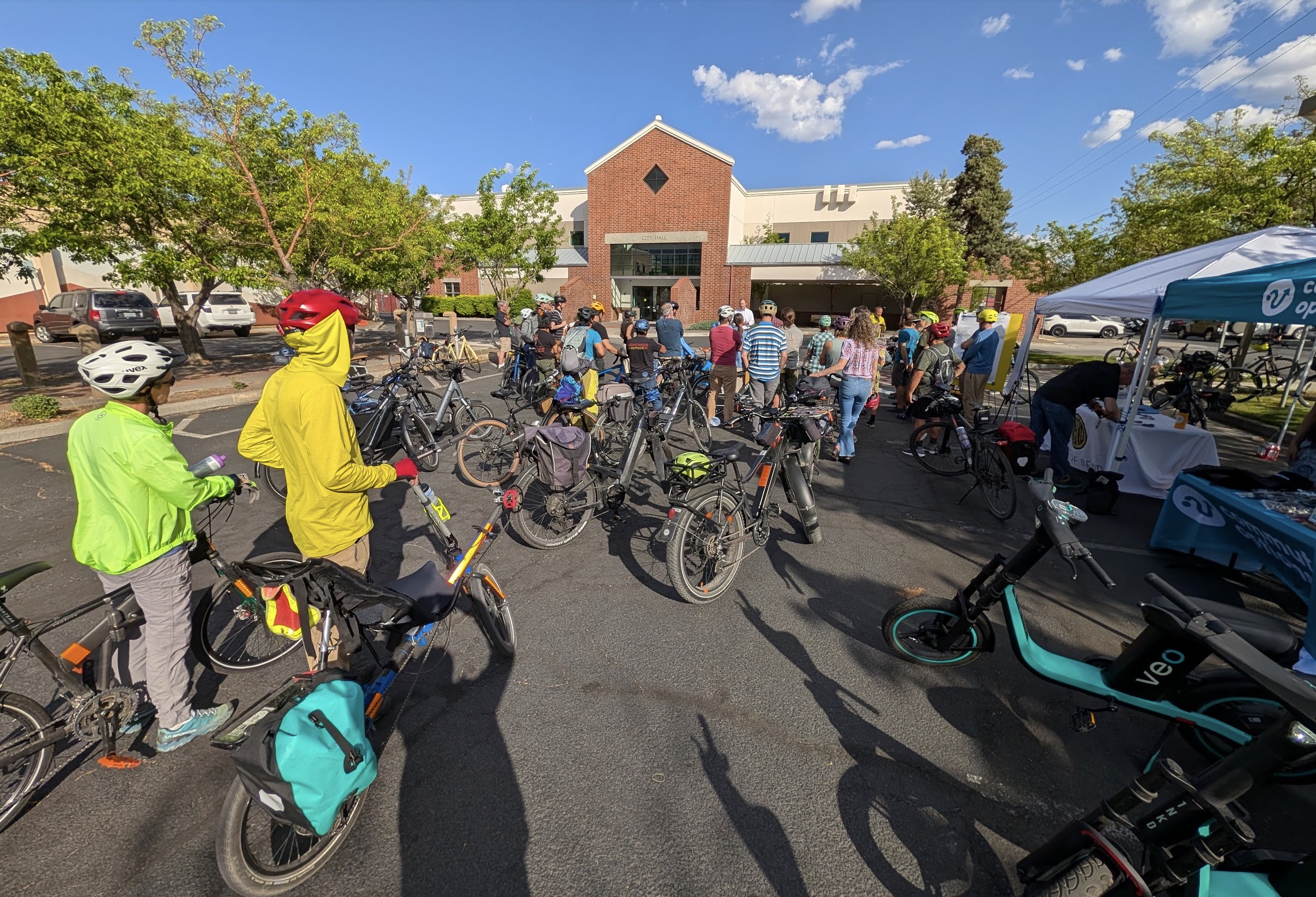
As a pilot project, they were installing these road dividers on some busier residential roads in an effort to improve bike & pedestrian safety, effectively turning some streets into one-way or right-turn only streets:
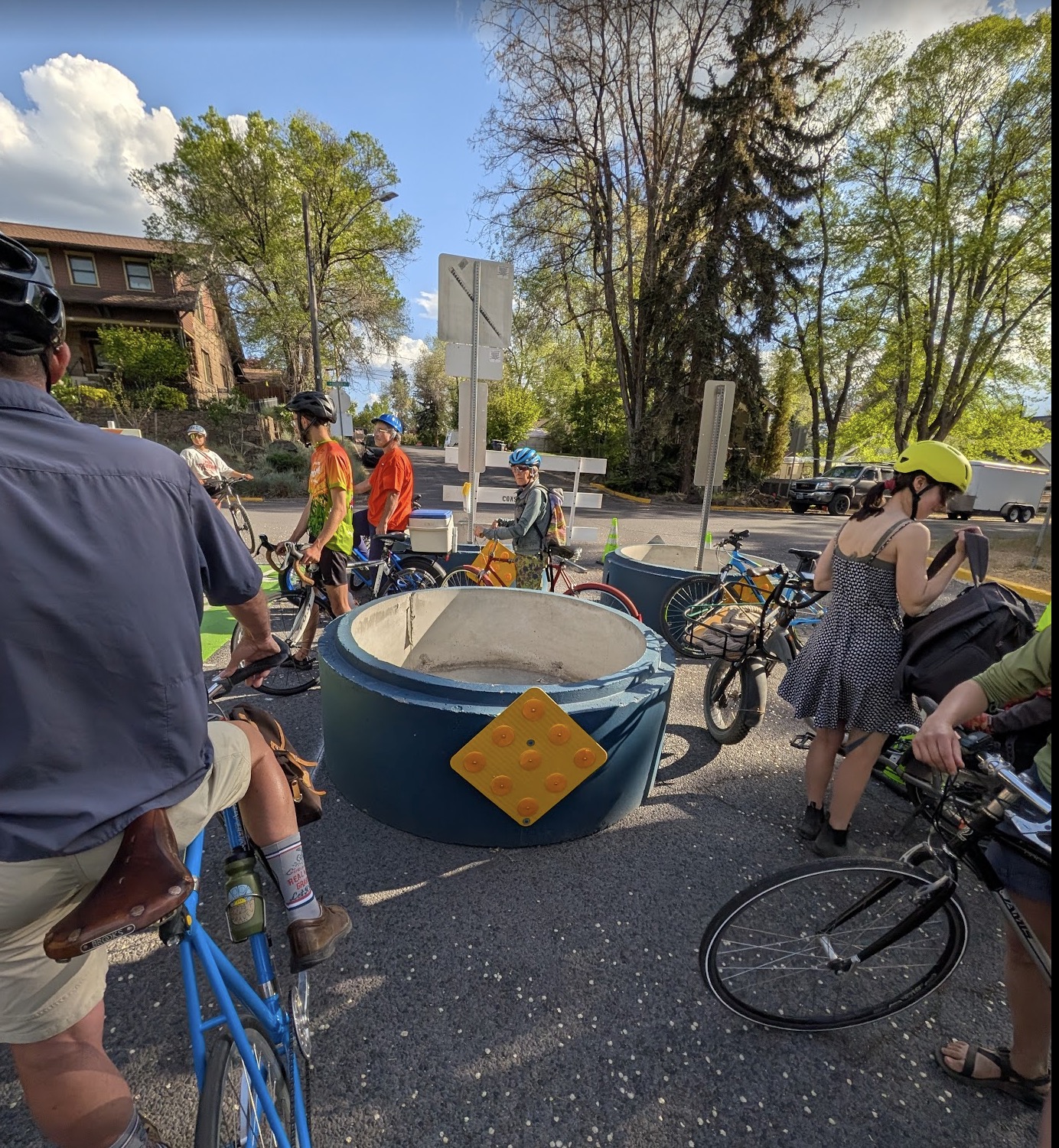
Safety talks aside, though, it was also just a nice afternoon, and everyone was happy to be out and pedaling…
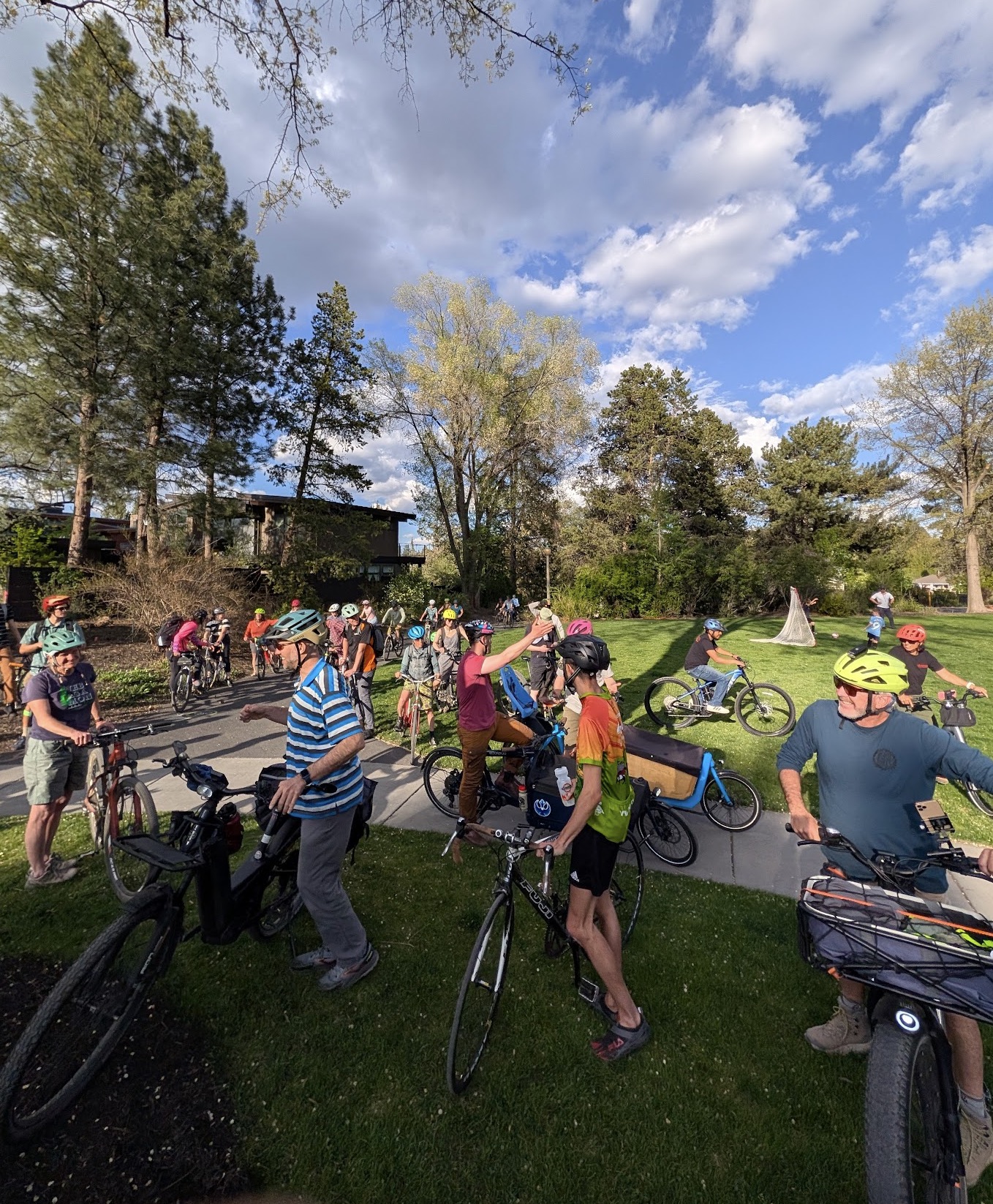
People came on all sorts of bikes: mountain bikes, electric bikes, tour bikes, gravel bikes, road bikes, cargo bikes, folding bikes, racing bikes, hand-me-downs… but the important part was that people were all just happy to be out and riding. Doesn’t really matter what you’re on as long as you’re comfortable and having a good time.
Find something that fits, learn the fun & safe routes near you, and the rest tends to sort itself out over time
Yah, much better info! Development in bike tires has made them better and more comfortable than riding those 23Cs pumped up to 100+PSI.
I always ask people what’s your primary use and what’s your secondary use. Two people whose needs are idendical 80% of the time might really need very different bikes (cameras, binoculars, etc) for the other 20%.
Of course, one possible response to that is to just get two different bikes. They’re a lot cheaper than cars, and take up a lot less space.
That’s a solid choice, but another way to go, with the right bike, is a second wheelset. A hardtail can also be a gravel bike, a gravel bike can also be a road bike, either one can be a touring bike.
I plan to bring mine for any trips down into the parkway, since it is migration season.