In cosmology the angular size of an object as viewed by an observer doesn’t depend on its current proper distance* to that observer from them, but its proper distance when the light from it which is now observed was emitted (and the spatial geometry). The upshot is that in all realistic cosmological models there comes a point where the angular size starts to increase with proper distance.
This means paradoxically that many of the furthest galaxies we observe have a larger angular size than if they were a bit nearer.
*there are several different measures of distance in cosmology, distance without qualification usually means proper distance, but red shift increase as all common measures of distance increase except for angular size distance.
"Mass can be converted to energy. E = mc[sup]2[/sup]!" Um, no. As pointed out by Chronos in another thread, mass is already energy, so it’s nonsensical to talk about mass “converting” to energy.
I’m an EE, and I’ve heard the following from other EEs:
"In AC, the current is alternating." Not always. In a typical “AC power system” (such as what’s in your house), the voltage is always alternating, but the current through the load (plugged in to the outlet) might be zero, alternating, or even DC.
"Current is due to mobile electrons under the influence of an electric field." Not always. It’s better to say current is due to mobile charges under the influence of an electric field. Current through an electrochemical battery, for example, is due to mobile ions, not electrons.
"The resistance of the device is the ratio of the voltage to the current." No. If the voltage across a diode is 0.6 V, and the current is 100 mA, are you saying the resistance of the diode is 6 Ω? That’s useless. Ohm’s law is simply a formula that allows you to predict the voltage across an ideal resistor if you know the current, or the current through an ideal resistor if you know the voltage. (And for a practical resistor, Ohm’s law is an approximation if R is a constant, since R is a function of temperature, and temperature is affected by I[sup]2[/sup]R. R is also a function of voltage (VCR), but VCR is only applicable to very high-valued resistors.)
"Voltage and current… you can’t have one without the other." Sure you can. A battery might have an open-circuit voltage of 3 V, but the current is (essentially) zero if nothing is connected to it. And a superconductor can have a current through it, but the voltage across it is zero.
The reason I hoped someone would guess is that simply realizing that the angular size of an object depends on the distance when it was emitted, knowing we have a limited viewing distance (i.e. a finite observable Universe) in the Universe and knowing there was a big bang when all points in space in the observable Universe were arbitrarily close is enough to deduce the effect.
We only use 10% of our brains. Using more would lead to superintelligence and/or world domination and/or magical powers.
Except we do use all of our brains, just not all at the same time… Unless you’re having a certain kind of seizure. Boy those seizures sure are a great superpower!
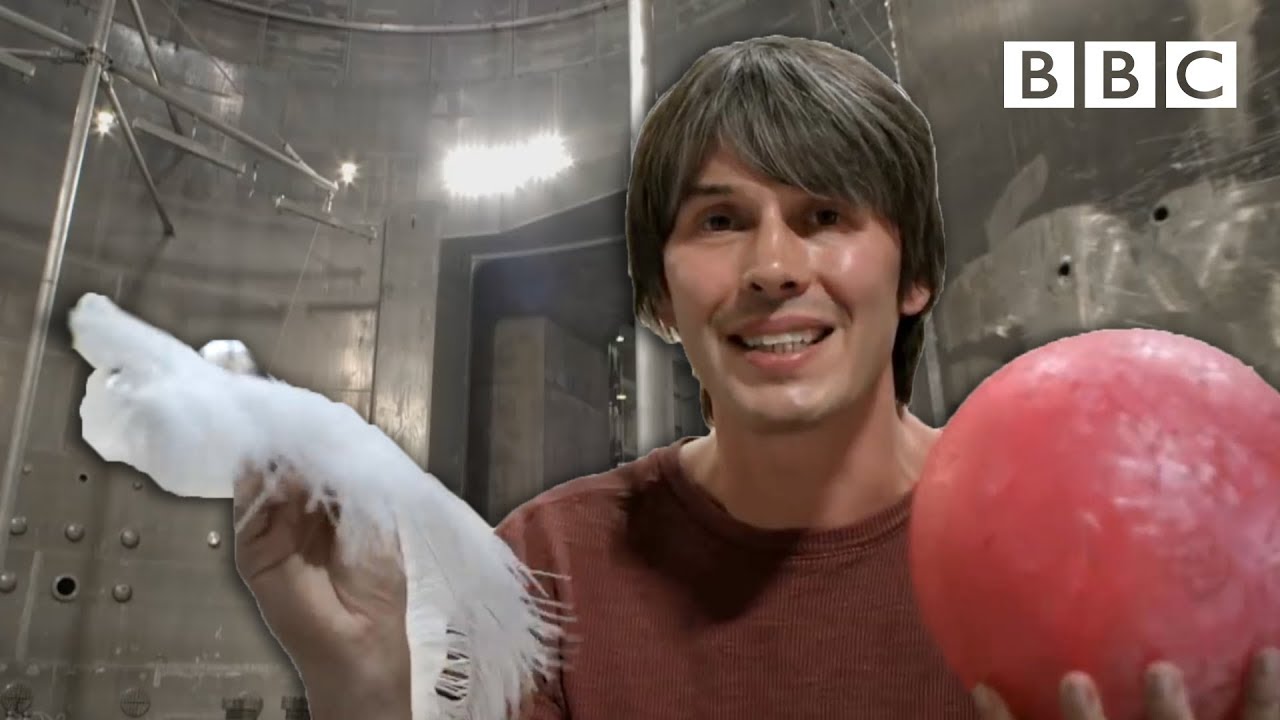
Yes. Take a balloon filled with just regular air and a bowling ball of the same approximate size and drop them both. You will find that the bowling ball hits the ground first.
For most weights, just dropping the objects out of your hand, there won’t be a particularly noticable difference by the human eye. But if one object is getting near to the mass of air, the difference will be pretty obvious.
It takes force to push through the sludge commonly known as air. Force requires mass. The heavier item has more mass and is thus able to push its way through the sludge.
I think Sage Rat’s explanation is reasonably good. The more rigorous explanation notes that:
[ul]When force is proportional to mass (as is the case with gravity), two objects of different masses will exhibit the same acceleration. This is what you see when the two balls are dropped in a vacuum.
[li]With air present, you introduce a force (drag) that is not proportional to mass - at any given non-zero speed it will the same for both balls and thus a larger fraction of the weight of the lighter ball than of the heavier.[/li][li]Thus, the net acceleration of the lighter ball will be less and it will take longer to reach the ground.[/li][/ul]
Tarot authorities invariably trace it’s origin to early 15th century Italian tarocchi cards handpainted for the nobility. But the imagery isn’t as symbolic as the Marseilles imagery. I think proto-Marseilles decks were likely the first tarot decks but were lost to the vagaries of time, sharing the same fate as other playing card decks of the time, due to being printed on cheap paper. And I’m not so sure they were created solely for card games, as many experts claim, and not also for didactic purposes. So although the 15th c. decks are the “earliest extant” decks, they shouldn’t be tagged as the earliest decks with the degree of certainty that is shared by experts.
Also, going out on a limb here, I don’t preclude a gypsy influence solely on the basis of the gypsies not arriving in Europe until centuries later. There was trade between Italy and India before that, and it wouldn’t have been impossible for someone to return to Italy with images if not actual cards, so there really wouldn’t need to be an actual presence of gypsies in Europe to transmit their tarot imagery. Not that I think this is likely what happened, I actually think the chances are remote, but I wouldn’t preclude it on the basis that experts usually mention.
That defibrillators bring dead people back to life. At best, they just normalize the heart beat. At worst, they kill the patient (the patient may well come back to life at that point, but it’s because the various autonomous systems of the body say “Hey, that’s supposed to be beating…” and start things back up again).
They don’t even normalize the heart beat. They stop it. Period. The body then hopefully normalizes it, but the defibrillator is just a heart stopping machine.
Very good! I will take you at your word, but I tell you that up to now, this has been a core belief of mine. Hand makes more sense though. Is it a fist?