Is it hot out there or is it just me?

You are being needlessly combative.

https://www.annualreviews.org/content/journals/10.1146/annurev-environ-112621-083538

2. METHODS FOR EVENT ATTRIBUTION

All methods of event attribution typically involve the comparison of observed historical changes, simulated under observed forcings, to a counterfactual climate simulated in the absence of all or some components of anthropogenic forcing. This can be done either in a quantitative, statistical way, in which case the results are probabilistic, or by simulating the evolution of an event under a different forcing to gather a process-based attribution statement (2, 3, 23, 24). The former is usually called probabilistic event attribution, whereas approaches that focus on the evolution of an event under a specific forcing are often called storyline approaches.

I’m not trying to be argumentative, but…could you please share a cite, and a quote, that shows that climatologists specifically state that a particular weather event is definitively the result of climate change, or at least is beyond reasonable doubt in their minds?

What I read about it is that climatologists state that extreme events are becoming more common, and more extreme, due to it, but are hesitant to make a direct causal connection to a specific weather event. But, I would like to be educated if I’ve missed something.

Sure, see above. Or folks can just google “climate change attribution for specific events” and view the numerous results.

And I don’t find it argumentative at all. If I’m wrong, I’d like to keep beating my head against the wall until I understand why (and I sincerely appreciate everyone’s patience and assistance in providing the bricks).

I’ll note that the first CNN article, and the Nature article, in your earlier post both come down to citing the same research organization – World Weather Attribution – which has developed a model that attempts to quantify if a weather event was caused by climate change. I’m not saying that they’re wrong, but I think that they may be an outlier among the climatology scientists in making definitive statements like that.

And, yes, meteorologists and climatologists are saying things like “eye-popping”, “mind boggling” and “truly astonishing" – and they should. Please make no mistake: I absolutely believe that climate change is a key factor in why the weather is getting more and more extreme.

Yes. I’m only a layman, but my understanding has been that most climatologists, at this point in the science, are not willing to definitively state that “this storm/heat wave/whatever would not have happened without climate change.”

Well has been fucking freezing in NY so no, it’s not hot out there. Looks to be getting back up into normal temps by the end of the week at least.

Of course last week we had two glorious days of high-70s, then it plummeted down into the 20s.

Re-reading this all - I think the issue is primarily one of miscommunication.

I did not speak precisely enough, and interpreted the responses as “you’re wrong on the substance” rather than “you’re wrong on the wording”. If that’s accurate, I apologize for wasting everyone’s time splitting hairs. While I read a lot of scientific content, I am in that nebulous area between layman and expert called “knowing just enough to get oneself in trouble”.

That shouldn’t really matter should it? Most climatologists (or scientists in general) will not venture strong opinions about things outside of their particular niche in the field beyond generalities that are well established in the consensus like “yes climate change is real and humans are causing it”. I’d care much more what the people publishing peer reviewed articles on the specific topic at hand have to say.

And that’s fair. I was trying to post something accessible and representative that the subject is clearly a thing that exists. Didn’t expect to do an impromptu lit review. :joy:

Because you started this argument with the contention that the western US heat wave absolutely positively must be due to climate change, and that’s just not how science works and certainly not how the immensely complex field of climate science and global climate modelling works.

None of this is new – the IPCC has been studying extreme weather events for years and issued a special report in 2011 of which this is a summary.

I’m just frustrated at your refusal to accept what you’re being told.

The basic thing you’re not grasping is that there’s a vast difference between using models to quantify the increased likelihood of extreme weather events under different scenarios of different temperatures and different levels of radiative heating, versus trying to claim without evidence that a particular weather event was caused by climate change.

You’re also not understanding what your latest cite means when it talks about a process-based storyline. This is something different from probabilistic attribution, but it equally does not try to link any specific event to climate change, and it technically also has probabilistic elements, too, because it necessarily uses stochastic climate models.

The difference between the two analytical methods, simply put is:

  • Probabilistic analysis tries to tell us how likely certain extreme weather events will be

  • Given that a particular event has occurred, simulating its evolution under different forcing conditions tests the robustness of a specific causal story, such as the extent to which a particular set of climate conditions might cause the event and, through an ensemble of different simulation parameters, how much worse (e.g.- a heat wave) might be under specific different climate conditions.

The two approaches are intended to answer different questions, but neither of them presumes to “prove” that climate change caused a particular event.

Sure, it should. They are climatologists – they are the scientists who study climate change!

Which that one group did. I suspect – though, again, I may be wrong – that they are in the minority of the overall climatology community which is willing to make direct attribution for specific weather events at this point in time.

Not all climatologists study the same specific sub fields.

The emerging field of extreme-event attribution (EEA) seeks to answer the question: “Has climate change influenced the frequency, likelihood, and/or severity of individual extreme events?” Methodological advances over the past 15 years have transformed what was once an unanswerable hypothetical into a tractable scientific question—and for certain types of extreme events, the influence of anthropogenic climate change has emerged beyond a reasonable doubt. (Emphasis mine)

You clearly have a higher bar than reasonable doubt, but please stop trying to hold me to it. It is not inaccurate to say that a specific event can be attributed as long as we are sticking to the term as used by the scientists publishing in the field. Personally, I’m fine with a high confidence statistical link as I mentioned earlier when I asked what problem you had with them.

Just forget the words “caused by”. The only one who actually used them was LSL. I replied and failed to push back on it because I thought we were arguing the substance (that we can say anything with confidence about specific events) and not the semantics (that my wording implied a level of certainty that couldn’t be backed by the scientific literature). See my reply above about substituting alternative language (search for “causal language” to find it)

tldr: I misspoke. This event almost certainly could not have happened without help from our friend climate change. For specifics - see the relevant attribution statements when they get published.

I don’t even know what you’re arguing about anymore. In one post alone, you made two statements, namely these two:

There is no evidence that supports such absolute certainty.

Then you linked to four papers in Nature that you claimed show attribution of specific weather events to climate change. None of them do.

Then you linked to a paper referencing storyline simulation as proof that it showed that specific weather events have been linked to climate change. It does not.

I’ll say it again. The occurrence of extreme weather is always probabilistic. Period. This should not be controversial because weather is intrinsically probabilistic.

Then you linked to yet another article asking "Has climate change influenced the frequency, likelihood, and/or severity of individual extreme events?”: which the article answers with “for certain types of extreme events, the influence of anthropogenic climate change has emerged beyond a reasonable doubt.”

Both of which statements you bolded, apparently for my edification. Look, I’ve been reading about climate science for a very long time and I completely agree with that statement. I do not need to be edified.

Furthermore, if someone asked whether I think that the western US heat wave is likely exacerbated by anthropogenic global warming, I would say quite likely. If you had said that, I’d have no issue with it. But that’s not what you said. The IPCC has been predicting these sorts of AGW-triggered extreme weather events for at least 25 years.

Again, weather is inherently probabilistic. It’s arguably one of the most impressive examples we have of chaos theory. Remember that although much of the western US is sweltering in unseasonably hot weather, some of the rest of North America is unseasonably cold. Is that absolutely positively due to global warming, too? It’s a hypothetical question that highlights the risk of making unwarranted attributions rather than following sound science. Sometimes weather is just random, and if it turns out there’s a consensus of opinion that AGW was likely a major contributor to this heat wave, it will be due to local climate dynamics and not because a whole bunch of CO2 just decided to gather over the area! Weather and climate are immensely complex, often with powerful regional effects that can be hard to predict.

As I said, this is likely, but I dislike absolutes. Here’s an abstract of a paper you might find interesting. The researchers analyzed the likely causes of the heatwave in 2021 in the Pacific Northwest. To be clear, they had to do it with climate model simulations, with all the consequent uncertainties. But here’s quick summary of the factors they found affecting the heatwave.

They found that large-scale meteorological factors played an important role, exacerbated by a hurricane that drove huge amounts of heat into the upper atmosphere over the northwest. They also speculate that topography was a factor.

To investigate the potential effects of climate change, they ran models with generated pre-industrial climate data and recent hindcasts for comparison as well as generated mid- and late-21st century climate data.

The money quote:

We find that the synoptic meteorology of the heatwave is relatively consistent across the hindcast and counter-factual ensembles, and that the magnitude of the heatwave is controlled by the background global temperature. Further, we find that anthropogenic climate change increased the severity of the heatwave and that the event could be considerably warmer if it were to happen at the end of the 21st century in a high-emission scenario.

So their models concluded that global warming had an impact on the PNW heat wave in June, 2021, along with significant large-scale meteorological and geographical causes, although they didn’t quantify the magnitude of the AGW contribution. They also concluded that higher emissions concentrations would likely have made the heat wave even warmer.

The previously posted paper was just an abstract; here is a full version which appears to be a slightly different version than the other, but with most of the same authors.

This one does quantify the climate change contribution to the PNW heatwave of June, 2021. They say they found that global warming caused a ∼0.8°C–1°C increase in heatwave temperatures. In contrast, Wikipedia reports that:

Much of the Pacific Northwest, normally known for its temperate weather in June, experienced temperature anomalies of 20–35 °F (11–19 °C) above average during this heat wave.

So if you take the average temperature anomaly of +15°C, global warming contributed about 6% of the total temperature rise during this massive heat wave. But, according to other statistics, the probability of such a heat wave occurring was about 150 times greater than normal due to climate change. This was a heat event in which the maximum temperature in BC reached a record 49.6 °C (121.3 °F).

Note that these are two very different parameters. You can have global warming create increasing high probabilities of record-breaking heat waves, while the actual AGW contribution to the heat wave may still be quite low. This is another reason one has to be very careful with attribution.

At the time I’m posting this the map in the OP seems to have gone blank and lost most of its little heat-indicator dots.

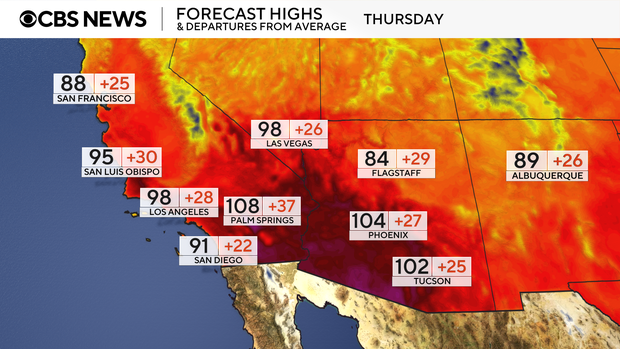
Here’s one from CBS, current for today March 19.

Great. And as I’ve tried and apparently failed to articulate, even with multiple citations, that’s good enough for me. The entire crux of this digression is me being held to a standard that I unintentionally alluded to but do not actually hold. All of my pushback was because it seemed like you all were saying we can’t link specific events to climate change at all - which is not accurate.

No evidence if we ignore all of the actual characteristics of the event, the multiple axis along which it is not just an outlier but unprecedented in the historical record, and the multiple mechanisms that are influencing and exacerbating it which are themselves a symptom of climate change. You dislike the degree to which I’m confident about the link between this event and climate change. If after the dust has settled everyone says “actually didn’t look like climate change was involved just a super rare but otherwise normal occurrence,” I’ll happily apologize for wasting everyone’s time.

But they won’t. Because it so clearly is, which even you agree to (in more restrained language).

Also, thanks for the callout on the image in the OP. I’ll try to capture a static image of it later today lit up like a Christmas tree as it breaks records again across half the damn country. It’s possible the old image is archived somewhere, but I’m not versed enough in their site to actually find it.

Now that we got the terminology settled, I’d like to get back to following the actual event with the thread if possible. You really and truly do not see this stuff every day (well at least not yet).

edit: oh apparently you can’t update the OP after a certain point? Just occurred to me I might be able to replace it with this, though the image itself is tiny (at least on mobile maybe better on desktop?) without clicking through unfortunately:

You can’t edit any post after 15 minutes unless you’re a mod.
(You could ask a mod to change it.)

Probably not worth it in this instance, but good to know. I’ll just try to grab static images in the future for that particular site and upload it.

In case you didn’t know, you can’t upload images here.
You need to provide a link to an existing picture (like you did
in your OP).
If you grab a static image (sreenshot) you’ll need to upload it
to an image hosting site (eg imgbb (preferably not imgur as it
won’t be visible to people from the UK (like me !)) and link to that.

Huh, ok. What’s the “upload” button for then? Or is it just non-functional?