This is terrific. Thanks for sharing!
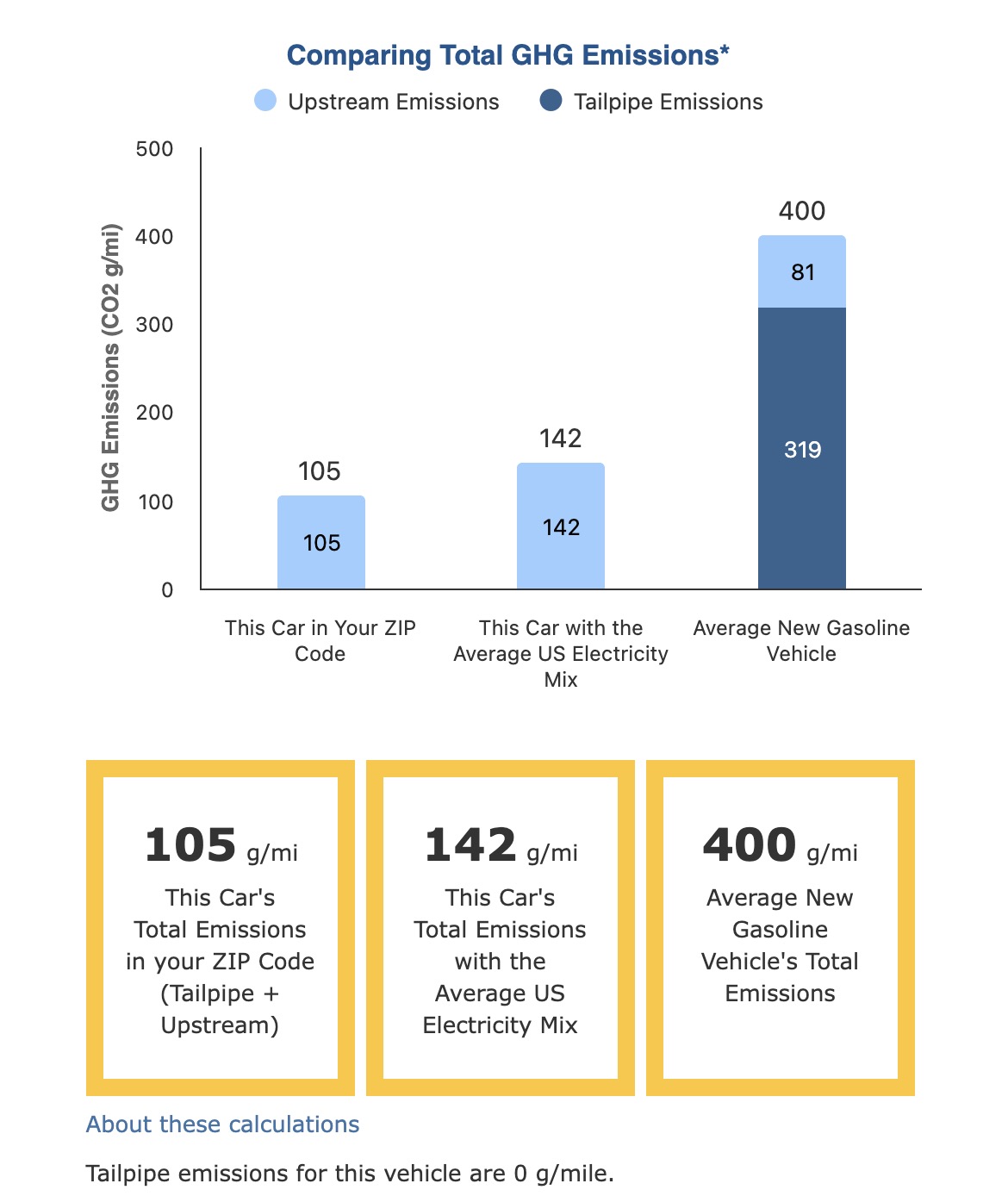
Also, the EPA has (for now) an interactive calculator for estimating your specific car’s emissions based on where you live:
Like for me, it shows:
All things considered, EVs are generally and usually better for the environment.
But I’m going to play devil’s advocate here for a sec, anyway, just because it is complicated.
Speaking at the “macro” level, as a nation, US electricity production is largely via fossil fuels… 60% of our electricity comes from natural gas and coal:
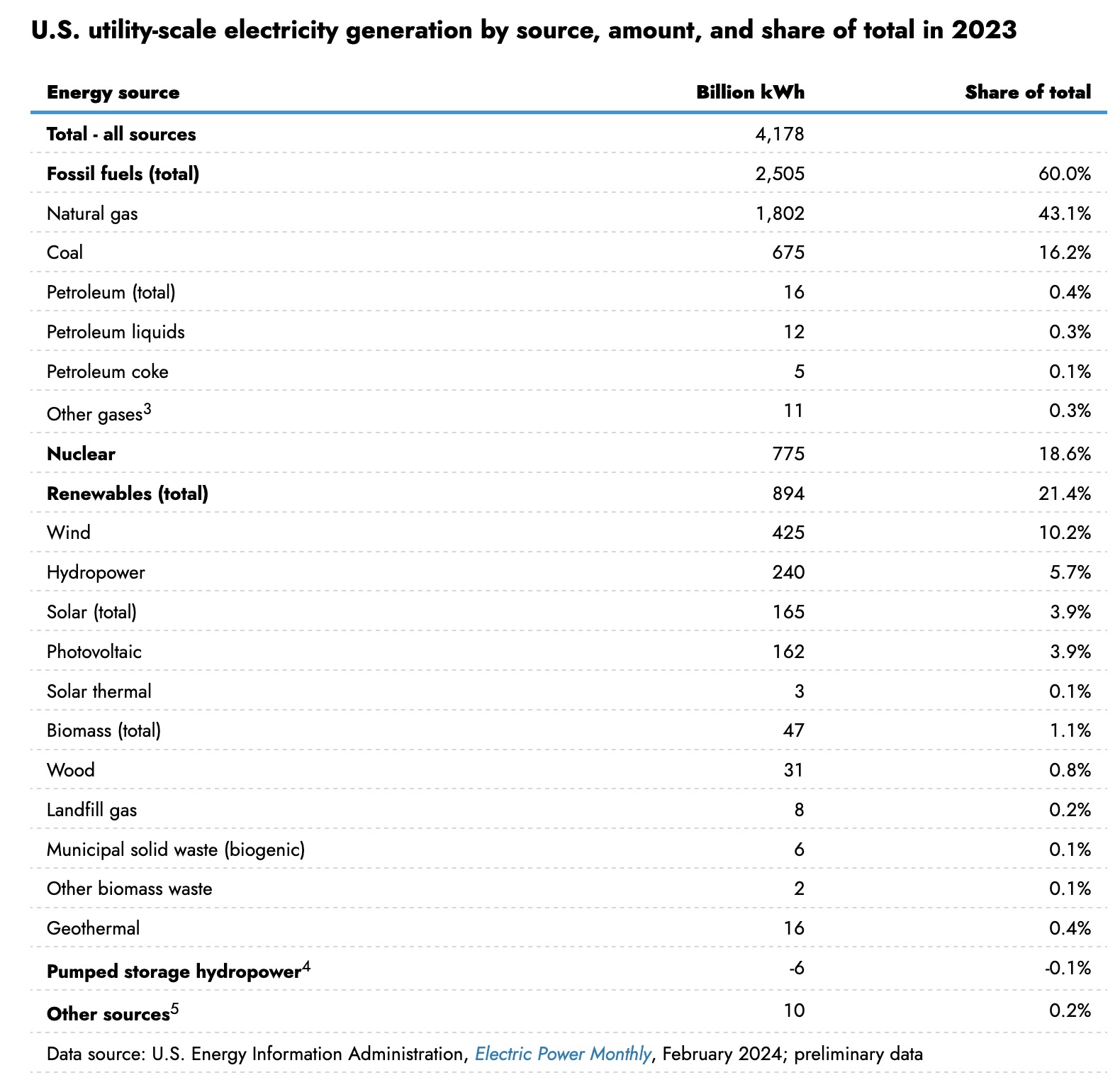
(from https://www.eia.gov/tools/faqs/faq.php?id=427&t=3)
This is called the “grid mix” (or energy mix/fuel mix/etc.), and it varies a lot between regions. DesertDog’s map shows it at the local level, and Power Profiler | US EPA has it at the subgrid level.
The EPA actually has an entire page dedicated to EV mythbusting: Electric Vehicle Myths | US EPA
And generally speaking, all of this is true — EVs are almost always cleaner and better. However, where it gets tricky is that a lot of these forward-looking projections and assumptions, e.g.:
Are assuming “progress” over time, as in sane policy combined with good engineering, planning, politics, science, etc.
But that isn’t necessarily the road we are headed down any longer.
EV cleanliness is a function of the national grid mix. If the grid mix gets cleaner (as was previously hoped for and assumed), EVs get cleaner. But now we’re facing a possibility of the grid getting dirtier over time due to factors like:
- US politics steer us back towards fracking (natural gas is cleaner than coal, but dirtier than renewables)
- Large-scale hydro being built less, and in some cases removed (due to environmental justice/tribal fishing concerns, their impacts on local ecosystems, water rights, etc.)
- Nuclear struggling to regain a foothold after Fukushima (although this is changing a bit now)
- AI data centers requiring massive amounts of power 24/7, even while solar isn’t producing
- If EVs take off, a further strain on the electrical grid
- Conservative and anti-technology pushback on smart grids technologies, like smart meters, managed appliances, vehicle-to-grid charging, etc.
- The availability of essential battery manufacturing materials, i.e., if we have to start going to war over it like we did for oil, that will drastically increase the human and environmental toll
We are already starting to see some slight evidence for this, e.g.: Chart: How the US electricity mix changed last year | Canary Media
Solar went up 30% year-over-year, but coal went up 12% in the same time period. This will probably get worse if Republicans keep winning.
It also has the side effect of moving pollution from one area to another. Tailpipe emissions are at the point of use, whereas EV emissions are at the point of generation. This means that as more and more cars become EVs, air pollution will generally move away from urban areas (which are often bluer and richer) to redder and poorer areas (where electricity generation, especially fossil fuels, happens). Cities will get cleaner but the rural areas will see an increase in air and noise pollution — this is already happening quite a lot with AI data centers being built in smaller towns and places with cheap land and power, and whose residents cannot organize well enough to fight back (or whose politicians can be more easily bribed). So from an environmental justice perspective, EVs have this way of hiding pollution from us the same way our recycling does, by outsourcing it to places we don’t see day to day and care less about.
None if it had to be this way — the whole idea was that EVs would go hand-in-hand with more renewables and a smarter grid — but if those don’t happen, EVs will get correspondingly dirtier over time.
I don’t have the math handy, but I think if coal becomes a significant enough portion of the grid mix again, EV emissions could start to creep up on ICE emissions… burning coal is dirtier than gasoline, but ICE engines are much less efficient than big power plants. There might be a break-even point where, say, BEVs on the worse grids are more polluting than an efficient hybrid-ICE car on a cleaner grid.
 .
.