I’ve always been a desktop PC guy, but I notice that the lower priced segment of the market are increasingly given over to the book-size mini units. Many of them tout “silent running,” which indicates they don’t have a fan.
In terms of specs/features, these units promise a lot of bang for the basic user. But I have to wonder, without a fan are they going to bake themselves to death? Am I supposed to get a cooling pad like they used to make for laptops? Or has the technology improved so that these newer units don’t produce as much heat as they used to?
I have one, it has only heated up once so far to where it throttled back. But as cooling is passive, I needed to powerdown completely and leave it off for an extended time to cool. It was the last Windows update that caused my issue.
I’ll try to check how long I’ve had this now.
My primary Computer is still a tower.
I’ve had this mini over a year now. So pretty reliable overall.
ETA: I’ve actually been using it since March of 2024. So only 1 blip is 2 years of use.
We use book-sized mini PCs and laptops exclusively at my work. They’re basically just laptop components in a different form factor and are just as reliable as a good laptop. Unless you need a gaming rig they can do everything you need to do.
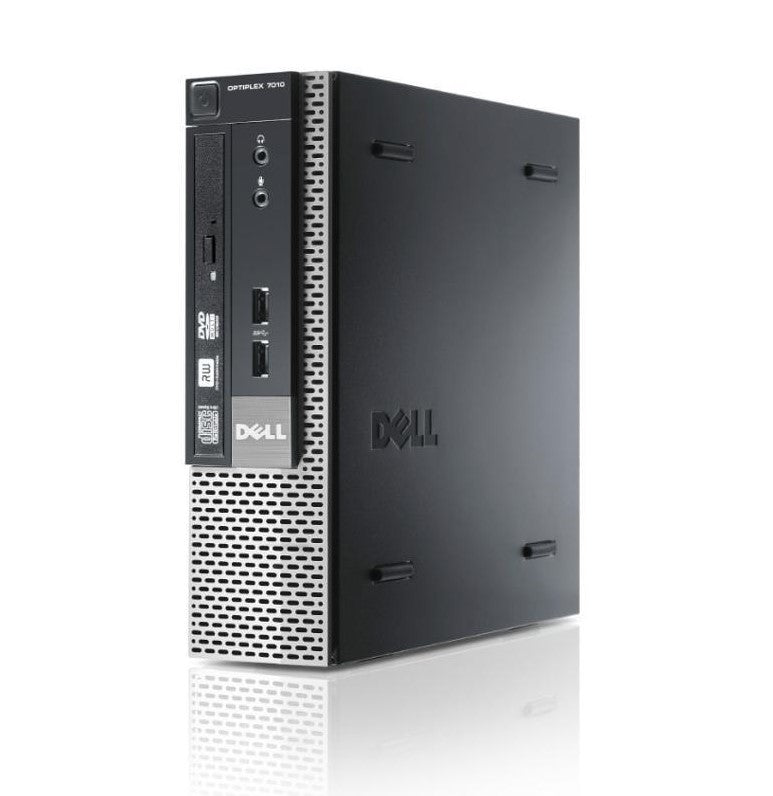
My employer uses those small desktop PCs as well. They look like this one (7.17" x 7.01" x 1.41") and we have thousands of them across hundreds of sites. Dell calls this form factor the “micro desktop” and I’ve seen similar looking ones from Hewlett-Packard as well.
Typically they’re built with lower powered processors (i3 or below) that can be passively cooled and have capped power limits. They’re not really a choice for intensive tasks like gaming, local Gen AI/LLMs and things of that nature but fine for office-style work, web browsing and other common tasks.
I have a few of them at work. One of them is just a general purpose computer. It’s meant for employees to spend 30 seconds looking something up on the internet or making a small document. Nothing special, though I suspect it could handle more just fine. The other one I use as a monitor for a surveillance system (with 10 camera feeds on display all the time). I originally tried that with a Raspberry Pi and it couldn’t handle it. The mini computer is doing just fine.
The Mini I have was pretty cheap. It handles fairly sophisticated Excel Spreadsheets with Macros and Formulas well. It also handles a giant word Doc with a hundreds of bookmarks and some crazy formatting. It deals with the JAVA of 5etools pretty well.
Great for browsing & streaming.
I have never played a game on it, so can’t report.
I’ve owned multiple USFF computers. As pointed out, they are really a repackaged laptop which has less internal volume. Most USFF still have room for a fan and a 2.5” drive. They are designed not to overheat.
The only other drawbacks is that they have limited ports, although some have a PCI-E slot. They use SODIMM memory and only have up to 2 slots.
My current mini is a media server running Linux with Docker, it’s great for the purpose.
Note that Dell, for one, uses USFF to refer to computers larger than the micro form factor I showed earlier. Their USFF computers were 9.3" x 9.4" x 2.6" while the micro one I showed was 7.17" x 7.01" x 1.41".
Yeah, as many have already stated, if a micro-sized desktop didn’t work, we wouldn’t have laptops (or tablets for that matter).
Of course, just as those portable devices have their limitations, so does a micro desktop. Those limitations might very well be something many or even most consumers won’t need to worry about, but they exist.
For the record, at the organization I work at, almost every computer outside of a server room is either a laptop or a very small desktop (and we have few desktops). The kind of application that needs a larger machine to handle the heat generated by heavy processing just isn’t something most people do. This is the model of desktop we use as standard:
(Large desktops do have their place. I’m literally posting this message on a full-sized tower desktop, because I do relatively high-end gaming on it, and that can generate a lot of heat.)
Flagship phones are almost certainly more powerful than a lot of these sort of low powered office PCs. If the phone can manage the thermals, there’s no conceptual reason a small desktop can’t. Though this isn’t quite the full picture since thermal design is a more important consideration in mobile components vs desktop.
A lot of set top boxes, like the Roku products I used to work on, are basically computers in a small form factor. Thermal management was definitely a consideration in the hardware design and to some extent the software as well, but it’s doable. All Roku’s products are smaller than these mini PC designs.

 Retired, the mini is my game room computer.